

Device : wearable IOT device
Battery capacity : Max 4.2V (Typ. 3.7V)
BLE Tx Power : Tx power is highest when the battery capacity is 4.2V (measured in air, not conduction)
I wonder if this phenomenon is natural, and if so, what the reason is.
Device : wearable IOT device
Battery capacity : Max 4.2V (Typ. 3.7V)
BLE Tx Power : Tx power is highest when the battery capacity is 4.2V (measured in air, not conduction)
I wonder if this phenomenon is natural, and if so, what the reason is.
I thought it was the nRF52832, but it turns out this phenomenon occured with the nRF5340 MCU.
Please double-check based on the nRF5340
VDD input voltage is 3.3V(for nRF5340)
RF Tx power is +3dBm

Hi,
Can you provide more details about power variation? how much it varies? and what is the voltage mode you are using ? For High voltage mode you need at least 2.5 V for reliable operation. IS the voltage dropping below 2.5 V when you see lower TX power? 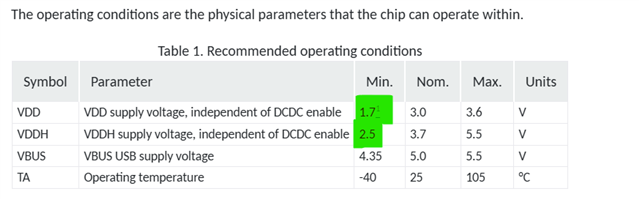
There is similar content in the nRF5340 datasheet, so I am sending you a screenshot.
voltage mode is normal voltage mode and dcdc mode.
3.3V is input to the VDD pin of all nRF5340. 3.3V dose not change.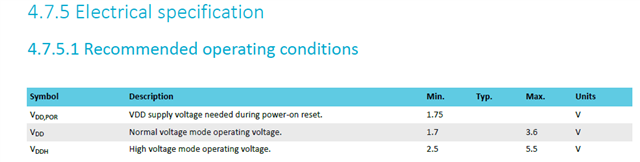
Hi ,
If the battery voltage is regulated before reaching to nRF5340 then you should not get any TX power variations. If you want I can have a look into your schematic / layout files to see if something obvious stands out.
Also you did not answer about how much power variation you are observing ? And how are you observing this variation in radiated mode ? is it in a controlled radiated chamber or free space? Please provide more quantitative details about your observation.
Best regards,
Ressa
This is the power connection of the nRF5340. Since VSYS, the power input to VDD, uses a 3.3V ldo output, there appears to be no power fluctuation, and when capturing the actual waveform, only a fluctuation of about 20mV is observed during BT Tx.
The Tx power variation is as follows:
It was observed that the power variation in the advertising channel decreased by up to 10dB at 100% and 20% battery levels. The measurement was performed by placing an IoT device inside a shield box and measuring the power.
BT power measurement is not conduction mode, but the radiated mode you mentioned.
Additonal Test.
Actual battery in use = norminal 19mAh
The 20mV fluctuation mentioned above was measured by using a power supply to check the VSYS voltage drop. This time, we confirmed that when using the actual 19mAh battery used by the IoT device, the VSYS voltage drop dropped from 3.3V to 3.142V. The battery voltage at this time is 3.5V
This is the power connection of the nRF5340. Since VSYS, the power input to VDD, uses a 3.3V ldo output, there appears to be no power fluctuation, and when capturing the actual waveform, only a fluctuation of about 20mV is observed during BT Tx.
The Tx power variation is as follows:
It was observed that the power variation in the advertising channel decreased by up to 10dB at 100% and 20% battery levels. The measurement was performed by placing an IoT device inside a shield box and measuring the power.
BT power measurement is not conduction mode, but the radiated mode you mentioned.
Additonal Test.
Actual battery in use = norminal 19mAh
The 20mV fluctuation mentioned above was measured by using a power supply to check the VSYS voltage drop. This time, we confirmed that when using the actual 19mAh battery used by the IoT device, the VSYS voltage drop dropped from 3.3V to 3.142V. The battery voltage at this time is 3.5V
sangyun.kim said:The 20mV fluctuation mentioned above was measured by using a power supply to check the VSYS voltage drop. This time, we confirmed that when using the actual 19mAh battery used by the IoT device, the VSYS voltage drop dropped from 3.3V to 3.142V. The battery voltage at this time is 3.5V
What type of LDO is being used? Is it a Nordic PMIC device? Some LDOs require a higher battery voltage ( for example higher than 300 mV) than LDO output to operate safely. Also the 20 mV voltage drop will not cause 10 dB power loss. Can you try to use external power supply instead of battery and gradually decrease the power supply voltage (similar to battery voltage eat 100 % and at 20 % charge) to see if the power variation still exist? This is to role out the battery internal resistance effect on the power observation.
Also what TX power is being used for advertising ?
TPS7A0533PYKAR is used for this system. (https://www.ti.com/product/ko-kr/TPS7A05/part-details/TPS7A0533PYKAR)
Input is Vbatt. output is 3.3V ldo output.
Im using the maximum power of the BLE nRF5340, which is +3dBm. As mentioned above, I observed a phenomenon where the input voltage to the nRF5340's VDD drops from 3.3V to 3.142V, and I am wondering if this could affect the BLE Tx power.