Hi Nordic team,
I am working on a custom board based on the nRF54L15 using nRF Connect SDK v3.1.0.
On our hardware, the nRF54L15 has a 32 MHz crystal connected to XC1/XC2, but there is no external 32.768 kHz crystal connected to XL1/XL2. The XL1/XL2 pins are used as GPIO/SPI pins for another device. Therefore, the LFCLK source is configured as the internal RC oscillator:
CONFIG_CLOCK_CONTROL_NRF_K32SRC_RC=y
CONFIG_CLOCK_CONTROL_NRF_K32SRC_RC_CALIBRATION=y
CONFIG_CLOCK_CONTROL_NRF_CALIBRATION_LF_ALWAYS_ON=y
CONFIG_CLOCK_CONTROL_NRF_CALIBRATION_PERIOD=4000
CONFIG_CLOCK_CONTROL_NRF_CALIBRATION_MAX_SKIP=1
CONFIG_CLOCK_CONTROL_NRF_CALIBRATION_TEMP_DIFF=2
CONFIG_CLOCK_CONTROL_NRF_K32SRC_250PPM=y
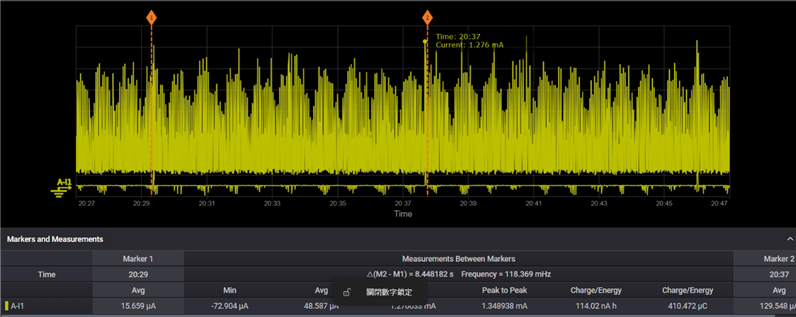
We are measuring current consumption in an application-level shipping mode / System ON low-power mode. In this mode, most peripherals are disabled or suspended, and the long-term average current is around several tens of microamps. However, we observe periodic current peaks. In some measurements, the peak current is around 600 µA, and in other measurements it can occasionally reach about 1 mA to 1.3 mA.
The interval of the major current peaks is approximately 8 seconds. This seems to match the LFRC calibration behavior, since our configuration uses:
CONFIG_CLOCK_CONTROL_NRF_CALIBRATION_PERIOD=4000
CONFIG_CLOCK_CONTROL_NRF_CALIBRATION_MAX_SKIP=1
We also tried changing CONFIG_CLOCK_CONTROL_NRF_CALIBRATION_PERIOD as an experiment, and the interval of the current peaks changed accordingly. Therefore, we suspect that these periodic current peaks are related to LFRC calibration.
I also understand from the nRF54L15 Product Specification that the calibrated LFRC accuracy of ±250 ppm requires calibration at least every 8 seconds. In addition, disabling CONFIG_CLOCK_CONTROL_NRF_K32SRC_RC_CALIBRATION is not an option for our BLE-enabled firmware, because MPSL requires RC clock calibration to be enabled when RC is used as the LFCLK source.
My questions are:
- Is it expected that LFRC calibration on nRF54L15 can cause periodic system-level current peaks in the range of several hundred microamps to around 1 mA?
- Does Nordic provide any measurement data or characterization data for the current consumption or energy impact of LFRC calibration on nRF54L15?
- Should this current peak be interpreted as the overall SoC activity during calibration, such as CPU wake-up, temperature measurement, and using the HF crystal oscillator as the calibration reference, rather than the current consumption of the LFRC oscillator block alone?
- For a BLE/MPSL-enabled application using LFRC as the LFCLK source, is it recommended to keep the default calibration settings instead of increasing the calibration period?
- If the product requires lower current in an application-level System ON shipping mode, is the recommended hardware solution to add an external 32.768 kHz crystal on XL1/XL2 and use LFXO instead of LFRC?
Thank you for your support.
I also attached three screenshots from our power measurement.
In the first screenshot, the marker interval is approximately 8 seconds, showing that the higher current event occurs periodically.
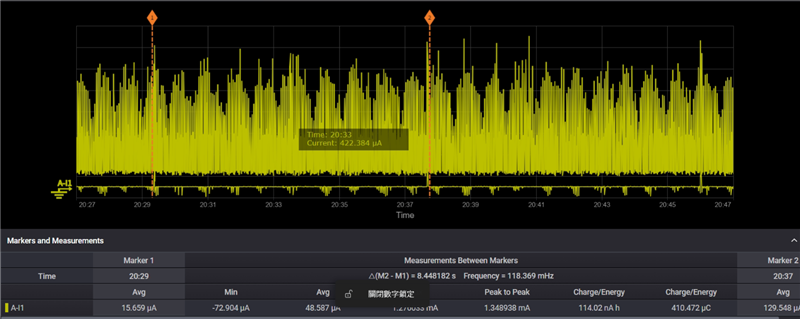
In the second screenshot, one of the peak points reaches approximately 1.276 mA.
In the third screenshot, the waveform shows that the instantaneous current samples are often between about 100 µA and 1 mA during the displayed interval. However, the average current between the markers remains around 48–49 µA. Therefore, the 1 mA to 1.3 mA values should be considered short current peaks rather than the average current consumption.