

NRF52810 RSSI accuracy in long time testing
Hi, we are using NRF52810 in our indoor navigation projects. By calculate signal source RSSIs got from different receiver we can get the approximate position of signal source. Below is some information when we develop on NRF52810.
- We use radio ESB protocol to transmit and receive
- In the receiver, the RSSI is detected when ADDRESS event happened, by enable using ADDRESS_RSSISTART shortcut
- We use SDK 15.0.0
To test the RSSI accuracy, we did a test: connect following component using SMA-IPEX cable, and place them in shielding case.
- Transmitter Source, send one packet every one second. In the test, we use four different frequencies
- Attenuator, -20dB
- Receiver, same frequency as transmitter
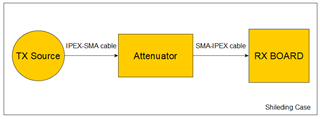
After about 19 hours, we get the following statistic result
|
Frequency |
Counter of different RSSI values |
|||||
|
-30dBm |
-31dBm |
-32dBm |
-33dBm |
-34dBm |
-35dBm |
|
|
Freq1 |
6 |
28 |
0 |
68602 |
4 |
/ |
|
Freq2 |
/ |
1639 |
57 |
2098 |
61009 |
3837 |
|
Freq3 |
/ |
/ |
2 |
68618 |
17 |
3 |
|
Freq4 |
439 |
0 |
13 |
68156 |
4 |
28 |
From the result, it seems the RSSI accuracy is out of the range +/-2dB, especially in the Freq2 and Freq4, which some RSSIs are +3dB more than the most frequently RSSI. So I have the following questions:
- Could I test the RSSI accuracy using the way described above? And is the result reasonable?
- Could I know the way that you do the RSSI accuracy test?
- In your test, the RSSI accuracy is 100% in +/-2dB range?
- Is +/-1dB happened must be more than +/-2dB?
- In the datasheet, the RSSI period only task 0.25us, does it only do one point measurement other than do several measurement and calculate the average?
6. is there any advice when we using RSSI function?


