This post is older than 2 years and might not be relevant anymore
More Info: Consider searching for newer posts

Connection to LTE network

Hi, 

I just got the nRF9160 dk and managed to register on the network following the tutorial. However, I tried to turn it on the next day and it doesn't connect to the network. I tried to check the nRF cloud dashboard to see the data usage but can't find any button on the website. There isn't a "buy more data" button as well as specified on the https://devzone.nordicsemi.com/b/nrf9160-development-status/posts/ibasis-global-access-for-things-frequently-asked-questions-faq

Please help. 

Thank you 

Best regards,

Chong 

Parents Reply
  • Hi I'm have deleted the device on the nrf cloud and tried to register again but am unable to do so. 

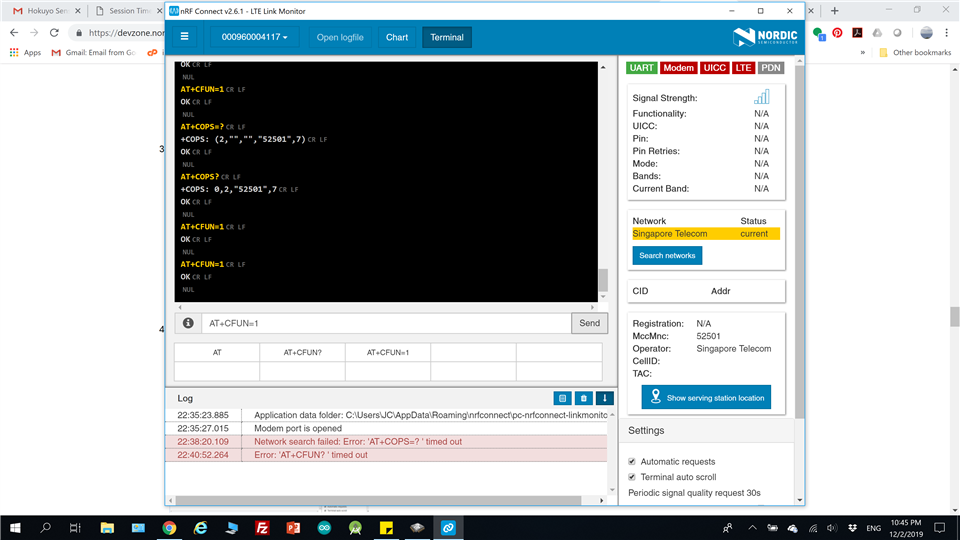
    The at commands are not working and not getting any response. 

    Application started


    LTE LC config ...


    [00:00:02.243,682] 
    
    
    [1;31m<err> net_if.net_if_init: There is no network interface to work with!
    
    
    [0m


    AT+CFUN?


    AT+COPS=?

    log shows

    Network search failed: Error: 'AT+COPS=? ' timed out

    Do you need my sim card details to check if the data service is still valid? 

    Thank you 

    Best regards.

    Chong 

Children
  • Dear All,

    I managed to get it working but the connection keeps dropping. 

    Just need to verify if it is a problem on the SIM card, Telco or chipset. 

    When connection drops, it resets. 
    NRF_CLOUD_EVT_TRANSPORT_DISCONNECTED is first seen,

    Failed to send data to cloud: -5
    ***** Booting Zephyr OS v1.13.99-ncs2 *****

    Then the 

    Thank you 

    Best regards,

    Chong 

  • Hi,


    ctchong said:
    I managed to get it working but the connection keeps dropping. 

    Are you able to successfully run the at_client example, in combination with nRF Connect LTE Link Monitor?

    If you are able to get a link using at_client + LTE Link Monitor, then your SIM card and network connection is working properly.


    Kind regards,

    Håkon

  • Hi, 

    The link is rather unstable. I'm using the LTE_BLE_gateway sample and it rarely reaches NRF_CLOUD_EVT_READY which I found that the GPS cannot be triggered as it hasn't been initialised yet. 

    NRF_CLOUD_EVT_TRANSPORT_CONNECTED
    Orientation: 1
    Orientation: 3
    trigger alarm
    Alarm triggered !
    1] Sending FLIP data.
    0] Sending FLIP data.
    Orientation: 0
    NRF_CLOUD_EVT_TRANSPORT_DISCONNECTED
    NRF_CLOUD_EVT_TRANSPORT_CONNECTED

    The connection keeps dropping and causes a reboot. 

    ***** Booting Zephyr OS v1.13.99-ncs2 *****
    Application started
    [00:00:04.940,063] <err> bt_driver.h4_get_type: Unknown H:4 type 0x3e
    [00:00:04.940,093] <err> bt_driver.h4_get_type: Unknown H:4 type 0x29
    [00:00:04.947,174] <err> bt_driver.read_payload: Not enough space in buffer
    ASSERTION FAIL [err == 0] @ D:/NordicSDK/ncs/zephyr/subsys/bluetooth/host/hci_core.c:272
    k_sem_take failed with err -11

    I see this occasionally too.  

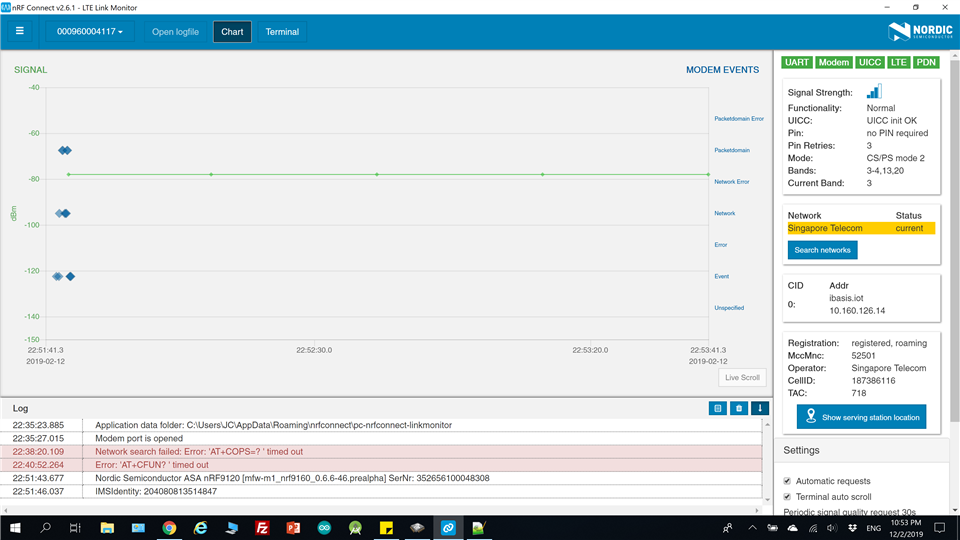
  •  Hi I tried the at_client and LTE Link monitor and it doesn't seem to work. 
    2019-02-12T14:35:23.885Z INFO Application data folder: C:\Users\JC\AppData\Roaming\nrfconnect\pc-nrfconnect-linkmonitor
    2019-02-12T14:35:23.970Z DEBUG App pc-nrfconnect-linkmonitor v0.7.0 official
    2019-02-12T14:35:23.970Z DEBUG App path: C:\Users\JC\.nrfconnect-apps\node_modules\pc-nrfconnect-linkmonitor
    2019-02-12T14:35:23.970Z DEBUG nRFConnect 2.6.1 is supported by the app (^2.4.0)
    2019-02-12T14:35:23.970Z DEBUG nRFConnect path: C:\Users\JC\AppData\Local\Programs\nrfconnect\resources\app.asar
    2019-02-12T14:35:23.970Z DEBUG HomeDir: C:\Users\JC
    2019-02-12T14:35:23.970Z DEBUG TmpDir: C:\Users\JC\AppData\Local\Temp
    2019-02-12T14:35:27.015Z INFO Modem port is opened
    2019-02-12T14:35:27.024Z DEBUG modem >> AT+CFUN?\x0D\x0A
    2019-02-12T14:35:34.982Z DEBUG modem << ***** Booting Zephyr OS v1.13.99-ncs2 *****\x0D\x0A
    2019-02-12T14:35:34.991Z DEBUG modem << Secure Boot: configure flash\x0D\x0A
    2019-02-12T14:35:35.000Z DEBUG modem << Secure Boot: SPU: set region 0 as Secure\x0D\x0A
    2019-02-12T14:35:35.002Z DEBUG modem << Secure Boot: SPU: set region 1 as Secure\x0D\x0A
    2019-02-12T14:35:35.004Z DEBUG modem << Secure Boot: SPU: set region 2 as Secure\x0D\x0A
    2019-02-12T14:35:35.005Z DEBUG modem << Secure Boot: SPU: set region 3 as Secure\x0D\x0A
    2019-02-12T14:35:35.008Z DEBUG modem << Secure Boot: SPU: set region 4 as Secure\x0D\x0A
    2019-02-12T14:35:35.016Z DEBUG modem << Secure Boot: SPU: set region 5 as Secure\x0D\x0A
    2019-02-12T14:35:35.018Z DEBUG modem << Secure Boot: SPU: set region 6 as Secure\x0D\x0A
    2019-02-12T14:35:35.020Z DEBUG modem << Secure Boot: SPU: set region 7 as Secure\x0D\x0A
    2019-02-12T14:35:35.023Z DEBUG modem << Secure Boot: SPU: set Flash region 8 as Non-Secure\x0D\x0A
    2019-02-12T14:35:35.031Z DEBUG modem << Secure Boot: SPU: set Flash region 9 as Non-Secure\x0D\x0A
    2019-02-12T14:35:35.048Z DEBUG modem << Secure Boot: SPU: set Flash region 10 as Non-Secure\x0D\x0A
    2019-02-12T14:35:35.050Z DEBUG modem << Secure Boot: SPU: set Flash region 11 as Non-Secure\x0D\x0A
    2019-02-12T14:35:35.052Z DEBUG modem << Secure Boot: SPU: set Flash region 12 as Non-Secure\x0D\x0A
    2019-02-12T14:35:35.063Z DEBUG modem << Secure Boot: SPU: set Flash region 13 as Non-Secure\x0D\x0A
    2019-02-12T14:35:35.067Z DEBUG modem << Secure Boot: SPU: set Flash region 14 as Non-Secure\x0D\x0A
    2019-02-12T14:35:35.069Z DEBUG modem << Secure Boot: SPU: set Flash region 15 as Non-Secure\x0D\x0A
    2019-02-12T14:35:35.072Z DEBUG modem << Secure Boot: SPU: set Flash region 16 as Non-Secure\x0D\x0A
    2019-02-12T14:35:35.096Z DEBUG modem << Secure Boot: SPU: set Flash region 17 as Non-Secure\x0D\x0A
    2019-02-12T14:35:35.102Z DEBUG modem << Secure Boot: SPU: set Flash region 18 as Non-Secure\x0D\x0A
    2019-02-12T14:35:35.105Z DEBUG modem << Secure Boot: SPU: set Flash region 19 as Non-Secure\x0D\x0A
    2019-02-12T14:35:35.108Z DEBUG modem << Secure Boot: SPU: set Flash region 20 as Non-Secure\x0D\x0A
    2019-02-12T14:35:35.122Z DEBUG modem << Secure Boot: SPU: set Flash region 21 as Non-Secure\x0D\x0A
    2019-02-12T14:35:35.126Z DEBUG modem << Secure Boot: SPU: set Flash region 22 as Non-Secure\x0D\x0A
    2019-02-12T14:35:35.129Z DEBUG modem << Secure Boot: SPU: set Flash region 23 as Non-Secure\x0D\x0A
    2019-02-12T14:35:35.132Z DEBUG modem << Secure Boot: SPU: set Flash region 24 as Non-Secure\x0D\x0A
    2019-02-12T14:35:35.134Z DEBUG modem << Secure Boot: SPU: set Flash region 25 as Non-Secure\x0D\x0A
    2019-02-12T14:35:35.135Z DEBUG modem << Secure Boot: SPU: set Flash region 26 as Non-Secure\x0D\x0A
    2019-02-12T14:35:35.139Z DEBUG modem << Secure Boot: SPU: set Flash region 27 as Non-Secure\x0D\x0A
    2019-02-12T14:35:35.143Z DEBUG modem << Secure Boot: SPU: set Flash region 28 as Non-Secure\x0D\x0A
    2019-02-12T14:35:35.167Z DEBUG modem << Secure Boot: SPU: set Flash region 29 as Non-Secure\x0D\x0A
    2019-02-12T14:35:35.170Z DEBUG modem << Secure Boot: SPU: set Flash region 30 as Non-Secure\x0D\x0A
    2019-02-12T14:35:35.173Z DEBUG modem << Secure Boot: SPU: set Flash region 31 as Non-Secure\x0D\x0A
    2019-02-12T14:35:35.174Z DEBUG modem << Secure Boot: configure SRAM\x0D\x0A
    2019-02-12T14:35:35.175Z DEBUG modem << Secure Boot: SPU: set SRAM region 0 as Secure\x0D\x0A
    2019-02-12T14:35:35.178Z DEBUG modem << Secure Boot: SPU: set SRAM region 1 as Secure\x0D\x0A
    2019-02-12T14:35:35.180Z DEBUG modem << Secure Boot: SPU: set SRAM region 2 as Secure\x0D\x0A
    2019-02-12T14:35:35.182Z DEBUG modem << Secure Boot: SPU: set SRAM region 3 as Secure\x0D\x0A
    2019-02-12T14:35:35.202Z DEBUG modem << Secure Boot: SPU: set SRAM region 4 as Secure\x0D\x0A
    2019-02-12T14:35:35.205Z DEBUG modem << Secure Boot: SPU: set SRAM region 5 as Secure\x0D\x0A
    2019-02-12T14:35:35.206Z DEBUG modem << Secure Boot: SPU: set SRAM region 6 as Secure\x0D\x0A
    2019-02-12T14:35:35.207Z DEBUG modem << Secure Boot: SPU: set SRAM region 7 as Secure\x0D\x0A
    2019-02-12T14:35:35.208Z DEBUG modem << Secure Boot: SPU: set SRAM region 8 as Non-Secure\x0D\x0A
    2019-02-12T14:35:35.209Z DEBUG modem << Secure Boot: SPU: set SRAM region 9 as Non-Secure\x0D\x0A
    2019-02-12T14:35:35.210Z DEBUG modem << Secure Boot: SPU: set SRAM region 10 as Non-Secure\x0D\x0A
    2019-02-12T14:35:35.212Z DEBUG modem << Secure Boot: SPU: set SRAM region 11 as Non-Secure\x0D\x0A
    2019-02-12T14:35:35.213Z DEBUG modem << Secure Boot: SPU: set SRAM region 12 as Non-Secure\x0D\x0A
    2019-02-12T14:35:35.227Z DEBUG modem << Secure Boot: SPU: set SRAM region 13 as Non-Secure\x0D\x0A
    2019-02-12T14:35:35.230Z DEBUG modem << Secure Boot: SPU: set SRAM region 14 as Non-Secure\x0D\x0A
    2019-02-12T14:35:35.232Z DEBUG modem << Secure Boot: SPU: set SRAM region 15 as Non-Secure\x0D\x0A
    2019-02-12T14:35:35.235Z DEBUG modem << Secure Boot: SPU: set SRAM region 16 as Non-Secure\x0D\x0A
    2019-02-12T14:35:35.237Z DEBUG modem << Secure Boot: SPU: set SRAM region 17 as Non-Secure\x0D\x0A
    2019-02-12T14:35:35.238Z DEBUG modem << Secure Boot: SPU: set SRAM region 18 as Non-Secure\x0D\x0A
    2019-02-12T14:35:35.240Z DEBUG modem << Secure Boot: SPU: set SRAM region 19 as Non-Secure\x0D\x0A
    2019-02-12T14:35:35.260Z DEBUG modem << Secure Boot: SPU: set SRAM region 20 as Non-Secure\x0D\x0A
    2019-02-12T14:35:35.263Z DEBUG modem << Secure Boot: SPU: set SRAM region 21 as Non-Secure\x0D\x0A
    2019-02-12T14:35:35.266Z DEBUG modem << Secure Boot: SPU: set SRAM region 22 as Non-Secure\x0D\x0A
    2019-02-12T14:35:35.268Z DEBUG modem << Secure Boot: SPU: set SRAM region 23 as Non-Secure\x0D\x0A
    2019-02-12T14:35:35.269Z DEBUG modem << Secure Boot: SPU: set SRAM region 24 as Non-Secure\x0D\x0A
    2019-02-12T14:35:35.272Z DEBUG modem << Secure Boot: SPU: set SRAM region 25 as Non-Secure\x0D\x0A
    2019-02-12T14:35:35.288Z DEBUG modem << Secure Boot: SPU: set SRAM region 26 as Non-Secure\x0D\x0A
    2019-02-12T14:35:35.292Z DEBUG modem << Secure Boot: SPU: set SRAM region 27 as Non-Secure\x0D\x0A
    2019-02-12T14:35:35.294Z DEBUG modem << Secure Boot: SPU: set SRAM region 28 as Non-Secure\x0D\x0A
    2019-02-12T14:35:35.296Z DEBUG modem << Secure Boot: SPU: set SRAM region 29 as Non-Secure\x0D\x0A
    2019-02-12T14:35:35.297Z DEBUG modem << Secure Boot: SPU: set SRAM region 30 as Non-Secure\x0D\x0A
    2019-02-12T14:35:35.298Z DEBUG modem << Secure Boot: SPU: set SRAM region 31 as Non-Secure\x0D\x0A
    2019-02-12T14:35:35.299Z DEBUG modem << Secure Boot: configure peripherals\x0D\x0A
    2019-02-12T14:35:35.301Z DEBUG modem << Secure Boot: MSP_NS 200265f0\x0D\x0A
    2019-02-12T14:35:35.325Z DEBUG modem << Secure Boot: prepare to jump to Non-Secure image\x0D\x0A
    2019-02-12T14:35:36.104Z DEBUG modem << ***** Booting Zephyr OS v1.13.99-ncs2 *****\x0D\x0A
    2019-02-12T14:35:36.124Z DEBUG modem << The AT host sample started\x0D\x0A
    2019-02-12T14:35:49.824Z DEBUG modem >> AT+CFUN?\x0D\x0A
    2019-02-12T14:35:49.836Z DEBUG modem << +CFUN: 4\x0D\x0A
    2019-02-12T14:35:49.869Z DEBUG modem << OK\x0D\x0A\x00
    2019-02-12T14:35:49.890Z DEBUG modem >> AT+CFUN=1\x0D\x0A
    2019-02-12T14:35:49.921Z DEBUG modem << OK\x0D\x0A\x00
    2019-02-12T14:37:20.055Z DEBUG modem >> AT+COPS=?\x0D\x0A
    2019-02-12T14:38:20.109Z ERROR Network search failed: Error: 'AT+COPS=?
    ' timed out

  • After a few attempts, I got the modem and other others turned on and connected. 

Related