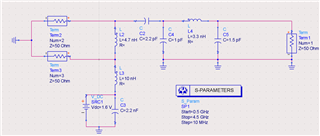
I simulated the balun of nrf51822 accroding to the referenced design of nrf51822 on the official website.
However,it showed the differential phase of the balun was not 180 degrees.
Please help me to find a solution,thanks.
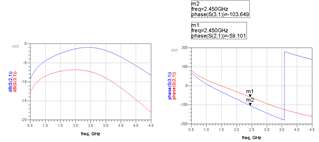
I simulated the balun of nrf51822 accroding to the referenced design of nrf51822 on the official website.
However,it showed the differential phase of the balun was not 180 degrees.
Please help me to find a solution,thanks.
When you simulate the phase difference on the pins, you will find that this is not 180 degrees. Inside the radio front end, on the PA output in TX mode and on the input of the LNA in RX mode, you will find that the phase difference is close to 180 degrees.
1. Yes
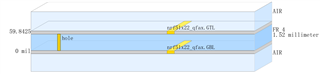
2. No, as said earlier, you need to take the layout into account as well. I don't see that you're using component models. Theoretical components doesn't give correct results.
The impedance 15 +j85 is measured on the actual layout with real components, it's not a simulated value.
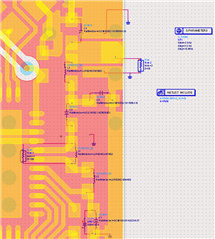
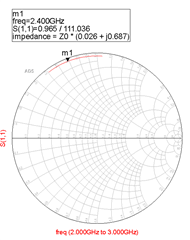
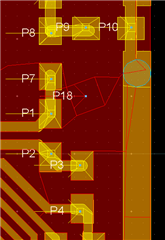
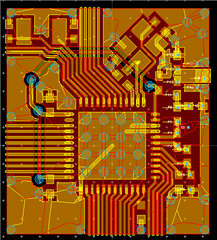
I simulated the circuit with the actual PCB Layout and Murata's capacitance,getting the impedance was 2.6+68.7j. What's the cause?And the key point is how to adjust the layout to match to 15 + 85j?


Sorry, I have no idea what you do wrong here.
Note that even if the impedance you get matches the recommended load impedance, you don't know how the harmonics are going to behave. Only real measurements will show that.
Sorry, I have no idea what you do wrong here.
Note that even if the impedance you get matches the recommended load impedance, you don't know how the harmonics are going to behave. Only real measurements will show that.
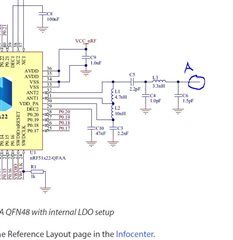
Please confirm it to you again.Is the impedance from point A to NRF51822 50 ohms, or the load at point A 50 ohms? 
The impedance, looking from the matching network, at A, into the load is 50 ohm. It's _not_ 50 ohm seen from the load into A.
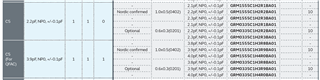
Why the parameters of QFAC are different ?

The length of the bonding wires are difference due to the larger die of the QFAC (more memory), meaning that the QFAC has shorter bonding wires and hence less series inductance.