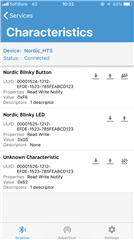
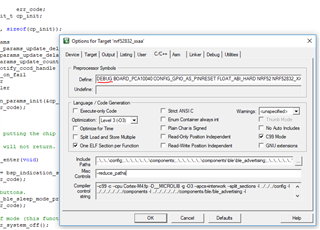
Hello
I am using Android and BLE communication with nRF52832 (BLENano2) now.
I am using SDK 15.0.0 with keil uversion.
Central is Android and peripheral is nRF52832.
Use the SDK "app_ble_blinky.
I want to send the sensor output value from the peripheral BLENano2 to the central Android terminal.
Therefore, we improved "ble_app_blinky" referring to this page.
The addition of the characteristic is complete, but it looks like the following image, as it can not receive the value.
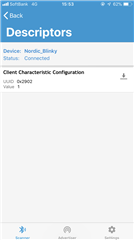
The value remains unchanged at 1 and does not change.
Did not set up event handler well?
/**
 * Copyright (c) 2012 - 2018, Nordic Semiconductor ASA
 *
 * All rights reserved.
 *
 * Redistribution and use in source and binary forms, with or without modification,
 * are permitted provided that the following conditions are met:
 *
 * 1. Redistributions of source code must retain the above copyright notice, this
 *    list of conditions and the following disclaimer.
 *
 * 2. Redistributions in binary form, except as embedded into a Nordic
 *    Semiconductor ASA integrated circuit in a product or a software update for
 *    such product, must reproduce the above copyright notice, this list of
 *    conditions and the following disclaimer in the documentation and/or other
 *    materials provided with the distribution.
 *
 * 3. Neither the name of Nordic Semiconductor ASA nor the names of its
 *    contributors may be used to endorse or promote products derived from this
 *    software without specific prior written permission.
 *
 * 4. This software, with or without modification, must only be used with a
 *    Nordic Semiconductor ASA integrated circuit.
 *
 * 5. Any software provided in binary form under this license must not be reverse
 *    engineered, decompiled, modified and/or disassembled.
 *
 * THIS SOFTWARE IS PROVIDED BY NORDIC SEMICONDUCTOR ASA "AS IS" AND ANY EXPRESS
 * OR IMPLIED WARRANTIES, INCLUDING, BUT NOT LIMITED TO, THE IMPLIED WARRANTIES
 * OF MERCHANTABILITY, NONINFRINGEMENT, AND FITNESS FOR A PARTICULAR PURPOSE ARE
 * DISCLAIMED. IN NO EVENT SHALL NORDIC SEMICONDUCTOR ASA OR CONTRIBUTORS BE
 * LIABLE FOR ANY DIRECT, INDIRECT, INCIDENTAL, SPECIAL, EXEMPLARY, OR
 * CONSEQUENTIAL DAMAGES (INCLUDING, BUT NOT LIMITED TO, PROCUREMENT OF SUBSTITUTE
 * GOODS OR SERVICES; LOSS OF USE, DATA, OR PROFITS; OR BUSINESS INTERRUPTION)
 * HOWEVER CAUSED AND ON ANY THEORY OF LIABILITY, WHETHER IN CONTRACT, STRICT
 * LIABILITY, OR TORT (INCLUDING NEGLIGENCE OR OTHERWISE) ARISING IN ANY WAY OUT
 * OF THE USE OF THIS SOFTWARE, EVEN IF ADVISED OF THE POSSIBILITY OF SUCH DAMAGE.
 *
 */
#include "sdk_common.h"
#if NRF_MODULE_ENABLED(NRF_BLE_CONN_PARAMS)
#include <stdlib.h>
#include "nrf.h"
#include "sdk_errors.h"
#include "ble_hci.h"
#include "ble_err.h"
#include "ble_conn_params.h"
#include "ble_srv_common.h"
#include "ble_conn_state.h"
#include "nrf_sdh_ble.h"
#include "app_timer.h"
#include "app_util.h"

#include "ble_lbs.h"////////////////////////////////////////////////////////////////////////////////


#define NRF_BLE_CONN_PARAMS_INSTANCE_COUNT  NRF_SDH_BLE_PERIPHERAL_LINK_COUNT   //!< The number of @ref ble_conn_params_instance_t instances kept by the conn_params module.

#if (NRF_BLE_CONN_PARAMS_INSTANCE_COUNT < 1)
#error Invalid NRF_SDH_BLE_PERIPHERAL_LINK_COUNT value. Set it in SDK config (nrf_sdh_ble).
#endif

/** @brief Each peripheral link has such an instance associated with it.
 */
typedef struct
{
    uint16_t              conn_handle;           //!< The connection handle of this link. If this is @ref BLE_CONN_HANDLE_INVALID, the instance is free.
    app_timer_id_t        timer_id;              //!< The ID of the timer associated with this link.
    uint8_t               update_count;          //!< The number of times the connection parameters have been attempted negotiated on this link.
    uint8_t               params_ok;             //!< Whether the current connection parameters on this link are acceptable according to the @p preferred_conn_params, and configured maximum deviations.
    ble_gap_conn_params_t preferred_conn_params; //!< The desired connection parameters for this link.
} ble_conn_params_instance_t;

static app_timer_t                m_timer_data[NRF_BLE_CONN_PARAMS_INSTANCE_COUNT] = {{{0}}};          //!< Data needed for timers.
static ble_conn_params_instance_t m_conn_params_instances[NRF_BLE_CONN_PARAMS_INSTANCE_COUNT] = {{0}}; //!< Configuration data for each connection.
static ble_conn_params_init_t     m_conn_params_config;                                                //!< Configuration as provided by the application during intialization.
static ble_gap_conn_params_t      m_preferred_conn_params;                                             //!< The preferred connection parameters as specified during initialization.
//lint -esym(551, m_preferred_conn_params) "Not accessed"


/**@brief Function for retrieving the conn_params instance belonging to a conn_handle
 *
 * @params[in]  conn_handle  The connection handle to retrieve the instance of.
 *
 * @return  A pointer to the instance, or NULL if no instance was found with that conn_handle.
 */
static ble_conn_params_instance_t * instance_get(uint16_t conn_handle)
{
    //lint -save -e681 "Loop not entered" when NRF_BLE_CONN_PARAMS_INSTANCE_COUNT is 0
    for (uint32_t i = 0; i < NRF_BLE_CONN_PARAMS_INSTANCE_COUNT; i++)
    {
        if (m_conn_params_instances[i].conn_handle == conn_handle)
        {
            return &m_conn_params_instances[i];
        }
    }
    //lint -restore
    return NULL;
}


/**@brief Function for initializing an instance, and associating it with a conn_handle.
 *
 * @params[in]  p_instance   The instance to initialize and associate.
 * @params[in]  conn_handle  The connection handle to associate with.
 */
static __INLINE void instance_claim(ble_conn_params_instance_t * p_instance, uint16_t conn_handle)
{
    p_instance->conn_handle           = conn_handle;
    p_instance->update_count          = 0;
    p_instance->preferred_conn_params = m_preferred_conn_params;
}


/**@brief Function for freeing an instance.
 *
 * @params[in]  p_instance   The instance to free.
 */
static __INLINE void instance_free(ble_conn_params_instance_t * p_instance)
{
    p_instance->conn_handle = BLE_CONN_HANDLE_INVALID;
}


/**@brief Function for validating a set of connection parameters against the preferred parameters.
 *
 * @param[in]  p_preferred_conn_params  The desired parameters.
 * @param[in]  p_actual_conn_params     The parameters to validate.
 * @param[in]  max_slave_latency_err    The amount of discrepancy in slave latency, in number of
 *                                      connection intervals, that will be accepted.
 * @param[in]  max_sup_timeout_err      The amount of discrepancy in supervision timeout, in tens of
 *                                      milliseconds, that will be accepted.
 *
 * @return  Whether the params in @p p_actual_conn_params are acceptable given the other parameters.
 */
static bool is_conn_params_ok(ble_gap_conn_params_t const * p_preferred_conn_params,
                              ble_gap_conn_params_t const * p_actual_conn_params,
                              uint16_t                      max_slave_latency_err,
                              uint16_t                      max_sup_timeout_err)
{
    uint32_t max_allowed_sl = p_preferred_conn_params->slave_latency + max_slave_latency_err;
    uint32_t min_allowed_sl = p_preferred_conn_params->slave_latency
                              - MIN(max_slave_latency_err, p_preferred_conn_params->slave_latency);
    uint32_t max_allowed_to = p_preferred_conn_params->conn_sup_timeout + max_sup_timeout_err;
    uint32_t min_allowed_to = p_preferred_conn_params->conn_sup_timeout
                              - MIN(max_sup_timeout_err, p_preferred_conn_params->conn_sup_timeout);

    // Check if interval is within the acceptable range.
    // NOTE: Using max_conn_interval in the received event data because this contains
    //       the client's connection interval.
    if   ((p_actual_conn_params->max_conn_interval < p_preferred_conn_params->min_conn_interval)
       || (p_actual_conn_params->max_conn_interval > p_preferred_conn_params->max_conn_interval))
    {
        return false;
    }

    // Check if slave latency is within the acceptable deviation.
    if   ((p_actual_conn_params->slave_latency < min_allowed_sl)
       || (p_actual_conn_params->slave_latency > max_allowed_sl))
    {
        return false;
    }

    // Check if supervision timeout is within the acceptable deviation.
    if   ((p_actual_conn_params->conn_sup_timeout < min_allowed_to)
       || (p_actual_conn_params->conn_sup_timeout > max_allowed_to))
    {
        return false;
    }

    return true;
}


static void send_error_evt(ret_code_t err_code)
{
    if (m_conn_params_config.error_handler != NULL)
    {
        m_conn_params_config.error_handler(err_code);
    }
}


/**@brief Function for sending a conn_param_update request on-air, and handling errors.
 *
 * @param[in]  conn_handle        Connection to send request on.
 * @param[in]  p_new_conn_params  Connection parameters to request.
 *
 * @return  Whether the request was successfully sent.
 */
static bool send_update_request(uint16_t conn_handle, ble_gap_conn_params_t * p_new_conn_params)
{
    ret_code_t err_code;

    err_code = sd_ble_gap_conn_param_update(conn_handle, p_new_conn_params);
    if ((err_code != NRF_SUCCESS) && (err_code != NRF_ERROR_BUSY)) // NRF_ERROR_BUSY means another conn_param_update request is pending.
    {
        send_error_evt(err_code);
    }

    return (err_code == NRF_SUCCESS);
}


/**@brief Function called after conn_params_update_delay has happened. This is triggered by app_timer.
 *
 * @param[in]  p_context  Context identifying which connection this is for.
 */
static void update_timeout_handler(void * p_context)
{
    uint32_t                     conn_handle = (uint32_t)p_context;
    ble_conn_params_instance_t * p_instance  = instance_get(conn_handle);

    if (p_instance != NULL)
    {
        // Check if we have reached the maximum number of attempts
        if (p_instance->update_count < m_conn_params_config.max_conn_params_update_count)
        {
            bool update_sent = send_update_request(conn_handle, &p_instance->preferred_conn_params);
            if (update_sent)
            {
                p_instance->update_count++;
            }
        }
        else
        {
            p_instance->update_count = 0;

            // Negotiation failed, disconnect automatically if this has been configured
            if (m_conn_params_config.disconnect_on_fail)
            {
                ret_code_t err_code;

                err_code = sd_ble_gap_disconnect(conn_handle, BLE_HCI_CONN_INTERVAL_UNACCEPTABLE);
                if ((err_code != NRF_SUCCESS) && (err_code != NRF_ERROR_INVALID_STATE)) // NRF_ERROR_INVALID_STATE means disconnect is already in progress.
                {
                    send_error_evt(err_code);
                }
            }

            // Notify the application that the procedure has failed
            if (m_conn_params_config.evt_handler != NULL)
            {
                ble_conn_params_evt_t evt;

                evt.evt_type = BLE_CONN_PARAMS_EVT_FAILED;
                evt.conn_handle = conn_handle;
                m_conn_params_config.evt_handler(&evt);
            }
        }
    }
}


ret_code_t ble_conn_params_init(const ble_conn_params_init_t * p_init)
{
    ret_code_t err_code;

    VERIFY_PARAM_NOT_NULL(p_init);

    m_conn_params_config = *p_init;
    m_conn_params_config.p_conn_params = &m_preferred_conn_params;

    if (p_init->p_conn_params != NULL)
    {
        // Set the connection params in stack.
        err_code = sd_ble_gap_ppcp_set(p_init->p_conn_params);
        if (err_code != NRF_SUCCESS)
        {
            return err_code;
        }
        m_preferred_conn_params = *p_init->p_conn_params;
    }
    else
    {
        // Get the (default) connection params from stack.
        err_code = sd_ble_gap_ppcp_get(&m_preferred_conn_params);
        if (err_code != NRF_SUCCESS)
        {
            return err_code;
        }
    }

    //lint -save -e681 "Loop not entered" when NRF_BLE_CONN_PARAMS_INSTANCE_COUNT is 0
    for (uint32_t i = 0; i < NRF_BLE_CONN_PARAMS_INSTANCE_COUNT; i++)
    {
        ble_conn_params_instance_t * p_instance = &m_conn_params_instances[i];

        instance_free(p_instance);
        p_instance->timer_id = &m_timer_data[i];

        err_code = app_timer_create(&p_instance->timer_id,
                            APP_TIMER_MODE_SINGLE_SHOT,
                            update_timeout_handler);
        if (err_code != NRF_SUCCESS)
        {
            return NRF_ERROR_INTERNAL;
        }
    }
    //lint -restore

    return NRF_SUCCESS;
}


ret_code_t ble_conn_params_stop(void)
{
    ret_code_t err_code;

    //lint -save -e681 "Loop not entered" when NRF_BLE_CONN_PARAMS_INSTANCE_COUNT is 0
    for (uint32_t i = 0; i < NRF_BLE_CONN_PARAMS_INSTANCE_COUNT; i++)
        {
        err_code = app_timer_stop(m_conn_params_instances[i].timer_id);
        switch (err_code)
            {
            case NRF_SUCCESS:
                /* do nothing */
                break;

            case NRF_ERROR_INVALID_STATE:
                /* do nothing */
                break;

            case NRF_ERROR_NO_MEM:
                return NRF_ERROR_BUSY;

            case NRF_ERROR_INVALID_PARAM:
                /* fallthrough */
            default:
                return NRF_ERROR_INTERNAL;
            }
        }
    //lint -restore
    return NRF_SUCCESS;
}


/**@brief Function for taking appropriate action based on the current state of connection parameters.
 *
 * @param[in]  conn_handle  Connection to handle.
 * @param[in]  p_instance   Configuration for the connection.
 */
static void conn_params_negotiation(uint16_t conn_handle, ble_conn_params_instance_t * p_instance)
        {
    // Start negotiation if the received connection parameters are not acceptable
    if (!p_instance->params_ok)
            {
        ret_code_t err_code;
        uint32_t   timeout_ticks;

        if (p_instance->update_count == 0)
        {
                // First connection parameter update
                timeout_ticks = m_conn_params_config.first_conn_params_update_delay;
            }
            else
            {
                timeout_ticks = m_conn_params_config.next_conn_params_update_delay;
            }

        err_code = app_timer_start(p_instance->timer_id, timeout_ticks, (void *)(uint32_t)conn_handle);
        if (err_code != NRF_SUCCESS)
            {
            send_error_evt(err_code);
            }
        }
    else
    {
        p_instance->update_count = 0;

        // Notify the application that the procedure has succeeded
        if (m_conn_params_config.evt_handler != NULL)
        {
            ble_conn_params_evt_t evt;

            evt.evt_type = BLE_CONN_PARAMS_EVT_SUCCEEDED;
            evt.conn_handle = conn_handle;
            m_conn_params_config.evt_handler(&evt);
        }
    }
}


/**@brief Function for handling a connection event from the SoftDevice.
 *
 * @param[in]  p_ble_evt  Event from the SoftDevice.
 */
static void on_connect(ble_evt_t const * p_ble_evt)
{
    uint8_t  role        = p_ble_evt->evt.gap_evt.params.connected.role;
    uint16_t conn_handle = p_ble_evt->evt.gap_evt.conn_handle;
	ble_lbs_t * p_lbs;

	ble_cus_evt_t evt;
	evt.evt_type = BLE_CUS_EVT_CONNECTED;


    if (role != BLE_GAP_ROLE_PERIPH)
    {
        return;
    }

    ble_conn_params_instance_t * p_instance  = instance_get(BLE_CONN_HANDLE_INVALID);

    if (p_instance == NULL)
    {
        send_error_evt(NRF_ERROR_NO_MEM);
        return;
    }

    instance_claim(p_instance, conn_handle);
    p_instance->params_ok = is_conn_params_ok(&p_instance->preferred_conn_params,
                                              &p_ble_evt->evt.gap_evt.params.connected.conn_params,
                                              NRF_BLE_CONN_PARAMS_MAX_SLAVE_LATENCY_DEVIATION,
                                              NRF_BLE_CONN_PARAMS_MAX_SUPERVISION_TIMEOUT_DEVIATION);

    // Check if we shall handle negotiation on connect
    if (m_conn_params_config.start_on_notify_cccd_handle == BLE_GATT_HANDLE_INVALID)
    {
        conn_params_negotiation(conn_handle, p_instance);
    }
		p_lbs->on_sensor_evt(p_lbs,&evt);
}


/**@brief Function for handling a disconnection event from the SoftDevice.
 *
 * @param[in]  p_ble_evt  Event from the SoftDevice.
 */
static void on_disconnect(ble_evt_t const * p_ble_evt)
{
    ret_code_t                   err_code;
    uint16_t                     conn_handle = p_ble_evt->evt.gap_evt.conn_handle;
    ble_conn_params_instance_t * p_instance  = instance_get(conn_handle);

    if (p_instance != NULL)
    {
    // Stop timer if running
        err_code = app_timer_stop(p_instance->timer_id);
        if (err_code != NRF_SUCCESS)
        {
            send_error_evt(err_code);
        }

        instance_free(p_instance);
    }
}


/**@brief Function for handling a GATT write event from the SoftDevice.
 *
 * @details To provide the start_on_notify_cccd_handle functionality.
 *
 * @param[in]  p_ble_evt  Event from the SoftDevice.
 */
static void on_write(ble_evt_t const * p_ble_evt)
{
    ble_gatts_evt_write_t const * p_evt_write = &p_ble_evt->evt.gatts_evt.params.write;
	ble_lbs_t * p_lbs;/////////////////////////////////////////////////////////////////////////

    // Check if this is the correct CCCD
    if (
        (p_evt_write->handle == m_conn_params_config.start_on_notify_cccd_handle)
        &&
        (p_evt_write->len == 2)
       )
    {
        uint16_t                     conn_handle = p_ble_evt->evt.gap_evt.conn_handle;
        ble_conn_params_instance_t * p_instance  = instance_get(conn_handle);

        if (p_instance != NULL)
        {
					ble_cus_evt_t evt;//////////////////////////////////////////////////////////////////////////////////////

            // Check if this is a 'start notification'
            if (ble_srv_is_notification_enabled(p_evt_write->data))
            {
                // Do connection parameter negotiation if necessary
                    conn_params_negotiation(conn_handle, p_instance);
							evt.evt_type = BLE_CUS_EVT_NOTIFICATION_ENABLED;//////////////////////////////////////////////////////////


            }
            else
            {
                ret_code_t err_code;
							evt.evt_type = BLE_CUS_EVT_NOTIFICATION_DISABLED;//////////////////////////////////////////////////////////////////////


                // Stop timer if running
                err_code = app_timer_stop(p_instance->timer_id);
                if (err_code != NRF_SUCCESS)
                {
                    send_error_evt(err_code);
                }
            }
						p_lbs->on_sensor_evt(p_lbs,&evt);////////////////////////////////////////////////////////////////////////////////////////////////////////////
        }
    }
}


/**@brief Function for handling a connection parameter update event from the SoftDevice.
 *
 * @details This event means the peer central has changed the connection parameters or declined our
 *          request.
 *
 * @param[in]  p_ble_evt  Event from the SoftDevice.
 */
static void on_conn_params_update(ble_evt_t const * p_ble_evt)
{
    uint16_t                     conn_handle = p_ble_evt->evt.gap_evt.conn_handle;
    ble_conn_params_instance_t * p_instance  = instance_get(conn_handle);

    if (p_instance != NULL)
    {
        p_instance->params_ok = is_conn_params_ok(
                                     &p_instance->preferred_conn_params,
                                     &p_ble_evt->evt.gap_evt.params.conn_param_update.conn_params,
                                     NRF_BLE_CONN_PARAMS_MAX_SLAVE_LATENCY_DEVIATION,
                                     NRF_BLE_CONN_PARAMS_MAX_SUPERVISION_TIMEOUT_DEVIATION);

        conn_params_negotiation(conn_handle, p_instance);
    }
}


/**
 * @brief Function for handling BLE events.
 *
 * @param[in]   p_ble_evt       Event received from the BLE stack.
 * @param[in]   p_context       Context.
 */
static void ble_evt_handler(ble_evt_t const * p_ble_evt, void * p_context)
{
    switch (p_ble_evt->header.evt_id)
    {
        case BLE_GAP_EVT_CONNECTED:
            on_connect(p_ble_evt);
            break;

        case BLE_GAP_EVT_DISCONNECTED:
            on_disconnect(p_ble_evt);
            break;

        case BLE_GATTS_EVT_WRITE:
            on_write(p_ble_evt);
            break;

        case BLE_GAP_EVT_CONN_PARAM_UPDATE:
            on_conn_params_update(p_ble_evt);
            break;

        default:
            // No implementation needed.
            break;
    }
}


ret_code_t ble_conn_params_change_conn_params(uint16_t                conn_handle,
                                              ble_gap_conn_params_t * p_new_params)
{
    ret_code_t                   err_code   = BLE_ERROR_INVALID_CONN_HANDLE;
    ble_conn_params_instance_t * p_instance = instance_get(conn_handle);

    if (p_new_params == NULL)
    {
        p_new_params = &m_preferred_conn_params;
    }

    if (p_instance != NULL)
    {
        // Send request to central.
        err_code = sd_ble_gap_conn_param_update(conn_handle, p_new_params);
        if (err_code == NRF_SUCCESS)
        {
            p_instance->params_ok             = false;
            p_instance->update_count          = 1;
            p_instance->preferred_conn_params = *p_new_params;
        }
    }

    return err_code;
}

NRF_SDH_BLE_OBSERVER(m_ble_observer, BLE_CONN_PARAMS_BLE_OBSERVER_PRIO, ble_evt_handler, NULL);


#endif //ENABLED
main
/**
 * Copyright (c) 2015 - 2018, Nordic Semiconductor ASA
 *
 * All rights reserved.
 *
 * Redistribution and use in source and binary forms, with or without modification,
 * are permitted provided that the following conditions are met:
 *
 * 1. Redistributions of source code must retain the above copyright notice, this
 *    list of conditions and the following disclaimer.
 *
 * 2. Redistributions in binary form, except as embedded into a Nordic
 *    Semiconductor ASA integrated circuit in a product or a software update for
 *    such product, must reproduce the above copyright notice, this list of
 *    conditions and the following disclaimer in the documentation and/or other
 *    materials provided with the distribution.
 *
 * 3. Neither the name of Nordic Semiconductor ASA nor the names of its
 *    contributors may be used to endorse or promote products derived from this
 *    software without specific prior written permission.
 *
 * 4. This software, with or without modification, must only be used with a
 *    Nordic Semiconductor ASA integrated circuit.
 *
 * 5. Any software provided in binary form under this license must not be reverse
 *    engineered, decompiled, modified and/or disassembled.
 *
 * THIS SOFTWARE IS PROVIDED BY NORDIC SEMICONDUCTOR ASA "AS IS" AND ANY EXPRESS
 * OR IMPLIED WARRANTIES, INCLUDING, BUT NOT LIMITED TO, THE IMPLIED WARRANTIES
 * OF MERCHANTABILITY, NONINFRINGEMENT, AND FITNESS FOR A PARTICULAR PURPOSE ARE
 * DISCLAIMED. IN NO EVENT SHALL NORDIC SEMICONDUCTOR ASA OR CONTRIBUTORS BE
 * LIABLE FOR ANY DIRECT, INDIRECT, INCIDENTAL, SPECIAL, EXEMPLARY, OR
 * CONSEQUENTIAL DAMAGES (INCLUDING, BUT NOT LIMITED TO, PROCUREMENT OF SUBSTITUTE
 * GOODS OR SERVICES; LOSS OF USE, DATA, OR PROFITS; OR BUSINESS INTERRUPTION)
 * HOWEVER CAUSED AND ON ANY THEORY OF LIABILITY, WHETHER IN CONTRACT, STRICT
 * LIABILITY, OR TORT (INCLUDING NEGLIGENCE OR OTHERWISE) ARISING IN ANY WAY OUT
 * OF THE USE OF THIS SOFTWARE, EVEN IF ADVISED OF THE POSSIBILITY OF SUCH DAMAGE.
 *
 */
/**
 * @brief Blinky Sample Application main file.
 *
 * This file contains the source code for a sample server application using the LED Button service.
 */

#include <stdint.h>
#include <string.h>
#include "nordic_common.h"
#include "nrf.h"
#include "app_error.h"
#include "ble.h"
#include "ble_err.h"
#include "ble_hci.h"
#include "ble_srv_common.h"
#include "ble_advdata.h"
#include "ble_conn_params.h"
#include "nrf_sdh.h"
#include "nrf_sdh_ble.h"
#include "boards.h"
#include "app_timer.h"
#include "app_button.h"
#include "ble_lbs.h"
#include "nrf_ble_gatt.h"
#include "nrf_ble_qwr.h"
#include "nrf_pwr_mgmt.h"
#include "nrf_delay.h"

#include "nrf_log.h"
#include "nrf_log_ctrl.h"
#include "nrf_log_default_backends.h"

#include "ble_cus.h"


#define ADVERTISING_LED                 BSP_BOARD_LED_0                         /**< Is on when device is advertising. */
#define CONNECTED_LED                   BSP_BOARD_LED_1                         /**< Is on when device has connected. */
#define LEDBUTTON_LED                   5//BSP_BOARD_LED_2                         /**< LED to be toggled with the help of the LED Button Service. */
#define LEDBUTTON_BUTTON                BSP_BUTTON_0                            /**< Button that will trigger the notification event with the LED Button Service */

#define DEVICE_NAME                     "Nordic_Blinky"                         /**< Name of device. Will be included in the advertising data. */

#define APP_BLE_OBSERVER_PRIO           3                                       /**< Application's BLE observer priority. You shouldn't need to modify this value. */
#define APP_BLE_CONN_CFG_TAG            1                                       /**< A tag identifying the SoftDevice BLE configuration. */

#define APP_ADV_INTERVAL                64                                      /**< The advertising interval (in units of 0.625 ms; this value corresponds to 40 ms). */
#define APP_ADV_DURATION                BLE_GAP_ADV_TIMEOUT_GENERAL_UNLIMITED   /**< The advertising time-out (in units of seconds). When set to 0, we will never time out. */


#define MIN_CONN_INTERVAL               MSEC_TO_UNITS(100, UNIT_1_25_MS)        /**< Minimum acceptable connection interval (0.5 seconds). */
#define MAX_CONN_INTERVAL               MSEC_TO_UNITS(200, UNIT_1_25_MS)        /**< Maximum acceptable connection interval (1 second). */
#define SLAVE_LATENCY                   0                                       /**< Slave latency. */
#define CONN_SUP_TIMEOUT                MSEC_TO_UNITS(4000, UNIT_10_MS)         /**< Connection supervisory time-out (4 seconds). */

#define FIRST_CONN_PARAMS_UPDATE_DELAY  APP_TIMER_TICKS(20000)                  /**< Time from initiating event (connect or start of notification) to first time sd_ble_gap_conn_param_update is called (15 seconds). */
#define NEXT_CONN_PARAMS_UPDATE_DELAY   APP_TIMER_TICKS(5000)                   /**< Time between each call to sd_ble_gap_conn_param_update after the first call (5 seconds). */
#define MAX_CONN_PARAMS_UPDATE_COUNT    3                                       /**< Number of attempts before giving up the connection parameter negotiation. */

#define BUTTON_DETECTION_DELAY          APP_TIMER_TICKS(50)                     /**< Delay from a GPIOTE event until a button is reported as pushed (in number of timer ticks). */

#define DEAD_BEEF                       0xDEADBEEF                              /**< Value used as error code on stack dump, can be used to identify stack location on stack unwind. */


BLE_LBS_DEF(m_lbs);                                                             /**< LED Button Service instance. */
NRF_BLE_GATT_DEF(m_gatt);                                                       /**< GATT module instance. */
NRF_BLE_QWR_DEF(m_qwr);                                                         /**< Context for the Queued Write module.*/

static uint16_t m_conn_handle = BLE_CONN_HANDLE_INVALID;                        /**< Handle of the current connection. */

static uint8_t m_adv_handle = BLE_GAP_ADV_SET_HANDLE_NOT_SET;                   /**< Advertising handle used to identify an advertising set. */
static uint8_t m_enc_advdata[BLE_GAP_ADV_SET_DATA_SIZE_MAX];                    /**< Buffer for storing an encoded advertising set. */
static uint8_t m_enc_scan_response_data[BLE_GAP_ADV_SET_DATA_SIZE_MAX];         /**< Buffer for storing an encoded scan data. */


//BLE send timeout handler
#define NOTIFICATION_INTERVAL           APP_TIMER_TICKS(1000)
APP_TIMER_DEF(m_notification_timer_id);
static uint8_t m_custom_value = 0;


/**@brief Struct that contains pointers to the encoded advertising data. */
static ble_gap_adv_data_t m_adv_data =
{
    .adv_data =
    {
        .p_data = m_enc_advdata,
        .len    = BLE_GAP_ADV_SET_DATA_SIZE_MAX
    },
    .scan_rsp_data =
    {
        .p_data = m_enc_scan_response_data,
        .len    = BLE_GAP_ADV_SET_DATA_SIZE_MAX

    }
};

/**@brief Function for assert macro callback.
 *
 * @details This function will be called in case of an assert in the SoftDevice.
 *
 * @warning This handler is an example only and does not fit a final product. You need to analyze
 *          how your product is supposed to react in case of Assert.
 * @warning On assert from the SoftDevice, the system can only recover on reset.
 *
 * @param[in] line_num    Line number of the failing ASSERT call.
 * @param[in] p_file_name File name of the failing ASSERT call.
 */
void assert_nrf_callback(uint16_t line_num, const uint8_t * p_file_name)
{
    app_error_handler(DEAD_BEEF, line_num, p_file_name);
}


/**@brief Function for the LEDs initialization.
 *
 * @details Initializes all LEDs used by the application.
 */
static void leds_init(void)
{
    bsp_board_init(BSP_INIT_LEDS);
}


/**@brief Function for the GAP initialization.
 *
 * @details This function sets up all the necessary GAP (Generic Access Profile) parameters of the
 *          device including the device name, appearance, and the preferred connection parameters.
 */
static void gap_params_init(void)
{
    ret_code_t              err_code;
    ble_gap_conn_params_t   gap_conn_params;
    ble_gap_conn_sec_mode_t sec_mode;

    BLE_GAP_CONN_SEC_MODE_SET_OPEN(&sec_mode);

    err_code = sd_ble_gap_device_name_set(&sec_mode,
                                          (const uint8_t *)DEVICE_NAME,
                                          strlen(DEVICE_NAME));
    APP_ERROR_CHECK(err_code);

    memset(&gap_conn_params, 0, sizeof(gap_conn_params));

    gap_conn_params.min_conn_interval = MIN_CONN_INTERVAL;
    gap_conn_params.max_conn_interval = MAX_CONN_INTERVAL;
    gap_conn_params.slave_latency     = SLAVE_LATENCY;
    gap_conn_params.conn_sup_timeout  = CONN_SUP_TIMEOUT;

    err_code = sd_ble_gap_ppcp_set(&gap_conn_params);
    APP_ERROR_CHECK(err_code);
}


/**@brief Function for initializing the GATT module.
 */
static void gatt_init(void)
{
    ret_code_t err_code = nrf_ble_gatt_init(&m_gatt, NULL);
    APP_ERROR_CHECK(err_code);
}


/**@brief Function for initializing the Advertising functionality.
 *
 * @details Encodes the required advertising data and passes it to the stack.
 *          Also builds a structure to be passed to the stack when starting advertising.
 */
static void advertising_init(void)
{
    ret_code_t    err_code;
    ble_advdata_t advdata;
    ble_advdata_t srdata;

    ble_uuid_t adv_uuids[] = {{LBS_UUID_SERVICE, m_lbs.uuid_type}};

    // Build and set advertising data.
    memset(&advdata, 0, sizeof(advdata));

    advdata.name_type          = BLE_ADVDATA_FULL_NAME;
    advdata.include_appearance = true;
    advdata.flags              = BLE_GAP_ADV_FLAGS_LE_ONLY_GENERAL_DISC_MODE;


    memset(&srdata, 0, sizeof(srdata));
    srdata.uuids_complete.uuid_cnt = sizeof(adv_uuids) / sizeof(adv_uuids[0]);
    srdata.uuids_complete.p_uuids  = adv_uuids;

    err_code = ble_advdata_encode(&advdata, m_adv_data.adv_data.p_data, &m_adv_data.adv_data.len);
    APP_ERROR_CHECK(err_code);

    err_code = ble_advdata_encode(&srdata, m_adv_data.scan_rsp_data.p_data, &m_adv_data.scan_rsp_data.len);
    APP_ERROR_CHECK(err_code);

    ble_gap_adv_params_t adv_params;

    // Set advertising parameters.
    memset(&adv_params, 0, sizeof(adv_params));

    adv_params.primary_phy     = BLE_GAP_PHY_1MBPS;
    adv_params.duration        = APP_ADV_DURATION;
    adv_params.properties.type = BLE_GAP_ADV_TYPE_CONNECTABLE_SCANNABLE_UNDIRECTED;
    adv_params.p_peer_addr     = NULL;
    adv_params.filter_policy   = BLE_GAP_ADV_FP_ANY;
    adv_params.interval        = APP_ADV_INTERVAL;

    err_code = sd_ble_gap_adv_set_configure(&m_adv_handle, &m_adv_data, &adv_params);
    APP_ERROR_CHECK(err_code);
}


/**@brief Function for handling Queued Write Module errors.
 *
 * @details A pointer to this function will be passed to each service which may need to inform the
 *          application about an error.
 *
 * @param[in]   nrf_error   Error code containing information about what went wrong.
 */
static void nrf_qwr_error_handler(uint32_t nrf_error)
{
    APP_ERROR_HANDLER(nrf_error);
}


/**@brief Function for handling write events to the LED characteristic.
 *
 * @param[in] p_lbs     Instance of LED Button Service to which the write applies.
 * @param[in] led_state Written/desired state of the LED.
 */
static void led_write_handler(uint16_t conn_handle, ble_lbs_t * p_lbs, uint8_t led_state)
{
	nrf_gpio_cfg_output(5);
    if (led_state)//receive 0x01
    {
			nrf_gpio_pin_set(5);
        //bsp_board_led_on(LEDBUTTON_LED);
        NRF_LOG_INFO("Received LED ON!");
    }
    else//receive 0x00
    {
			nrf_gpio_pin_clear(5);
        //bsp_board_led_off(LEDBUTTON_LED);
        NRF_LOG_INFO("Received LED OFF!");
    }
}


///////////////////////////////////////////////////////////////////////////////////////////////////////////////////
///////////////////////////////////////////////////////////////////////////////////////////////////////////////////
static void on_sensor_evt(ble_lbs_t * p_lbs, ble_cus_evt_t * p_evt)
{
	ret_code_t err_code;

    switch(p_evt->evt_type)
    {
        case BLE_CUS_EVT_NOTIFICATION_ENABLED:
					err_code = app_timer_start(m_notification_timer_id, NOTIFICATION_INTERVAL, NULL);
           APP_ERROR_CHECK(err_code);

            break;

        case BLE_CUS_EVT_NOTIFICATION_DISABLED:
					err_code = app_timer_stop(m_notification_timer_id);
           APP_ERROR_CHECK(err_code);

            break;

        case BLE_CUS_EVT_CONNECTED :
            break;

        case BLE_CUS_EVT_DISCONNECTED:
            break;

        default:
              // No implementation needed.
              break;
    }
}

/////////////////////////////////////////////////////////////////////////////////////////////////////////////////////
/////////////////////////////////////////////////////////////////////////////////////////////////////////////////////


/**@brief Function for initializing services that will be used by the application.
 */
static void services_init(void)
{
    ret_code_t         err_code;
    ble_lbs_init_t     init     = {0};
    nrf_ble_qwr_init_t qwr_init = {0};

    // Initialize Queued Write Module.
    qwr_init.error_handler = nrf_qwr_error_handler;

    err_code = nrf_ble_qwr_init(&m_qwr, &qwr_init);
    APP_ERROR_CHECK(err_code);

    // Initialize LBS.
    init.led_write_handler = led_write_handler;
		init.on_sensor_evt = on_sensor_evt;////////////////////////////////////////////////////////////////////////////

    err_code = ble_lbs_init(&m_lbs, &init);
    APP_ERROR_CHECK(err_code);
}


/**@brief Function for handling the Connection Parameters Module.
 *
 * @details This function will be called for all events in the Connection Parameters Module that
 *          are passed to the application.
 *
 * @note All this function does is to disconnect. This could have been done by simply
 *       setting the disconnect_on_fail config parameter, but instead we use the event
 *       handler mechanism to demonstrate its use.
 *
 * @param[in] p_evt  Event received from the Connection Parameters Module.
 */
static void on_conn_params_evt(ble_conn_params_evt_t * p_evt)
{
    ret_code_t err_code;

    if (p_evt->evt_type == BLE_CONN_PARAMS_EVT_FAILED)
    {
        err_code = sd_ble_gap_disconnect(m_conn_handle, BLE_HCI_CONN_INTERVAL_UNACCEPTABLE);
        APP_ERROR_CHECK(err_code);
    }
}


/**@brief Function for handling a Connection Parameters error.
 *
 * @param[in] nrf_error  Error code containing information about what went wrong.
 */
static void conn_params_error_handler(uint32_t nrf_error)
{
    APP_ERROR_HANDLER(nrf_error);
}


/**@brief Function for initializing the Connection Parameters module.
 */
static void conn_params_init(void)
{
    ret_code_t             err_code;
    ble_conn_params_init_t cp_init;

    memset(&cp_init, 0, sizeof(cp_init));

    cp_init.p_conn_params                  = NULL;
    cp_init.first_conn_params_update_delay = FIRST_CONN_PARAMS_UPDATE_DELAY;
    cp_init.next_conn_params_update_delay  = NEXT_CONN_PARAMS_UPDATE_DELAY;
    cp_init.max_conn_params_update_count   = MAX_CONN_PARAMS_UPDATE_COUNT;
    cp_init.start_on_notify_cccd_handle    = BLE_GATT_HANDLE_INVALID;
    cp_init.disconnect_on_fail             = false;
    cp_init.evt_handler                    = on_conn_params_evt;
    cp_init.error_handler                  = conn_params_error_handler;

    err_code = ble_conn_params_init(&cp_init);
    APP_ERROR_CHECK(err_code);
}


/**@brief Function for starting advertising.
 */
static void advertising_start(void)
{
    ret_code_t           err_code;

    err_code = sd_ble_gap_adv_start(m_adv_handle, APP_BLE_CONN_CFG_TAG);
    APP_ERROR_CHECK(err_code);

    bsp_board_led_on(ADVERTISING_LED);
}


/**@brief Function for handling BLE events.
 *
 * @param[in]   p_ble_evt   Bluetooth stack event.
 * @param[in]   p_context   Unused.
 */
static void ble_evt_handler(ble_evt_t const * p_ble_evt, void * p_context)
{
    ret_code_t err_code;

    switch (p_ble_evt->header.evt_id)
    {
        case BLE_GAP_EVT_CONNECTED:
            NRF_LOG_INFO("Connected");
            bsp_board_led_on(CONNECTED_LED);
            bsp_board_led_off(ADVERTISING_LED);
            m_conn_handle = p_ble_evt->evt.gap_evt.conn_handle;
            err_code = nrf_ble_qwr_conn_handle_assign(&m_qwr, m_conn_handle);
            APP_ERROR_CHECK(err_code);
            err_code = app_button_enable();
            APP_ERROR_CHECK(err_code);
            break;

        case BLE_GAP_EVT_DISCONNECTED:
            NRF_LOG_INFO("Disconnected");
            bsp_board_led_off(CONNECTED_LED);
            m_conn_handle = BLE_CONN_HANDLE_INVALID;
            err_code = app_button_disable();
            APP_ERROR_CHECK(err_code);
            advertising_start();
            break;

        case BLE_GAP_EVT_SEC_PARAMS_REQUEST:
            // Pairing not supported
            err_code = sd_ble_gap_sec_params_reply(m_conn_handle,
                                                   BLE_GAP_SEC_STATUS_PAIRING_NOT_SUPP,
                                                   NULL,
                                                   NULL);
            APP_ERROR_CHECK(err_code);
            break;

        case BLE_GAP_EVT_PHY_UPDATE_REQUEST:
        {
            NRF_LOG_DEBUG("PHY update request.");
            ble_gap_phys_t const phys =
            {
                .rx_phys = BLE_GAP_PHY_AUTO,
                .tx_phys = BLE_GAP_PHY_AUTO,
            };
            err_code = sd_ble_gap_phy_update(p_ble_evt->evt.gap_evt.conn_handle, &phys);
            APP_ERROR_CHECK(err_code);
        } break;

        case BLE_GATTS_EVT_SYS_ATTR_MISSING:
            // No system attributes have been stored.
            err_code = sd_ble_gatts_sys_attr_set(m_conn_handle, NULL, 0, 0);
            APP_ERROR_CHECK(err_code);
            break;

        case BLE_GATTC_EVT_TIMEOUT:
            // Disconnect on GATT Client timeout event.
            NRF_LOG_DEBUG("GATT Client Timeout.");
            err_code = sd_ble_gap_disconnect(p_ble_evt->evt.gattc_evt.conn_handle,
                                             BLE_HCI_REMOTE_USER_TERMINATED_CONNECTION);
            APP_ERROR_CHECK(err_code);
            break;

        case BLE_GATTS_EVT_TIMEOUT:
            // Disconnect on GATT Server timeout event.
            NRF_LOG_DEBUG("GATT Server Timeout.");
            err_code = sd_ble_gap_disconnect(p_ble_evt->evt.gatts_evt.conn_handle,
                                             BLE_HCI_REMOTE_USER_TERMINATED_CONNECTION);
            APP_ERROR_CHECK(err_code);
            break;

        default:
            // No implementation needed.
            break;
    }
}


///////////////////////////////////////////////////////////////////////////////////////////////////////////////////////

static void notification_timeout_handler(void * p_context)
{
    UNUSED_PARAMETER(p_context);
    ret_code_t err_code;

    // Increment the value of m_custom_value before nortifing it.
    m_custom_value++;

    err_code = send_value(m_conn_handle,&m_lbs, m_custom_value);
    APP_ERROR_CHECK(err_code);
}


/**@brief Function for the Timer initialization.
 *
 * @details Initializes the timer module.
 */
static void timers_init(void)
{
    // Initialize timer module, making it use the scheduler
    ret_code_t err_code = app_timer_init();
    APP_ERROR_CHECK(err_code);


	err_code = app_timer_create(&m_notification_timer_id, APP_TIMER_MODE_REPEATED, notification_timeout_handler);
    APP_ERROR_CHECK(err_code);

}

/////////////////////////////////////////////////////////////////////////////////////////////////////////////////////////


/**@brief Function for initializing the BLE stack.
 *
 * @details Initializes the SoftDevice and the BLE event interrupt.
 */
static void ble_stack_init(void)
{
    ret_code_t err_code;
    err_code = nrf_sdh_enable_request();
    APP_ERROR_CHECK(err_code);


    // Configure the BLE stack using the default settings.
    // Fetch the start address of the application RAM.
    uint32_t ram_start = 0;
    err_code = nrf_sdh_ble_default_cfg_set(APP_BLE_CONN_CFG_TAG, &ram_start);
    APP_ERROR_CHECK(err_code);

    // Enable BLE stack.
    err_code = nrf_sdh_ble_enable(&ram_start);
    APP_ERROR_CHECK(err_code);

    // Register a handler for BLE events.
    NRF_SDH_BLE_OBSERVER(m_ble_observer, APP_BLE_OBSERVER_PRIO, ble_evt_handler, NULL);
}


/**@brief Function for handling events from the button handler module.
 *
 * @param[in] pin_no        The pin that the event applies to.
 * @param[in] button_action The button action (press/release).
 */
static void button_event_handler(uint8_t pin_no, uint8_t button_action)
{
    ret_code_t err_code;

    switch (pin_no)
    {
        case LEDBUTTON_BUTTON://push button to state change
            NRF_LOG_INFO("Send button state change.");
            err_code = ble_lbs_on_button_change(m_conn_handle, &m_lbs, button_action);
            if (err_code != NRF_SUCCESS &&
                err_code != BLE_ERROR_INVALID_CONN_HANDLE &&
                err_code != NRF_ERROR_INVALID_STATE &&
                err_code != BLE_ERROR_GATTS_SYS_ATTR_MISSING)
            {
                APP_ERROR_CHECK(err_code);
            }
            break;

        default:
            APP_ERROR_HANDLER(pin_no);
				// send value


            break;
    }
}


/**@brief Function for initializing the button handler module.
 */
static void buttons_init(void)
{
    ret_code_t err_code;

    //The array must be static because a pointer to it will be saved in the button handler module.
    static app_button_cfg_t buttons[] =
    {
        {LEDBUTTON_BUTTON, false, BUTTON_PULL, button_event_handler}
    };

    err_code = app_button_init(buttons, ARRAY_SIZE(buttons),
                               BUTTON_DETECTION_DELAY);
    APP_ERROR_CHECK(err_code);
}


static void log_init(void)
{
    ret_code_t err_code = NRF_LOG_INIT(NULL);
    APP_ERROR_CHECK(err_code);

    NRF_LOG_DEFAULT_BACKENDS_INIT();
}


/**@brief Function for initializing power management.
 */
static void power_management_init(void)
{
    ret_code_t err_code;
    err_code = nrf_pwr_mgmt_init();
    APP_ERROR_CHECK(err_code);
}


/**@brief Function for handling the idle state (main loop).
 *
 * @details If there is no pending log operation, then sleep until next the next event occurs.
 */
static void idle_state_handle(void)
{
    if (NRF_LOG_PROCESS() == false)
    {
        nrf_pwr_mgmt_run();
    }
}


/**@brief Function for application main entry.
 */
int main(void)
{
	nrf_gpio_cfg_output(5);
	nrf_gpio_pin_set(5);
	nrf_delay_ms(500);
	nrf_gpio_pin_clear(5);
	/////

    // Initialize.
    log_init();
    leds_init();
    timers_init();
    buttons_init();
    power_management_init();

    ble_stack_init();
    gap_params_init();
    gatt_init();
    services_init();
//	services2_init();
    advertising_init();
    conn_params_init();


    // Start execution.
    NRF_LOG_INFO("Blinky example started.");

    advertising_start();

    // Enter main loop.
    for (;;)
    {
        idle_state_handle();
    }

}


/**
 * @}
 */
Thank you.