

Hello, all.
I am working on a project in which the ultimate goal is to read an 8-bit signal with 10kHz frequency.
To test if this would be possible, I tried to generate a digital signal using a timer. The timer is configured as below:
void digital_signal_event_init(void)
{
    ret_code_t err_code;

    nrf_drv_timer_config_t timer_cfg = NRF_DRV_TIMER_DEFAULT_CONFIG;
    timer_cfg.bit_width = NRF_TIMER_BIT_WIDTH_32;
    err_code = nrf_drv_timer_init(&TIMER_DIGITAL, &timer_cfg, digital_signal_handler);
    APP_ERROR_CHECK(err_code);

    // setup m_timer for compare event every 400ms
    uint32_t ticks = nrf_drv_timer_us_to_ticks(&TIMER_DIGITAL, 1);
    nrf_drv_timer_extended_compare(&TIMER_DIGITAL,
                                   NRF_TIMER_CC_CHANNEL0,
                                   ticks,
                                   NRF_TIMER_SHORT_COMPARE0_CLEAR_MASK,
                                   true);
    nrf_drv_timer_enable(&TIMER_DIGITAL);

}
And the handle is as shown next:
void digital_signal_handler(nrf_timer_event_t event_type, void * p_context)
{
    switch (event_type)
        {
            case NRF_TIMER_EVENT_COMPARE0:
                if(currentSample < 10){
                  GPIO0_OUT_R = ((SineWave[currentSample])<<14);
                  sprintf(GPIO_Out_current_Value, "GPIO0_OUT register current value: %d\n", (GPIO0_OUT_R>>14)&0xFF);
                  SEGGER_RTT_WriteString(0, GPIO_Out_current_Value);
                  currentSample++;
                }
                else{
                  currentSample = 0;
                }
                break;

            default:
                //Do nothing.
                break;
        }

}
The signal is in the array SineWave:
const uint16_t SineWave[10] = {12, 14, 14, 12, 8, 3, 1, 1, 3, 7};
The GPIO is initialized as follows:
#define IN1          NRF_GPIO_PIN_MAP(0,14)
#define IN2          NRF_GPIO_PIN_MAP(0,15)
#define IN3          NRF_GPIO_PIN_MAP(0,16)
#define IN4          NRF_GPIO_PIN_MAP(0,17)
#define IN5          NRF_GPIO_PIN_MAP(0,18)
#define IN6          NRF_GPIO_PIN_MAP(0,19)
#define IN7          NRF_GPIO_PIN_MAP(0,20)
#define IN8          NRF_GPIO_PIN_MAP(0,21)

#define IN_NUMBER                        8

static const uint8_t input_list[8] = {IN1, IN2, IN3, IN4, IN5, IN6, IN7, IN8};


for (i = 0; i < IN_NUMBER; ++i)
    {
        nrf_gpio_cfg_output(input_list[i]);  //Configure as Output
    }
But when I measure the generated signal using a DAC and an oscilloscope the frequency of the signal is as seen in the next image:
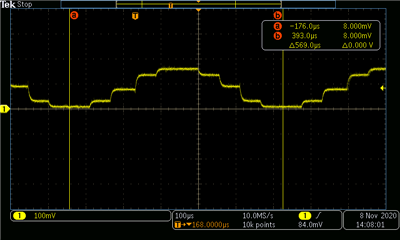
The achieved period is of 569us, which gives a 1.757kHz frequency.
I saw in other tickets people saying that GPIO frequency can go up to 16Mhz. Then, why can't I generate a high-frequency signal?
