This post is older than 2 years and might not be relevant anymore
More Info: Consider searching for newer posts

How to configure nRF82540 for using multiple BLE packages in one connection interval?

Hi,

I try to achieve high throughput via BLE connection between two nRF82540dk boards. I would like to maximize duty cycle of transmission in the connection interval.
Unfortunately I observe only one or two BLE packets in each interval.
How can I configure SoftDevice to transmit more packets in one interval?

I use slighly modified ble_app_uart_c_pca10056_s140 and ble_app_uart_pca10056_s140 as starting point examples for the serial connection.
A stream of 244 bytes packets is sent from peripheral to the central device. 

Other options:
1) BLE PHY 2Mbps,
2) Connection interval = 7.5ms
3) NRF_SDH_BLE_GAP_EVENT_LENGTH = 6

Kind regards,

Piotr Romaniuk

Parents
  • Hello,

    I try to achieve high throughput via BLE connection between two nRF82540dk boards.

    Have you seen the throughput test results in the SoftDevice documentation? It details which parameters was used during the tests, to reach the different throughput speeds.

    I would like to maximize duty cycle of transmission in the connection interval.
    3) NRF_SDH_BLE_GAP_EVENT_LENGTH = 6

    Please change your event length to allow for more notifications being sent every connection event.
    Since you are only holding a single connection, you can use the entire 'duty-cycle' of the connection interval for this connection.
    You thus may set your event length to 500 (or any other high number), to allow for the event to span the entire interval, if needed.
    Could you also confirm for me that connection event length extension is configured in your project?
    It is default in all newer SDK versions, but I do not know which version you are working with. You might find this answer by my colleague helpful, for an explanation of the parameter.
    You may also find the online power-profiler useful to have a look at, to visualize how the different connection settings will affect your radio usage.

    Please try this, and let me know if you achieve the sought-after radio usage.

    Best regards,
    Karl

  • Hi Karl,

    Yes, I saw the documentation, it reports 1.4Mbps, I have only 250kbps. 

    Please change your event length to allow for more notifications being sent every connection event.
    Since you are only holding a single connection, you can use the entire 'duty-cycle' of the connection interval for this connection

    In my configuration Connection Interval is set 7.5ms, and NRF_SDH_BLE_GAP_EVENT_LENGTH = 6 (i.e. 6x1.25ms = 7.5ms) hence I assigned whole interval for communication. The chip should transmit with almost 100% duty cycle, but it doesn't.

    As you saw on the oscillogram above setting of the event length is not effective. The SoftDevice transmits mostly one packet in the cycle.

    What I am doing wrong?

    Kind regards,
    Piotr Romaniuk

    PS
    I am using SDK 17.0.2 (nRF5_SDK_17.0.2_d674dde)

  • Hello Piotr,

    Piotr Romaniuk said:
    Are the numbers that you asked for?

    Yes, the numbers on the Nordic chip - QIAAD0 - is the build number, and tells us that these are Revision 2 chips, great!

    Piotr Romaniuk said:
    According to Softdevice version I only know that I use S140 from SDK 17.0.2. I don't know how to check more. Maybe I missunderstood version numbering [?]

    Thank you for clarifying.
    The SoftDevice is located at nRF5_SDK_17.0.2_d674dde\components\softdevice\s140\hex in the SDK, and the name will contain its version. If you have not made any changes to this, SDK 17.0.2 ships with S140 v7.2.0 by default.

    Piotr Romaniuk said:
    I thought that Softdevice is programmed together with my program as precompiled binary module. Is it true?

    This is correct, the SoftDevice is supplied as a precompiled hex file, which is programmed together with the application when the preprocessor defines S140 and SoftDevice_present is set. 

    Piotr Romaniuk said:
    I assumed that by selecting folder pca10056 and its subfolder S140 for Segger Embedded Studio project I have selected what chip version and Softdevice version I use. I also assumed that S140 will support all the chips.
    I am I wrong?

    No, you are not wrong - the SDK only contains compatible SoftDevice versions.
    The reason why I asked for SoftDevice version is because customers sometimes use older versions of them without ensuring that the SoftDevice version they are using is compatible with the SDK version they are using. This could have been the reason for the RAM adjustment warnings you are getting. It sounds to me like this is not the case here, however. My apologies if this seemed like a unnecessary detour from the issue, I just wanted to rule out compatibility issues being the cause.

    Did you try to do the RAM adjustments as detailed in the warning, by the way? Did this resolve the NRF_ERROR_NO_MEM error you were getting?

    Best regards,
    Karl

  • Hi Karl,

    I did not try yet RAM adjustment.
    Can you send me exact expression that I should write into linker window options?
    I browsed source code including linker script and I am really confused.

    I very concerned that the same problem (i.e. with memory) exists in Nordic original example (ble_uart project) without any modification. I plan to open new case for that, because it is basic code and is not influenced by any my changes.

    I am very worried that I stuck in some basic issue, that further coding depends on. We are sending one message per day.
    I am sending you private messages in chat window. I am not sure if you receive them?
    Maybe chat will be faster to determine the cause of the problem.

    Kind regards,
    Piotr Romaniuk

  • Hello Piotr,

    Piotr Romaniuk said:
    I did not try yet RAM adjustment.
    Can you send me exact expression that I should write into linker window options?
    I browsed source code including linker script and I am really confused.

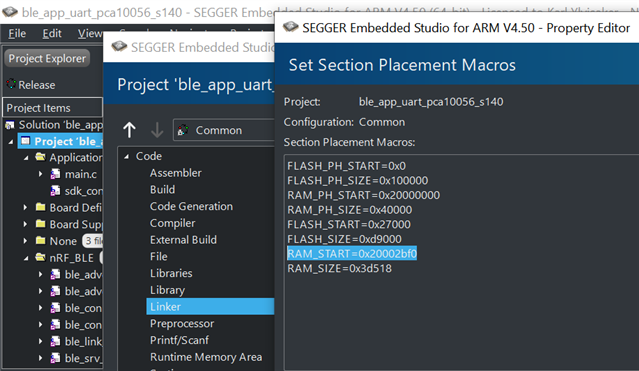
    I have attached an image that shows how it should look for you, after you have made the RAM start changes. The exact expression is the same as written in the warning in your log, and the location can be found by right clicking on the 'Project' in SES project explorer, selecting 'options', selecting 'Common' configuration, opening the 'Linker' tab, and double clicking on the 'Section Placement Macros'. Make sure to click OK to close all windows, once you have made the changes.
    Please do this, and let me know if it resolves your error. 

    Piotr Romaniuk said:
    I very concerned that the same problem (i.e. with memory) exists in Nordic original example (ble_uart project) without any modification. I plan to open new case for that, because it is basic code and is not influenced by any my changes.

    I have tested this on a mint SDK, and I am not seeing this issue.
    Are you certain that you have tested this on an example which you have made no changes to?
    The SoftDevice's memory footprint may change if you change its configuration, and this may be the reason why you have to update the RAM_START macro.
    Could you download a mint version of the SDK 17.0.2, and see if you get this error there as well? If the issue persists, you should open a new ticket for this, yes.

    Piotr Romaniuk said:
    I am very worried that I stuck in some basic issue, that further coding depends on. We are sending one message per day.

    This is indeed a seemingly basic issue, but I hope and think this error will be resolved when you change the RAM_START macro.

    Piotr Romaniuk said:
    I am sending you private messages in chat window. I am not sure if you receive them?
    Maybe chat will be faster to determine the cause of the problem.

    It is best to keep all related information in the ticket, so it may be of use to other's experiencing the same, or a similar issue, later, and to easily look up earlier information regarding the issue. The chat feature is not quicker than the tickets, unfortunately.

    I look forward to hearing the effects of the RAM_START macro change, on your issue.

    Best regards,
    Karl

  • Hi Karl,

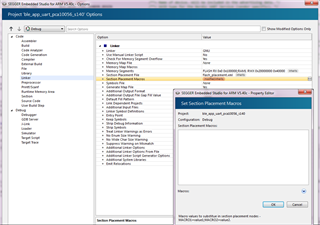
    I was confused with linker macro window because it was inherited in my IDE:

    Where the linker options are inherited from?

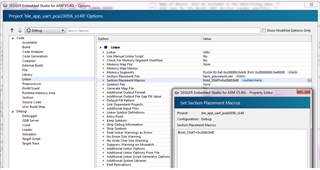
    Your suggestion to setup RAM_START solve the problem:

    I was able then to increase the event length.

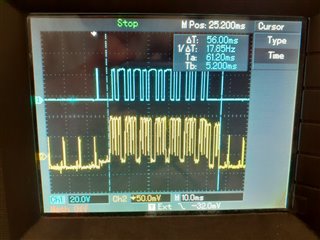
    Above oscillogram is for ConnInterval=7.5ms Edges on top (blue) signal are moments of passing packets to BLE stack.

    If I increase ConnInterval (e.g. 10ms, 50ms) still no more than 4 packets are transmitted in one chunk.

    What is the reason for that? Looks like some queue is filled up or temporary missing resources (dynamic memory).

    Kind regards

    Piotr Romaniuk

    PS
    Please do not mark this case as solved yet. Above question is still opened.

  • Hello again Piotr,

    Piotr Romaniuk said:
    Please do not mark this case as solved yet. Above question is still opened.

    Do not worry, it is you yourself that needs to mark an answer as the solution to your problem.
    I would not not close the case until the issue(s) are resolved, and for future reference you also always have the option to re-open tickets that have been closed.
    I am literally here to help, and I am happy to do so.

    Piotr Romaniuk said:
    Your suggestion to setup RAM_START solve the problem:

    I am happy to hear that this resolved your issue, Piotr!

    Piotr Romaniuk said:
    I was confused with linker macro window because it was inherited in my IDE:
    Piotr Romaniuk said:
    Where the linker options are inherited from?

    Piotr, I think a lot of this confusion could have been avoided if you had read the steps I wrote out more carefully. I specifically mentioned the 'common' configuration twice, and it is also visible in the screenshot I sent you.
    The 'debug' build configuration (which you are editing in your screenshots) inherits from the 'common' build configuration that I have asked you to modify. The common build configuration is the core of the project, which all other configurations inherits from. The reason why you must make the change in the common configuration, is because currently only your debug configuration will work (because it is the only one with the proper RAM_START macro).
    So, once you switch to the 'release' configuration, your project will break again.

    Please see the steps I wrote out earlier, or the screenshot I attached. In the upper left corner of the options window there is a drop down menu, which in your pictures says 'debug'. Click this, and change to common, and make the RAM_START changes there.

    Piotr Romaniuk said:
    I was able then to increase the event length.

    This is great! Glad to see that it produced the desired and expected results.

    Piotr Romaniuk said:
    Above oscillogram is for ConnInterval=7.5ms Edges on top (blue) signal are moments of passing packets to BLE stack.

    By this, do you mean that the blue channel indicates calls to 'ble_nus_data_send', for queueing of data to be transferred?
    If so, what does the length of the toggle indicate?

    Piotr Romaniuk said:

    If I increase ConnInterval (e.g. 10ms, 50ms) still no more than 4 packets are transmitted in one chunk.

    What is the reason for that? Looks like some queue is filled up or temporary missing resources (dynamic memory).

    What MTU size are you using for your transfers, when changing to 10 or 50 ms connection intervals?
    Is the call to ble_nus_data_send (which in turn calls sd_ble_gatts_hvx) returning any errors, such as NRF_ERROR_RESOURCES, when you try to queue your data for transfer?
    How have you ensured that there is enough data queued for transer to fill the entire connection interval of 50 ms?
    Please elaborate what you are referring to when you say '(dynamic memory)'.
    Are you using dynamic memory allocation in your application, and asking if this may interfere with the SoftDevice's data queueing process?

    Looking forward to resolving these issues together!

    Best regards,
    Karl


Reply
  • Hello again Piotr,

    Piotr Romaniuk said:
    Please do not mark this case as solved yet. Above question is still opened.

    Do not worry, it is you yourself that needs to mark an answer as the solution to your problem.
    I would not not close the case until the issue(s) are resolved, and for future reference you also always have the option to re-open tickets that have been closed.
    I am literally here to help, and I am happy to do so.

    Piotr Romaniuk said:
    Your suggestion to setup RAM_START solve the problem:

    I am happy to hear that this resolved your issue, Piotr!

    Piotr Romaniuk said:
    I was confused with linker macro window because it was inherited in my IDE:
    Piotr Romaniuk said:
    Where the linker options are inherited from?

    Piotr, I think a lot of this confusion could have been avoided if you had read the steps I wrote out more carefully. I specifically mentioned the 'common' configuration twice, and it is also visible in the screenshot I sent you.
    The 'debug' build configuration (which you are editing in your screenshots) inherits from the 'common' build configuration that I have asked you to modify. The common build configuration is the core of the project, which all other configurations inherits from. The reason why you must make the change in the common configuration, is because currently only your debug configuration will work (because it is the only one with the proper RAM_START macro).
    So, once you switch to the 'release' configuration, your project will break again.

    Please see the steps I wrote out earlier, or the screenshot I attached. In the upper left corner of the options window there is a drop down menu, which in your pictures says 'debug'. Click this, and change to common, and make the RAM_START changes there.

    Piotr Romaniuk said:
    I was able then to increase the event length.

    This is great! Glad to see that it produced the desired and expected results.

    Piotr Romaniuk said:
    Above oscillogram is for ConnInterval=7.5ms Edges on top (blue) signal are moments of passing packets to BLE stack.

    By this, do you mean that the blue channel indicates calls to 'ble_nus_data_send', for queueing of data to be transferred?
    If so, what does the length of the toggle indicate?

    Piotr Romaniuk said:

    If I increase ConnInterval (e.g. 10ms, 50ms) still no more than 4 packets are transmitted in one chunk.

    What is the reason for that? Looks like some queue is filled up or temporary missing resources (dynamic memory).

    What MTU size are you using for your transfers, when changing to 10 or 50 ms connection intervals?
    Is the call to ble_nus_data_send (which in turn calls sd_ble_gatts_hvx) returning any errors, such as NRF_ERROR_RESOURCES, when you try to queue your data for transfer?
    How have you ensured that there is enough data queued for transer to fill the entire connection interval of 50 ms?
    Please elaborate what you are referring to when you say '(dynamic memory)'.
    Are you using dynamic memory allocation in your application, and asking if this may interfere with the SoftDevice's data queueing process?

    Looking forward to resolving these issues together!

    Best regards,
    Karl


Children
  • Hi Karl,

    Piotr, I think a lot of this confusion could have been avoided if you had read the steps I wrote out more carefully. I specifically mentioned the 'common' configuration twice, and it is also visible in the screenshot I sent you.

    I am sorry, I overlooked that. Thank you for the explanation.

    By this, do you mean that the blue channel indicates calls to 'ble_nus_data_send', for queueing of data to be transferred?

    Yes. It is toggled every time when ble_nus_data_send() returns something else than NRF_ERROR_RESOURSES, see below:

        for(i = 0; i < 30; i++){
            data_array[1] = '@'+i;
            do
            {
                uint16_t length = (uint16_t)index+1;
                err_code = ble_nus_data_send(&m_nus, data_array, &length, m_conn_handle);
                
                
            } while (err_code == NRF_ERROR_RESOURCES);
            nrf_gpio_pin_toggle( pin_dbg2 );
        }

    The length of the signal levels between edges corresponds to periods when above code is not active or is spinning in while - means waiting for the BLE stack untill it accepts a packet for transfer. Looking to oscilogram, one can see that it is synchronized with transmission, hence my conclussion about some queue capacity inside the stack. Also returning code NRF_ERROR_RESOURCES suggests that some resources are not available.

    What MTU size are you using for your transfers, when changing to 10 or 50 ms connection intervals?

    I did not change MTU for 10 or 50ms connection interval, it is: 

       NRF_SDH_BLE_GATT_MAX_MTU_SIZE = 247

    Is the call to ble_nus_data_send (which in turn calls sd_ble_gatts_hvx) returning any errors, such as NRF_ERROR_RESOURCES, when you try to queue your data for transfer?

    Yes, I followed calling path. From my code I conclude that NRF_ERROR_RESOURCES is returned.

    How have you ensured that there is enough data queued for transer to fill the entire connection interval of 50 ms?

    I cannot queue more, because of returned above error. I am trying continuously add more - see while loop.

    Please elaborate what you are referring to when you say '(dynamic memory)'.
    Are you using dynamic memory allocation in your application, and asking if this may interfere with the SoftDevice's data queueing process?

    I just was trying to explain why there is problem with resources in BLE stack. I am not using dynamic memory in my software. I tried to increase heap size and increase RAM_START, but it did not help.

    Mayby there is some limited size of queue on central device site?

    Kind regards,
    Piotr Romaniuk

    PS
    What is  general architecture of BLE stack? Does it use some threads, or is only interrupt driven?
    I am asking just to understand how main processor is loaded with BLE stack operation.
    I am aware of general mechanism: SVC calls and designated interrupt for event signaling from the stack.

  • Hello Piotr,

    Piotr Romaniuk said:
    I am sorry, I overlooked that. Thank you for the explanation.

    No need to apologies, it is no problem at all - I am happy to help! :)

    Piotr Romaniuk said:
    Yes. It is toggled every time when ble_nus_data_send() returns something else than NRF_ERROR_RESOURSES, see below:
    Piotr Romaniuk said:
    The length of the signal levels between edges corresponds to periods when above code is not active or is spinning in while - means waiting for the BLE stack untill it accepts a packet for transfer. Looking to oscilogram, one can see that it is synchronized with transmission, hence my conclussion about some queue capacity inside the stack. Also returning code NRF_ERROR_RESOURCES suggests that some resources are not available.

    Ah, yes, I remember this now. Thank you for clarifying, this is very helpful information.
    Looking at the oscilloscope picture you sent earlier, it then seems to me that the radio is in fact being used for the entire connection interval length - given that the picture was taken while using a 7.5 ms connection interval.
    Regarding that only 4 packets seem to be sent per 50 ms interval, this is then the problem we are currently looking into?
    It is hard to say exactly what is going on from the oscilloscope screenshot as opposed to a sniffer trace, but it is up to the central to dictate how many packets actually will be sent each event, since the central has to prompt each and every one of the packets.

    The returned NRF_ERROR_RESOURCES from sd_ble_gatts_hvx just means that the queue is filled up with data queued for transfer, so this is alright in your case.

    Could you take another oscilloscope screenshot of the test you are conducting, taken from the central side, using 50 ms connection interval? 
    It would be interesting to see whether the central stops prompting for more packets.
    How many transfers of how many bytes is successful each interval?
    These are all things that would be easy to see in a sniffer trace, but we will try to make due with the oscilloscope pictures to understand what is happening.

    In case the the oscilloscope screenshots prove futile for debugging this issue, you could download the nRF Connect application for Smartphones on your phone, and use that as a central connected to your peripheral device. This way, you should be able to use the freed up device as the sniffer, and produce a sniffer trace of their communication.

    Piotr Romaniuk said:

    I just was trying to explain why there is problem with resources in BLE stack. I am not using dynamic memory in my software. I tried to increase heap size and increase RAM_START, but it did not help.

    Mayby there is some limited size of queue on central device site?

    I see - I just had to make sure what you were referring to. Increasing RAM_START and heap_size does not change this, no.
    What is your hvn_tx_queue_size on your peripheral side of the link?

    Best regards,
    Karl

  • Hi Karl,

    Sorry for delay in my response but I had to switch to another project.

    Looking at the oscilloscope picture you sent earlier, it then seems to me that the radio is in fact being used for the entire connection interval length - given that the picture was taken while using a 7.5 ms connection interval.

    Yes, it is much better, but you can observe a gap every 4 packets. 
    I suspected that more cannot fit into such a small connection interval, so I tried to increase that parameter.
    Unfortunatelly, still and only 4 packets were transmitted every one cycle.

    It looks like there is another limitation.

    Could you take another oscilloscope screenshot of the test you are conducting, taken from the central side, using 50 ms connection interval? 

    There will be 4 packets at the begining of the cycle, then long gap to next cycle. Each packet is 244 bytes long on data payload.

    you could download the nRF Connect application for Smartphones on your phone, and use that as a central connected to your peripheral device. This way, you should be able to use the freed up device as the sniffer, and produce a sniffer trace of their communication.

    Thank you for this suggestion it is good idea.

    What is your hvn_tx_queue_size on your peripheral side of the link?

    Should I read this parameter or it should be set?
    I browsed the code, I cannot find reference to that in the code, I probably don't set it. I only call nrf_sdh_ble_default_cfg_set() that is in nrf_sdh_ble.c (in ble_uart example) but it doesn't set it.

    Kind regards,
    Piotr Romaniuk

  • Hello Piotr,

    Piotr Romaniuk said:
    Sorry for delay in my response but I had to switch to another project.

    No problem at all, I completely understand. Do not worry about any delays - we'll continue with the debugging whenever you are ready.

    Piotr Romaniuk said:

    I suspected that more cannot fit into such a small connection interval, so I tried to increase that parameter.
    Unfortunatelly, still and only 4 packets were transmitted every one cycle.

    It looks like there is another limitation.

    Piotr Romaniuk said:
    There will be 4 packets at the begining of the cycle, then long gap to next cycle. Each packet is 244 bytes long on data payload.

    Yes, this is where a sniffer trace would be tremendously helpful. With a sniffer trace of the communication we could immediately rule out some issues and potential sources of errors - such as the central not prompting for more packets, etc.  

    Piotr Romaniuk said:
    Thank you for this suggestion it is good idea.

    I am glad it could be helpful. I look forward to taking a look at the sniffer trace you produce of the on-air communication. It will be very helpful to have a look at.

    Piotr Romaniuk said:
    Should I read this parameter or it should be set?

    You can set this parameter yourself to change the notification TX buffer, so that you are able to queue more data for transfer (more successful calls to sd_ble_gatts_hvx before NRF_ERROR_RESOURCES is returned) before each connection event.

    If you do not set it yourself, it will use the default value of 1. The variable determines 'the minimum guaranteed number of notifications that can be queued for transmission'.
    Try to increase this to 10, for example.

    Best regards,
    Karl

Related