This post is older than 2 years and might not be relevant anymore
More Info: Consider searching for newer posts

I2C gets stuck with -EBUSY if i2c_* function calls timeout on zephyr (NCS) for nRF52840

To reproduce this problemm Ive added a device to the I2C that does not respond to a read command.

The `i2c_read` call first returns `-EOI` (-5) and for every other i2c funcion calls it will return `-EBUSY` (-16).

Apparently it locks the i2c subsystem, a `sys_reboot` makes the i2c BUS available again.

I wonder if this is a known issue, and if there is a way of recovering the i2c subsystem? `i2c_recover_bus` is useless for this effect.


a similar issues were posted here:

https://devzone.nordicsemi.com/f/nordic-q-a/70481/what-means-errno--16-for-nrf52832/289628 
- https://devzone.nordicsemi.com/f/nordic-q-a/66928/zephyr-i2c-locked-into-ebusy

Parents
  • Hi,

    Do you have a logic analyzer trace? Typically if you get a busy you should retry, so I am wondering does it fail when retrying? Is there any difference depending on the delay between calling i2c_read()?

    Do you have the exact error codes from nrfx_twim_xfer() as asked for here:
    https://devzone.nordicsemi.com/f/nordic-q-a/70481/what-means-errno--16-for-nrf52832/289628#289628

    Do you see the same if no device is connected to the i2c bus? 

    Kenneth

  • This issue gets the bus stuck after the first failure.
    I can confirm that if I remove the device from the bus physically (no devices connected to the bus), it still returns me -EBUSY for any i2c_* call.
    Im not sure the logic analyser is of any help since I know that what triggers it is the target device not responding (timeout) for this case in particular and it persists after I disconnect the device from the BUS (no other device is connected), and the only way I could see to get the bus back to a usable state is to call a sys_reboot, because it gets stuck at -EBUSY indefinitely.

    I verified myself that:
    - The first -EOI error comes from here https://github.com/nrfconnect/sdk-zephyr/blob/d5fe6f2e7f5ba28c9637297368ab1d3ecce7183c/drivers/i2c/i2c_nrfx_twim.c#L145
    - All the following -EBUSY errors come from here: github.com/.../i2c_nrfx_twim.c


  • The following is what happens after I:

    // write 0x1 to 0x5
    i2c_write(0x1, 0x5) ---> returns 0

    // read one byte from 0x5
    i2c_read(1, 0x5) ---> returns -5 from the line previously mentioned


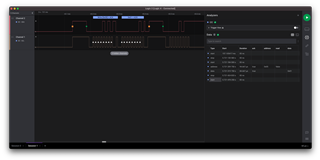
    We can see here that the line doesnt change anymore after the start of the i2c_read


    Then all the calls to i2c_* get a -16 response, no change to the i2c line in the analyser as well...

  • If I understand it correctly you have tried both twim and twi. Are you able to try slightly older versions of ncs for test (e.g. 1.4.0, and possible also even 1.3)?

    Kenneth

  • I can confirm that the behaviour is the same for v1.4.0.

    For v1.3.0, it hangs forever on read. I guess this is due to some change/addition of a timeout code?

    The following is a short code to test (considering you have a device on the other end that doesn't write back):


    uint8_t r_buff;
    uint8_t w_buff = 0x02;
    
    const struct device *i2c1_dev;
    i2c1_dev = device_get_binding("I2C_1");
    
    while (true)
    {
    	r_buff = 0;
    	// Write something to device at 0x05
    	ret = i2c_write(i2c1_dev, &w_buff, 1, 0x05);
    	if(ret != 0) {
    		printk("error write: %d\n", ret);
    	}
    
    	// Read byte from device at 0x05, this is where it is problematic
    	// if the device doesnt write back
    	ret = i2c_read(i2c1_dev, &r_buff, 1, 0x05);
    	if(ret != 0) {
    		printk("error read: %d\n", ret);
    	}
    	printk("r_buff: %u\n", r_buff);
    	k_msleep(2000);
    }


    So far I've noticed that the bus gets stuck forever if:

    • i2c_read times out
    • i2c SDA and SCL are shorted for a short amount of time

    My main problem is not being able to recover the bus, If I was able to do that in runtime without resetting I could have that workaround. Is there any way I can do this in the meanwhile?

  • I assume you can try to do some low level calls, like:

    NRF_TWI1->ENABLE = TWI_ENABLE_ENABLE_Disabled << TWI_ENABLE_ENABLE_Pos;
    NRF_TWI1->ENABLE = TWI_ENABLE_ENABLE_Enabled << TWI_ENABLE_ENABLE_Pos;

    Assuming you are using TWI1.

    You can even add a power cycle of the TWI1 peripheral by adding the following between the two lines above:

    NRF_TWI1->ENABLE = TWI_ENABLE_ENABLE_Disabled << TWI_ENABLE_ENABLE_Pos;
    *(volatile uint32_t *)0x40004FFC = 0;
    *(volatile uint32_t *)0x40004FFC;
    *(volatile uint32_t *)0x40004FFC = 1;
    NRF_TWI1->ENABLE = TWI_ENABLE_ENABLE_Enabled << TWI_ENABLE_ENABLE_Pos;

    I can't see how this should not reset TWI1 instance and release the pins.

    If you are using TWI0 you should use address 0x40003FFC instead.

    But I am not sure how the zephyr driver will like that.

    Kenneth

  • Just tried that after I receiving a -EBUSY error, no difference from the i2c api perspective afterwards...

    It will apparently returns -EBUSY because the driver gets stuck with NRFX_ERROR_BUSY from the 

    nrfx_twi_xfer call from the line I previously mentioned.


    How will Nordic proceed with this issue? Will this be filled in as a bug?
Reply Children
Related