

Hi everyone, I'm an intermediate level nRF Connect SDK IDE programmer, and I describe my issue below:
1.- In the link below I found an example of code for the analog port with the nRF5340DK board:
https://devzone.nordicsemi.com/nordic/nrf-connect-sdk-guides/b/getting-started/posts/nrf-connect-sdk-tutorial---part-2-ncs-v1-4-0#h185sjwm5882m1bcimiad82dnf4kcy0b
2.- I removed the PWM code that I'm not interested in, and the main.c file is shown below:
#include <zephyr.h>
#include <sys/printk.h>

#if defined(CONFIG_BOARD_NRF5340DK_NRF5340_CPUAPP) || defined(CONFIG_BOARD_NRF5340DK_NRF5340_CPUAPPNS) || defined(CONFIG_BOARD_NRF9160DK_NRF9160NS) || defined(CONFIG_BOARD_NRF9160DK_NRF9160)

/*ADC definitions and includes*/
#include <hal/nrf_saadc.h>
#define ADC_DEVICE_NAME DT_LABEL(DT_INST(0, nordic_nrf_saadc))
#define ADC_RESOLUTION 10
#define ADC_GAIN ADC_GAIN_1_6
#define ADC_REFERENCE ADC_REF_INTERNAL
#define ADC_ACQUISITION_TIME ADC_ACQ_TIME(ADC_ACQ_TIME_MICROSECONDS, 10)
#define ADC_1ST_CHANNEL_ID 0
#define ADC_1ST_CHANNEL_INPUT NRF_SAADC_INPUT_AIN0

#else
#error "Choose supported board or add new board for the application"
#endif

#include <device.h>
#include <drivers/gpio.h>
#include <drivers/adc.h>
#include <string.h>

//#define PWM_MAX 253
#define TIMER_INTERVAL_MSEC 200
#define BUFFER_SIZE 1

struct k_timer my_timer;
const struct device *adc_dev;

static const struct adc_channel_cfg m_1st_channel_cfg = {
.gain = ADC_GAIN,
.reference = ADC_REFERENCE,
.acquisition_time = ADC_ACQUISITION_TIME,
.channel_id = ADC_1ST_CHANNEL_ID,
#if defined(CONFIG_ADC_CONFIGURABLE_INPUTS)
.input_positive = ADC_1ST_CHANNEL_INPUT,
#endif
};

static int16_t m_sample_buffer[BUFFER_SIZE];

static int adc_sample(void)
{
int ret;

const struct adc_sequence sequence = {
.channels = BIT(ADC_1ST_CHANNEL_ID),
.buffer = m_sample_buffer,
.buffer_size = sizeof(m_sample_buffer),
.resolution = ADC_RESOLUTION,
};

if (!adc_dev) {
return -1;
}

ret = adc_read(adc_dev, &sequence);
if (ret) {
printk("adc_read() failed with code %d\n", ret);
}

for (int i = 0; i < BUFFER_SIZE; i++) {
printk("ADC raw value: %d\n", m_sample_buffer[i]);
}

return ret;
}

void adc_sample_event(struct k_timer *timer_id){
int err = adc_sample();
if (err) {
printk("Error in adc sampling: %d\n", err);
}
}

void main(void)
{
int err;


//Timer setup
k_timer_init(&my_timer, adc_sample_event, NULL);
k_timer_start(&my_timer, K_MSEC(TIMER_INTERVAL_MSEC), K_MSEC(TIMER_INTERVAL_MSEC));


//ADC0 setup
adc_dev = device_get_binding(ADC_DEVICE_NAME);
if (!adc_dev) {
printk("device_get_binding ADC_0 (=%s) failed\n", ADC_DEVICE_NAME);
}

err = adc_channel_setup(adc_dev, &m_1st_channel_cfg);
if (err) {
printk("Error in adc setup: %d\n", err);
}

#if defined(CONFIG_BOARD_NRF9160DK_NRF9160NS) || defined(CONFIG_BOARD_NRF5340DK_NRF5340_CPUAPPNS)
NRF_SAADC_NS->TASKS_CALIBRATEOFFSET = 1;
#elif defined(CONFIG_BOARD_NRF9160DK_NRF9160) || defined(CONFIG_BOARD_NRF5340DK_NRF5340_CPUAPP)
NRF_SAADC->TASKS_CALIBRATEOFFSET = 1;
#else
#error "Choose supported board or add new board for the application"
#endif
}
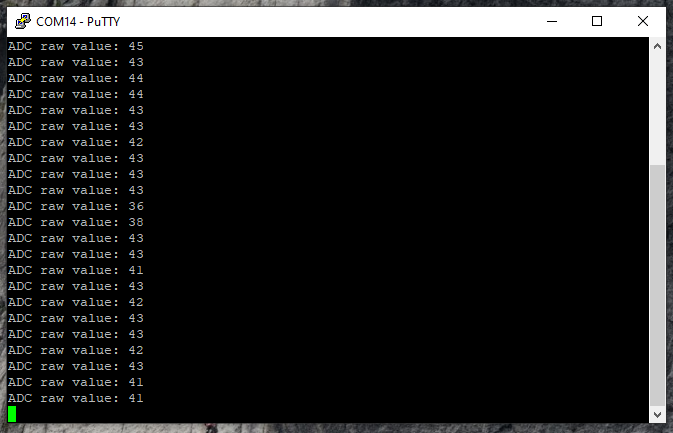
3. The code works fine as shown in the image below:
4. I want to use the "peripheral_uart" example to print the data from the analog port in the serial output, and finally see the data in the Android app "nRF Connect". The example code is found in: ... \ ncs \ v1.5.0 \ nrf \ samples \ bluetooth \ peripheral_uart
and the main.c code is shown below:
/*
 * Copyright (c) 2018 Nordic Semiconductor ASA
 *
 * SPDX-License-Identifier: LicenseRef-Nordic-5-Clause
 */

/** @file
 *  @brief Nordic UART Bridge Service (NUS) sample
 */

#include <zephyr/types.h>
#include <zephyr.h>
#include <drivers/uart.h>

#include <device.h>
#include <soc.h>

#include <bluetooth/bluetooth.h>
#include <bluetooth/uuid.h>
#include <bluetooth/gatt.h>
#include <bluetooth/hci.h>

#include <bluetooth/services/nus.h>

#include <dk_buttons_and_leds.h>

#include <settings/settings.h>

#include <stdio.h>

#include <logging/log.h>

#define LOG_MODULE_NAME peripheral_uart
LOG_MODULE_REGISTER(LOG_MODULE_NAME);

#define STACKSIZE CONFIG_BT_NUS_THREAD_STACK_SIZE
#define PRIORITY 7

#define DEVICE_NAME CONFIG_BT_DEVICE_NAME
#define DEVICE_NAME_LEN	(sizeof(DEVICE_NAME) - 1)

#define RUN_STATUS_LED DK_LED1
#define RUN_LED_BLINK_INTERVAL 1000

#define CON_STATUS_LED DK_LED2

#define KEY_PASSKEY_ACCEPT DK_BTN1_MSK
#define KEY_PASSKEY_REJECT DK_BTN2_MSK

#define UART_BUF_SIZE CONFIG_BT_NUS_UART_BUFFER_SIZE
#define UART_WAIT_FOR_BUF_DELAY K_MSEC(50)
#define UART_WAIT_FOR_RX CONFIG_BT_NUS_UART_RX_WAIT_TIME

static K_SEM_DEFINE(ble_init_ok, 0, 1);

static struct bt_conn *current_conn;
static struct bt_conn *auth_conn;

static const struct device *uart;
static struct k_work_delayable uart_work;

struct uart_data_t {
	void *fifo_reserved;
	uint8_t data[UART_BUF_SIZE];
	uint16_t len;
};

static K_FIFO_DEFINE(fifo_uart_tx_data);
static K_FIFO_DEFINE(fifo_uart_rx_data);

static const struct bt_data ad[] = {
	BT_DATA_BYTES(BT_DATA_FLAGS, (BT_LE_AD_GENERAL | BT_LE_AD_NO_BREDR)),
	BT_DATA(BT_DATA_NAME_COMPLETE, DEVICE_NAME, DEVICE_NAME_LEN),
};

static const struct bt_data sd[] = {
	BT_DATA_BYTES(BT_DATA_UUID128_ALL, BT_UUID_NUS_VAL),
};

static void uart_cb(const struct device *dev, struct uart_event *evt, void *user_data)
{
	ARG_UNUSED(dev);

	static uint8_t *current_buf;
	static size_t aborted_len;
	static bool buf_release;
	struct uart_data_t *buf;
	static uint8_t *aborted_buf;

	switch (evt->type) {
	case UART_TX_DONE:
		if ((evt->data.tx.len == 0) ||
		    (!evt->data.tx.buf)) {
			return;
		}

		if (aborted_buf) {
			buf = CONTAINER_OF(aborted_buf, struct uart_data_t,
					   data);
			aborted_buf = NULL;
			aborted_len = 0;
		} else {
			buf = CONTAINER_OF(evt->data.tx.buf, struct uart_data_t,
					   data);
		}

		k_free(buf);

		buf = k_fifo_get(&fifo_uart_tx_data, K_NO_WAIT);
		if (!buf) {
			return;
		}

		if (uart_tx(uart, buf->data, buf->len, SYS_FOREVER_MS)) {
			LOG_WRN("Failed to send data over UART");
		}

		break;

	case UART_RX_RDY:
		buf = CONTAINER_OF(evt->data.rx.buf, struct uart_data_t, data);
		buf->len += evt->data.rx.len;
		buf_release = false;

		if (buf->len == UART_BUF_SIZE) {
			k_fifo_put(&fifo_uart_rx_data, buf);
		} else if ((evt->data.rx.buf[buf->len - 1] == '\n') ||
			  (evt->data.rx.buf[buf->len - 1] == '\r')) {
			k_fifo_put(&fifo_uart_rx_data, buf);
			current_buf = evt->data.rx.buf;
			buf_release = true;
			uart_rx_disable(uart);
		}

		break;

	case UART_RX_DISABLED:
		buf = k_malloc(sizeof(*buf));
		if (buf) {
			buf->len = 0;
		} else {
			LOG_WRN("Not able to allocate UART receive buffer");
			k_work_reschedule(&uart_work, UART_WAIT_FOR_BUF_DELAY);
			return;
		}

		uart_rx_enable(uart, buf->data, sizeof(buf->data),
			       UART_WAIT_FOR_RX);

		break;

	case UART_RX_BUF_REQUEST:
		buf = k_malloc(sizeof(*buf));
		if (buf) {
			buf->len = 0;
			uart_rx_buf_rsp(uart, buf->data, sizeof(buf->data));
		} else {
			LOG_WRN("Not able to allocate UART receive buffer");
		}

		break;

	case UART_RX_BUF_RELEASED:
		buf = CONTAINER_OF(evt->data.rx_buf.buf, struct uart_data_t,
				   data);
		if (buf_release && (current_buf != evt->data.rx_buf.buf)) {
			k_free(buf);
			buf_release = false;
			current_buf = NULL;
		}

		break;

	case UART_TX_ABORTED:
			if (!aborted_buf) {
				aborted_buf = (uint8_t *)evt->data.tx.buf;
			}

			aborted_len += evt->data.tx.len;
			buf = CONTAINER_OF(aborted_buf, struct uart_data_t,
					   data);

			uart_tx(uart, &buf->data[aborted_len],
				buf->len - aborted_len, SYS_FOREVER_MS);

		break;

	default:
		break;
	}
}

static void uart_work_handler(struct k_work *item)
{
	struct uart_data_t *buf;

	buf = k_malloc(sizeof(*buf));
	if (buf) {
		buf->len = 0;
	} else {
		LOG_WRN("Not able to allocate UART receive buffer");
		k_work_reschedule(&uart_work, UART_WAIT_FOR_BUF_DELAY);
		return;
	}

	uart_rx_enable(uart, buf->data, sizeof(buf->data), UART_WAIT_FOR_RX);
}

static int uart_init(void)
{
	int err;
	struct uart_data_t *rx;

	uart = device_get_binding(DT_LABEL(DT_NODELABEL(uart0)));
	if (!uart) {
		return -ENXIO;
	}

	rx = k_malloc(sizeof(*rx));
	if (rx) {
		rx->len = 0;
	} else {
		return -ENOMEM;
	}

	k_work_init_delayable(&uart_work, uart_work_handler);

	err = uart_callback_set(uart, uart_cb, NULL);
	if (err) {
		return err;
	}

	return uart_rx_enable(uart, rx->data, sizeof(rx->data), 50);
}

static void connected(struct bt_conn *conn, uint8_t err)
{
	char addr[BT_ADDR_LE_STR_LEN];

	if (err) {
		LOG_ERR("Connection failed (err %u)", err);
		return;
	}

	bt_addr_le_to_str(bt_conn_get_dst(conn), addr, sizeof(addr));
	LOG_INF("Connected %s", log_strdup(addr));

	current_conn = bt_conn_ref(conn);

	dk_set_led_on(CON_STATUS_LED);
}

static void disconnected(struct bt_conn *conn, uint8_t reason)
{
	char addr[BT_ADDR_LE_STR_LEN];

	bt_addr_le_to_str(bt_conn_get_dst(conn), addr, sizeof(addr));

	LOG_INF("Disconnected: %s (reason %u)", log_strdup(addr), reason);

	if (auth_conn) {
		bt_conn_unref(auth_conn);
		auth_conn = NULL;
	}

	if (current_conn) {
		bt_conn_unref(current_conn);
		current_conn = NULL;
		dk_set_led_off(CON_STATUS_LED);
	}
}

#ifdef CONFIG_BT_NUS_SECURITY_ENABLED
static void security_changed(struct bt_conn *conn, bt_security_t level,
			     enum bt_security_err err)
{
	char addr[BT_ADDR_LE_STR_LEN];

	bt_addr_le_to_str(bt_conn_get_dst(conn), addr, sizeof(addr));

	if (!err) {
		LOG_INF("Security changed: %s level %u", log_strdup(addr),
			level);
	} else {
		LOG_WRN("Security failed: %s level %u err %d", log_strdup(addr),
			level, err);
	}
}
#endif

static struct bt_conn_cb conn_callbacks = {
	.connected    = connected,
	.disconnected = disconnected,
#ifdef CONFIG_BT_NUS_SECURITY_ENABLED
	.security_changed = security_changed,
#endif
};

#if defined(CONFIG_BT_NUS_SECURITY_ENABLED)
static void auth_passkey_display(struct bt_conn *conn, unsigned int passkey)
{
	char addr[BT_ADDR_LE_STR_LEN];

	bt_addr_le_to_str(bt_conn_get_dst(conn), addr, sizeof(addr));

	LOG_INF("Passkey for %s: %06u", log_strdup(addr), passkey);
}

static void auth_passkey_confirm(struct bt_conn *conn, unsigned int passkey)
{
	char addr[BT_ADDR_LE_STR_LEN];

	auth_conn = bt_conn_ref(conn);

	bt_addr_le_to_str(bt_conn_get_dst(conn), addr, sizeof(addr));

	LOG_INF("Passkey for %s: %06u", log_strdup(addr), passkey);
	LOG_INF("Press Button 1 to confirm, Button 2 to reject.");
}


static void auth_cancel(struct bt_conn *conn)
{
	char addr[BT_ADDR_LE_STR_LEN];

	bt_addr_le_to_str(bt_conn_get_dst(conn), addr, sizeof(addr));

	LOG_INF("Pairing cancelled: %s", log_strdup(addr));
}


static void pairing_confirm(struct bt_conn *conn)
{
	char addr[BT_ADDR_LE_STR_LEN];

	bt_addr_le_to_str(bt_conn_get_dst(conn), addr, sizeof(addr));

	bt_conn_auth_pairing_confirm(conn);

	LOG_INF("Pairing confirmed: %s", log_strdup(addr));
}


static void pairing_complete(struct bt_conn *conn, bool bonded)
{
	char addr[BT_ADDR_LE_STR_LEN];

	bt_addr_le_to_str(bt_conn_get_dst(conn), addr, sizeof(addr));

	LOG_INF("Pairing completed: %s, bonded: %d", log_strdup(addr),
		bonded);
}


static void pairing_failed(struct bt_conn *conn, enum bt_security_err reason)
{
	char addr[BT_ADDR_LE_STR_LEN];

	bt_addr_le_to_str(bt_conn_get_dst(conn), addr, sizeof(addr));

	LOG_INF("Pairing failed conn: %s, reason %d", log_strdup(addr),
		reason);
}


static struct bt_conn_auth_cb conn_auth_callbacks = {
	.passkey_display = auth_passkey_display,
	.passkey_confirm = auth_passkey_confirm,
	.cancel = auth_cancel,
	.pairing_confirm = pairing_confirm,
	.pairing_complete = pairing_complete,
	.pairing_failed = pairing_failed
};
#else
static struct bt_conn_auth_cb conn_auth_callbacks;
#endif

static void bt_receive_cb(struct bt_conn *conn, const uint8_t *const data,
			  uint16_t len)
{
	int err;
	char addr[BT_ADDR_LE_STR_LEN] = {0};

	bt_addr_le_to_str(bt_conn_get_dst(conn), addr, ARRAY_SIZE(addr));

	LOG_INF("Received data from: %s", log_strdup(addr));

	for (uint16_t pos = 0; pos != len;) {
		struct uart_data_t *tx = k_malloc(sizeof(*tx));

		if (!tx) {
			LOG_WRN("Not able to allocate UART send data buffer");
			return;
		}

		/* Keep the last byte of TX buffer for potential LF char. */
		size_t tx_data_size = sizeof(tx->data) - 1;

		if ((len - pos) > tx_data_size) {
			tx->len = tx_data_size;
		} else {
			tx->len = (len - pos);
		}

		memcpy(tx->data, &data[pos], tx->len);

		pos += tx->len;

		/* Append the LF character when the CR character triggered
		 * transmission from the peer.
		 */
		if ((pos == len) && (data[len - 1] == '\r')) {
			tx->data[tx->len] = '\n';
			tx->len++;
		}

		err = uart_tx(uart, tx->data, tx->len, SYS_FOREVER_MS);
		if (err) {
			k_fifo_put(&fifo_uart_tx_data, tx);
		}
	}
}

static struct bt_nus_cb nus_cb = {
	.received = bt_receive_cb,
};

void error(void)
{
	dk_set_leds_state(DK_ALL_LEDS_MSK, DK_NO_LEDS_MSK);

	while (true) {
		/* Spin for ever */
		k_sleep(K_MSEC(1000));
	}
}

static void num_comp_reply(bool accept)
{
	if (accept) {
		bt_conn_auth_passkey_confirm(auth_conn);
		LOG_INF("Numeric Match, conn %p", (void *)auth_conn);
	} else {
		bt_conn_auth_cancel(auth_conn);
		LOG_INF("Numeric Reject, conn %p", (void *)auth_conn);
	}

	bt_conn_unref(auth_conn);
	auth_conn = NULL;
}

void button_changed(uint32_t button_state, uint32_t has_changed)
{
	uint32_t buttons = button_state & has_changed;

	if (auth_conn) {
		if (buttons & KEY_PASSKEY_ACCEPT) {
			num_comp_reply(true);
		}

		if (buttons & KEY_PASSKEY_REJECT) {
			num_comp_reply(false);
		}
	}
}

static void configure_gpio(void)
{
	int err;

	err = dk_buttons_init(button_changed);
	if (err) {
		LOG_ERR("Cannot init buttons (err: %d)", err);
	}

	err = dk_leds_init();
	if (err) {
		LOG_ERR("Cannot init LEDs (err: %d)", err);
	}
}

void main(void)
{
	int blink_status = 0;
	int err = 0;

	configure_gpio();

	err = uart_init();
	if (err) {
		error();
	}

	bt_conn_cb_register(&conn_callbacks);

	if (IS_ENABLED(CONFIG_BT_NUS_SECURITY_ENABLED)) {
		bt_conn_auth_cb_register(&conn_auth_callbacks);
	}

	err = bt_enable(NULL);
	if (err) {
		error();
	}

	LOG_INF("Bluetooth initialized");

	k_sem_give(&ble_init_ok);

	if (IS_ENABLED(CONFIG_SETTINGS)) {
		settings_load();
	}

	err = bt_nus_init(&nus_cb);
	if (err) {
		LOG_ERR("Failed to initialize UART service (err: %d)", err);
		return;
	}

	err = bt_le_adv_start(BT_LE_ADV_CONN, ad, ARRAY_SIZE(ad), sd,
			      ARRAY_SIZE(sd));
	if (err) {
		LOG_ERR("Advertising failed to start (err %d)", err);
	}

	printk("Starting Nordic UART service example\n");

	for (;;) {
		dk_set_led(RUN_STATUS_LED, (++blink_status) % 2);
		k_sleep(K_MSEC(RUN_LED_BLINK_INTERVAL));
	}
}

void ble_write_thread(void)
{
	/* Don't go any further until BLE is initialized */
	k_sem_take(&ble_init_ok, K_FOREVER);

	for (;;) {
		/* Wait indefinitely for data to be sent over bluetooth */
		struct uart_data_t *buf = k_fifo_get(&fifo_uart_rx_data,
						     K_FOREVER);

		if (bt_nus_send(NULL, buf->data, buf->len)) {
			LOG_WRN("Failed to send data over BLE connection");
		}

		k_free(buf);
	}
}

K_THREAD_DEFINE(ble_write_thread_id, STACKSIZE, ble_write_thread, NULL, NULL,
		NULL, PRIORITY, 0, 0);
5.- As I said before, my goal is to insert the analog code into the periphera_uart's main.c code. There is no problem in inserting the code of the headers, declaration of variables and functions.
QUESTION: Should I insert the analog port data in the "main (void)" function or in the "void ble_write_thread (void)" function of "peripheral_uart"?
6.- I did my first experiment and I inserted it into the main.c's code of "peripheral_uart's". Argument: I believed that anything that would be printed on the serial port (input or output, it would automatically be sent by the "peripheral_uart" code). Conclusion: False, the data from the analog port was not printed on the input serial port and the screen threw me an error and the App never connected:
ASSERTION FAIL [((arch_is_in_isr() == 0) || ((timeout).ticks == (((k_timeout_t) {})).ticks))] @ WEST_TOPDIR/zephyr/kernel/sem.c:140
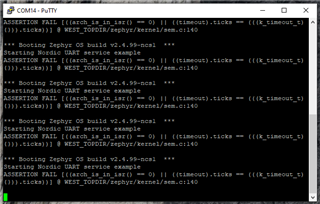
This error is mentioned in the link of point 1, and in the link: https://devzone.nordicsemi.com/f/nordic-q-a/74617/config_assert-cause-code-to-crash
7.- Now I have two problems: 1) data is not printed neither in the output serial port nor the input serial port; 2) then I have to experiment with the function "void ble_write_thread (void)" ... How? I still don't know.
After solving this issue I want to print the data on a 16x2 or I2C 20x4 LCD screen but that will be in another ticket, I hope...
I get any kind of suggestion, help and technical support because I will take this model to solve similar issues.
If you need more information, please let me know...

