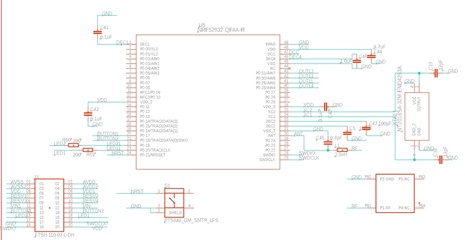
Hello there, I am working on a customized nrf52832 board. For the limited size, the 32kHz crystal is not install because I think the clock from 32khz crystal can be replaced by 32MHz oscillator.. Now I am debugging the board and change the NRF_SDH_CLOCK_LF_SRC, NRFX_CLOCK_CONFIG_LF_SRC, CLOCK_CONFIG_LF_SRC to 1, NRF_SDH_CLOCK_LF_RC_CTIV to 16, NRF_SDH_CLOCK_LF_RC_TEMP_CTIV to 2, NRF_SDH_CLOCK_LF_ACCURACY to 1.
// <e> NRF_CLOCK_ENABLED - nrf_drv_clock - CLOCK peripheral driver - legacy layer
//==========================================================
#ifndef NRF_CLOCK_ENABLED
#define NRF_CLOCK_ENABLED 1
#endif
// <o> CLOCK_CONFIG_LF_SRC  - LF Clock Source

// <0=> RC
// <1=> XTAL
// <2=> Synth
// <131073=> External Low Swing
// <196609=> External Full Swing

#ifndef CLOCK_CONFIG_LF_SRC
#define CLOCK_CONFIG_LF_SRC 0             // 1
#endif

// <e> NRFX_CLOCK_ENABLED - nrfx_clock - CLOCK peripheral driver
//==========================================================
#ifndef NRFX_CLOCK_ENABLED
#define NRFX_CLOCK_ENABLED 1
#endif
// <o> NRFX_CLOCK_CONFIG_LF_SRC  - LF Clock Source

// <0=> RC
// <1=> XTAL
// <2=> Synth
// <131073=> External Low Swing
// <196609=> External Full Swing

#ifndef NRFX_CLOCK_CONFIG_LF_SRC
#define NRFX_CLOCK_CONFIG_LF_SRC 0              // 1
#endif

//==========================================================
// <o> NRF_SDH_CLOCK_LF_SRC  - SoftDevice clock source.

// <0=> NRF_CLOCK_LF_SRC_RC
// <1=> NRF_CLOCK_LF_SRC_XTAL
// <2=> NRF_CLOCK_LF_SRC_SYNTH

#ifndef NRF_SDH_CLOCK_LF_SRC
#define NRF_SDH_CLOCK_LF_SRC 0                      // 1
#endif

// <o> NRF_SDH_CLOCK_LF_RC_CTIV - SoftDevice calibration timer interval.
#ifndef NRF_SDH_CLOCK_LF_RC_CTIV
#define NRF_SDH_CLOCK_LF_RC_CTIV 16
#endif

// <o> NRF_SDH_CLOCK_LF_RC_TEMP_CTIV - SoftDevice calibration timer interval under constant temperature.
// <i> How often (in number of calibration intervals) the RC oscillator shall be calibrated
// <i>  if the temperature has not changed.

#ifndef NRF_SDH_CLOCK_LF_RC_TEMP_CTIV
#define NRF_SDH_CLOCK_LF_RC_TEMP_CTIV 2
#endif

// <o> NRF_SDH_CLOCK_LF_ACCURACY  - External clock accuracy used in the LL to compute timing.

// <0=> NRF_CLOCK_LF_ACCURACY_250_PPM
// <1=> NRF_CLOCK_LF_ACCURACY_500_PPM
// <2=> NRF_CLOCK_LF_ACCURACY_150_PPM
// <3=> NRF_CLOCK_LF_ACCURACY_100_PPM
// <4=> NRF_CLOCK_LF_ACCURACY_75_PPM
// <5=> NRF_CLOCK_LF_ACCURACY_50_PPM
// <6=> NRF_CLOCK_LF_ACCURACY_30_PPM
// <7=> NRF_CLOCK_LF_ACCURACY_20_PPM
// <8=> NRF_CLOCK_LF_ACCURACY_10_PPM
// <9=> NRF_CLOCK_LF_ACCURACY_5_PPM
// <10=> NRF_CLOCK_LF_ACCURACY_2_PPM
// <11=> NRF_CLOCK_LF_ACCURACY_1_PPM

#ifndef NRF_SDH_CLOCK_LF_ACCURACY
#define NRF_SDH_CLOCK_LF_ACCURACY 1                   // 7
#endif
The firmware version is 17.0.2 and the firmware code is modified from ble_app_uart__saadc_timer_driven__scan_mode from NORDIC PLAYGROUND in Github.
Now the code can running into "saadc_callback" function and the timer works well. But I can't scan the advertising from the customized board with "nRF Connect" app on cell phone. What other parameters should I change? Any help will be appreciated.
void saadc_callback(nrf_drv_saadc_evt_t const * p_event)
{
    if (p_event->type == NRF_DRV_SAADC_EVT_DONE)
    {
        ret_code_t err_code;
        uint16_t adc_value;
        uint8_t value[SAADC_SAMPLES_IN_BUFFER*2];
        uint16_t bytes_to_send;

        // set buffers
        err_code = nrf_drv_saadc_buffer_convert(p_event->data.done.p_buffer, SAADC_SAMPLES_IN_BUFFER);
        APP_ERROR_CHECK(err_code);

        // print samples on hardware UART and parse data for BLE transmission
        printf("ADC event number: %d\r\n",(int)m_adc_evt_counter);
        for (int i = 0; i < SAADC_SAMPLES_IN_BUFFER; i++)
        {
            printf("%d\r\n", p_event->data.done.p_buffer[i]);

            adc_value = p_event->data.done.p_buffer[i];
            value[i*2] = adc_value;
            value[(i*2)+1] = adc_value >> 8;
        }

         // Send data over BLE via NUS service. Create string from samples and send string with correct length.
        uint8_t nus_string[50];
        bytes_to_send = sprintf(nus_string,
                                "CH0: %d\r\nCH1: %d\r\nCH2: %d\r\nCH3: %d",
                                p_event->data.done.p_buffer[0],
                                p_event->data.done.p_buffer[1],
                                p_event->data.done.p_buffer[2],
                                p_event->data.done.p_buffer[3]);

        err_code = ble_nus_data_send(&m_nus, nus_string, &bytes_to_send, m_conn_handle);
        if ((err_code != NRF_ERROR_INVALID_STATE) && (err_code != NRF_ERROR_NOT_FOUND))
        {
            APP_ERROR_CHECK(err_code);
        }
	NRF_LOG_INFO("Debug logging for UART over RTT started.");
        m_adc_evt_counter++;
    }
}