Hi, I'm using the PWR_MGMT SDK 17.0.2 demo code on my nRF52 DK.
Q1) After enabling parameters in the sdk_config.h, the nRF52 DK could enter the Power Off Mode if I press the button manually (LED4 will turn on as the indication). However, by using Scheduler, nRF52 DK cannot automatically enter Power Off Mode after 5 seconds period.
Here is the PuTTY information when Schedular timeout is triggerred:
<info> pwr_mgmt: Shutdown request 0
<info> pwr_mgmt: Shutdown started. Type 0
<info> pwr_mgmt: SysOff handler 0x00003A85 => blocking
Here is my sdk_config.h
// <e> NRF_PWR_MGMT_ENABLED - nrf_pwr_mgmt - Power management module
//==========================================================
#ifndef NRF_PWR_MGMT_ENABLED
#define NRF_PWR_MGMT_ENABLED 1
#endif
// <e> NRF_PWR_MGMT_CONFIG_DEBUG_PIN_ENABLED - Enables pin debug in the module.

// <i> Selected pin will be set when CPU is in sleep mode.
//==========================================================
// Set a GPIO (LED) on/off when the CPU is active/asleep, so that we could track of when the CPU is active or asleep.
#ifndef NRF_PWR_MGMT_CONFIG_DEBUG_PIN_ENABLED
#define NRF_PWR_MGMT_CONFIG_DEBUG_PIN_ENABLED 1
#endif
// <o> NRF_PWR_MGMT_SLEEP_DEBUG_PIN  - Pin number

// <0=> 0 (P0.0)
// <1=> 1 (P0.1)
// <2=> 2 (P0.2)
// <3=> 3 (P0.3)
// <4=> 4 (P0.4)
// <5=> 5 (P0.5)
// <6=> 6 (P0.6)
// <7=> 7 (P0.7)
// <8=> 8 (P0.8)
// <9=> 9 (P0.9)
// <10=> 10 (P0.10)
// <11=> 11 (P0.11)
// <12=> 12 (P0.12)
// <13=> 13 (P0.13)
// <14=> 14 (P0.14)
// <15=> 15 (P0.15)
// <16=> 16 (P0.16)
// <17=> 17 (P0.17)
// <18=> 18 (P0.18)
// <19=> 19 (P0.19)
// <20=> 20 (P0.20)
// <21=> 21 (P0.21)
// <22=> 22 (P0.22)
// <23=> 23 (P0.23)
// <24=> 24 (P0.24)
// <25=> 25 (P0.25)
// <26=> 26 (P0.26)
// <27=> 27 (P0.27)
// <28=> 28 (P0.28)
// <29=> 29 (P0.29)
// <30=> 30 (P0.30)
// <31=> 31 (P0.31)
// <4294967295=> Not connected

// We could select the debug pin = LED pin to debug (i.e. display) the sleep mode ON/OFF (For nRF52 DK, LED1/2/3/4 coresponds to P0.17/18/19/20)
// Since the LEDs on nRF52DK are active low, that means the LED will be turned ON when CPU is active. LED will be OFF when CPU is asleep.
#ifndef NRF_PWR_MGMT_SLEEP_DEBUG_PIN
#define NRF_PWR_MGMT_SLEEP_DEBUG_PIN 20
#endif

// </e>

// <q> NRF_PWR_MGMT_CONFIG_CPU_USAGE_MONITOR_ENABLED  - Enables CPU usage monitor.


// <i> Module will trace percentage of CPU usage in one second intervals.
// This feature is used with the Logger Module to trace and log CPU usage (0% to 100%), and display through RTT/UART every 1 second.
#ifndef NRF_PWR_MGMT_CONFIG_CPU_USAGE_MONITOR_ENABLED
#define NRF_PWR_MGMT_CONFIG_CPU_USAGE_MONITOR_ENABLED 1
#endif

// <e> NRF_PWR_MGMT_CONFIG_STANDBY_TIMEOUT_ENABLED - Enable standby timeout.
//==========================================================
// Allow us to configure an auto-sleep after a period of inactivity (Note: requires the RTC to be configured)
#ifndef NRF_PWR_MGMT_CONFIG_STANDBY_TIMEOUT_ENABLED
#define NRF_PWR_MGMT_CONFIG_STANDBY_TIMEOUT_ENABLED 1
#endif
// <o> NRF_PWR_MGMT_CONFIG_STANDBY_TIMEOUT_S - Standby timeout (in seconds).
// <i> Shutdown procedure will begin no earlier than after this number of seconds.

#ifndef NRF_PWR_MGMT_CONFIG_STANDBY_TIMEOUT_S
#define NRF_PWR_MGMT_CONFIG_STANDBY_TIMEOUT_S 5
#endif

// </e>

// <q> NRF_PWR_MGMT_CONFIG_FPU_SUPPORT_ENABLED  - Enables FPU event cleaning.

// To handle "sleep" or "exit sleep" when the Floating Point Unit (FPU) of the SoC is used
#ifndef NRF_PWR_MGMT_CONFIG_FPU_SUPPORT_ENABLED
#define NRF_PWR_MGMT_CONFIG_FPU_SUPPORT_ENABLED 1
#endif

// <q> NRF_PWR_MGMT_CONFIG_AUTO_SHUTDOWN_RETRY  - Blocked shutdown procedure will be retried every second.


#ifndef NRF_PWR_MGMT_CONFIG_AUTO_SHUTDOWN_RETRY
#define NRF_PWR_MGMT_CONFIG_AUTO_SHUTDOWN_RETRY 1
#endif

// <q> NRF_PWR_MGMT_CONFIG_USE_SCHEDULER  - Module will use @ref app_scheduler.
//
#ifndef NRF_PWR_MGMT_CONFIG_USE_SCHEDULER
#define NRF_PWR_MGMT_CONFIG_USE_SCHEDULER 1
#endif

// <o> NRF_PWR_MGMT_CONFIG_HANDLER_PRIORITY_COUNT - The number of priorities for module handlers.
// <i> The number of stages of the shutdown process.

#ifndef NRF_PWR_MGMT_CONFIG_HANDLER_PRIORITY_COUNT
#define NRF_PWR_MGMT_CONFIG_HANDLER_PRIORITY_COUNT 3
#endif

// </e>

// <q> NRF_SECTION_ITER_ENABLED  - nrf_section_iter - Section iterator


#ifndef NRF_SECTION_ITER_ENABLED
#define NRF_SECTION_ITER_ENABLED 1
#endif
Here is my main.c:
#include <stdbool.h>
#include <stdint.h>
#include "boards.h"
#include "bsp.h"
#include "bsp_nfc.h"
#include "app_timer.h"
#include "nordic_common.h"
#include "app_error.h"
#include "nrf_drv_clock.h"
#include "nrf_pwr_mgmt.h"       // Power management library

#include "nrf_log.h"
#include "nrf_log_ctrl.h"
#include "nrf_log_default_backends.h"

#if NRF_PWR_MGMT_CONFIG_USE_SCHEDULER
#include "app_scheduler.h"
#define APP_SCHED_MAX_EVENT_SIZE    0   /**< Maximum size of scheduler events. */
#define APP_SCHED_QUEUE_SIZE        4   /**< Maximum number of events in the scheduler queue. */
#endif // NRF_PWR_MGMT_CONFIG_USE_SCHEDULER

#define BTN_ID_READY                0   /**< ID of the button used to change the readiness to sleep. */
#define BTN_ID_SLEEP                1   /**< ID of the button used to put the application into sleep/system OFF mode. */
#define BTN_ID_WAKEUP               1   /**< ID of the button used to wake up the application. */
#define BTN_ID_RESET                2   /**< ID of the button used to reset the application. */

static volatile bool m_stay_in_sysoff;  /**< True if the application should stay in system OFF mode. */
static volatile bool m_is_ready;        /**< True if the application is ready to enter sleep/system OFF mode. */
static volatile bool m_sysoff_started;  /**< True if the application started sleep preparation. */


/**@brief Handler for shutdown preparation.
 */
bool shutdown_handler(nrf_pwr_mgmt_evt_t event)
{
    uint32_t err_code;

    if (m_is_ready == false)
    {
        m_sysoff_started = true;
        return false;
    }

    switch (event)
    {
        case NRF_PWR_MGMT_EVT_PREPARE_SYSOFF:
            NRF_LOG_INFO("NRF_PWR_MGMT_EVT_PREPARE_SYSOFF");
            /**@brief       Function for disabling all buttons.
             *
             * @details     After calling this function, no buttons will generate events when pressed, and
             *              no buttons will be able to wake the system up from sleep mode.
             *
             * @retval      NRF_SUCCESS              If the buttons were successfully disabled.
             * @retval      NRF_ERROR_NOT_SUPPORTED  If the board has no buttons or BSP_SIMPLE is defined.
             * @return      A propagated error.
             */
            err_code = bsp_buttons_disable();
            APP_ERROR_CHECK(err_code);
            break;

        case NRF_PWR_MGMT_EVT_PREPARE_WAKEUP:
            NRF_LOG_INFO("NRF_PWR_MGMT_EVT_PREPARE_WAKEUP");
            err_code = bsp_buttons_disable();
            // Suppress NRF_ERROR_NOT_SUPPORTED return code.
            UNUSED_VARIABLE(err_code);

            /**@brief       Function for enabling wakeup from SYSTEM OFF for given button.
             *
             * @details     After calling this function, button can be used to wake up the chip.
             *              This function should only be called immediately before going into sleep.
             *
             * @param[in]   button_idx  Index of the button.
             *
             * @retval      NRF_SUCCESS              If the button was successfully enabled.
             * @retval      NRF_ERROR_NOT_SUPPORTED  If the board has no buttons or BSP_SIMPLE is defined.
             */
             err_code = bsp_wakeup_button_enable(BTN_ID_WAKEUP);
            // Suppress NRF_ERROR_NOT_SUPPORTED return code.
            UNUSED_VARIABLE(err_code);

            err_code = bsp_nfc_sleep_mode_prepare();
            // Suppress NRF_ERROR_NOT_SUPPORTED return code.
            UNUSED_VARIABLE(err_code);
            break;

        case NRF_PWR_MGMT_EVT_PREPARE_DFU:
            NRF_LOG_ERROR("Entering DFU is not supported by this example.");
            APP_ERROR_HANDLER(NRF_ERROR_API_NOT_IMPLEMENTED);
            break;

        case NRF_PWR_MGMT_EVT_PREPARE_RESET:
            NRF_LOG_INFO("NRF_PWR_MGMT_EVT_PREPARE_RESET");
            break;
    }

    err_code = app_timer_stop_all();
    APP_ERROR_CHECK(err_code);

    return true;
}


/**@brief Register application shutdown handler with priority 0. */
/**@brief   Macro for registering a shutdown handler to be called before entering system off sleep mode.
 * It's very useful for doing application-level housekeeping before netering System off sleep mode.
 * Modules that want to get events
 *          from this module must register the handler using this macro.
 *
 * @details This macro places the handler in a section named "pwr_mgmt_data".
 *
 * @param[in]   _handler    Event handler (@ref nrf_pwr_mgmt_shutdown_handler_t).
 * @param[in]   _priority   Priority of the given handler.
 */
NRF_PWR_MGMT_HANDLER_REGISTER(shutdown_handler, 0);


/**@brief Function for handling BSP events.
 */
static void bsp_evt_handler(bsp_event_t evt)
{
#if NRF_PWR_MGMT_CONFIG_STANDBY_TIMEOUT_ENABLED
    /*
    *@brief Function for indicating activity.
     *
     * @details Call this function whenever doing something that constitutes "activity".
     *          For example, whenever sending data, call this function to indicate that the application
     *          is active and should not disconnect any ongoing communication links.
     * This API is only applicable when NRF_PWR_MGMT_CONFIG_STANDBY_TIMEOUT_ENABLED is enabled.
     *
     * It is called to reset the counter and hence prevent the automatic sleep.
     */
    nrf_pwr_mgmt_feed();
    NRF_LOG_INFO("bsp_evt_handler: Power management fed");
#endif // NRF_PWR_MGMT_CONFIG_STANDBY_TIMEOUT_ENABLED

    switch (evt)
    {
        // BSP_EVENT_KEY_0 = Default event of the push action of BSP_BUTTON_0 (only if this button is present)
        case BSP_EVENT_KEY_0:
            if (m_is_ready)
            {
                m_is_ready = false;
                NRF_LOG_INFO("System is not ready for shutdown");
            }
            else
            {
                m_is_ready = true;
                NRF_LOG_INFO("System is ready for shutdown");
            }
            if (m_sysoff_started && m_is_ready)
            {
                /**@brief Function for shutting down the system.
                 * @param[in] shutdown_type     Type of operation.
                 * @details All callbacks will be executed prior to shutdown.
                 */
                 nrf_pwr_mgmt_shutdown(NRF_PWR_MGMT_SHUTDOWN_CONTINUE);
            }
            break;


        // BSP_EVENT_SYSOFF = The device should enter system off mode (without wakeup)
        case BSP_EVENT_SYSOFF:
            m_stay_in_sysoff = true;
            break;


        // BSP_EVENT_SLEEP = The device should enter sleep mode
        case BSP_EVENT_SLEEP:
            if (m_stay_in_sysoff)
            {
                nrf_pwr_mgmt_shutdown(NRF_PWR_MGMT_SHUTDOWN_STAY_IN_SYSOFF);
            }
            else
            {
                nrf_pwr_mgmt_shutdown(NRF_PWR_MGMT_SHUTDOWN_GOTO_SYSOFF);
            }
            break;


        // BSP_EVENT_RESET = The device should reset
        case BSP_EVENT_RESET:
            nrf_pwr_mgmt_shutdown(NRF_PWR_MGMT_SHUTDOWN_RESET);
            break;

        default:
            return; // no implementation needed
    }
}


/**@brief Function for initializing low-frequency clock.
    In this example, LFCLK is used for
 */
static void lfclk_config(void)
{

    /**
     * @brief Function for initializing the nrf_drv_clock module.
     *
     * After initialization, the module is in power off state (clocks are not requested).
     *
     * @retval NRF_SUCCESS                          If the procedure was successful.
     * @retval NRF_ERROR_MODULE_ALREADY_INITIALIZED If the driver was already initialized.
     */
     ret_code_t err_code = nrf_drv_clock_init();
    APP_ERROR_CHECK(err_code);


    /**
     * @brief Function for requesting the LFCLK.
     *
     * The low-frequency clock can be requested by different modules
     * or contexts. The driver ensures that the clock will be started only when it is requested
     * the first time. If the clock is not ready but it was already started, the handler item that is
     * provided as an input parameter is added to the list of handlers that will be notified
     * when the clock is started. If the clock is already enabled, user callback is called from the
     * current context.
     *
     * The first request will start the selected LFCLK source. If an event handler is
     * provided, it will be called once the LFCLK is started. If the LFCLK was already started at this
     * time, the event handler will be called from the context of this function. Additionally,
     * the @ref nrf_drv_clock_lfclk_is_running function can be polled to check if the clock has started.
     *
     * @note When a SoftDevice is enabled, the LFCLK is always running and the driver cannot control it.
     *
     * @note The handler item provided by the user cannot be an automatic variable.
     *
     * @param[in] p_handler_item A pointer to the event handler structure.
     */
    nrf_drv_clock_lfclk_request(NULL);
}


/**
@brief Function for initializing the BSP module.
#define BTN_ID_READY                0   //< ID of the button used to change the readiness to sleep
#define BTN_ID_SLEEP                1   //< ID of the button used to put the application into sleep/system OFF mode
#define BTN_ID_WAKEUP               1   //< ID of the button used to wake up the application
#define BTN_ID_RESET                2   //< ID of the button used to reset the application
*/
static void bsp_configuration()
{
    uint32_t err_code;

    /**@brief       Function for initializing BSP.
     *
     * @details     The function initializes the board support package to allow state indication and
     *              button reaction. Default events are assigned to buttons.
     * @note        Before calling this function, you must initiate the following required modules:
     *              - @ref app_timer for LED support
     *              - @ref app_gpiote for button support
     *
     * @param[in]   type               Type of peripherals used.
     * @param[in]   callback           Function to be called when button press/event is detected.
     *
     * @retval      NRF_SUCCESS               If the BSP module was successfully initialized.
     * @retval      NRF_ERROR_INVALID_STATE   If the application timer module has not been initialized.
     * @retval      NRF_ERROR_NO_MEM          If the maximum number of timers has already been reached.
     * @retval      NRF_ERROR_INVALID_PARAM   If GPIOTE has too many users.
     * @retval      NRF_ERROR_INVALID_STATE   If button or GPIOTE has not been initialized.
     */
     err_code = bsp_init(BSP_INIT_BUTTONS, bsp_evt_handler);
    APP_ERROR_CHECK(err_code);


    /**@brief       Function for assigning a specific event to a button.
     *
     * @details     This function allows redefinition of standard events assigned to buttons.
     *              To unassign events, provide the event @ref BSP_EVENT_NOTHING.
     *
     * @param[in]   button                   Button ID to be redefined.
     * @param[in]   action                   Button action to assign event to.
     * @param[in]   event                    Event to be assigned to button.
     *
     * @retval      NRF_SUCCESS              If the event was successfully assigned to button.
     * @retval      NRF_ERROR_INVALID_PARAM  If the button ID or button action was invalid.
     */
     // When press button 1 for 2000 ms (long press), the device should enter system off mode (without wakeup)
     err_code = bsp_event_to_button_action_assign(BTN_ID_SLEEP,
                                                 BSP_BUTTON_ACTION_LONG_PUSH,
                                                 BSP_EVENT_SYSOFF);
    APP_ERROR_CHECK(err_code);

    // When release button 1, The device should enter sleep mode.
    err_code = bsp_event_to_button_action_assign(BTN_ID_SLEEP,
                                                 BSP_BUTTON_ACTION_RELEASE,
                                                 BSP_EVENT_SLEEP);
    APP_ERROR_CHECK(err_code);

    //-----------------------------------------
    // When press button 0, assign this event to an action to prevent the action from generating an event (disable the action)
    err_code = bsp_event_to_button_action_assign(BTN_ID_READY,
                                                 BSP_BUTTON_ACTION_PUSH,
                                                 BSP_EVENT_NOTHING);
    APP_ERROR_CHECK(err_code);


    // When release button 0, Default event of the push action of BSP_BUTTON_0 (only if this button is present)
    err_code = bsp_event_to_button_action_assign(BTN_ID_READY,
                                                 BSP_BUTTON_ACTION_RELEASE,
                                                 BSP_EVENT_KEY_0);
    APP_ERROR_CHECK(err_code);

    //-----------------------------------------
    // When release button 2, The device should reset
    err_code = bsp_event_to_button_action_assign(BTN_ID_RESET,
                                                 BSP_BUTTON_ACTION_RELEASE,
                                                 BSP_EVENT_RESET);
    APP_ERROR_CHECK(err_code);
}


/**
 * @brief Function for application main entry.
 */
int main(void)
{
    APP_ERROR_CHECK(NRF_LOG_INIT(NULL));
    NRF_LOG_DEFAULT_BACKENDS_INIT();

    NRF_LOG_INFO("Power Management example");

    // Cnfigure and initialize the LFCLK
    // We need a LFCLK for NRF_PWR_MGMT_CONFIG_STANDBY_TIMEOUT_S feature
    // If use SoftDevice, this step is NOT needed because the SoftDevice already tuen on the LFCLK
    lfclk_config();
    uint32_t err_code = app_timer_init();
    APP_ERROR_CHECK(err_code);


#if NRF_PWR_MGMT_CONFIG_USE_SCHEDULER
    /**@brief Macro for initializing the event scheduler.
     *
     * @details It will also handle dimensioning and allocation of the memory buffer required by the
     *          scheduler, making sure the buffer is correctly aligned.
     *
     * @param[in] EVENT_SIZE   Maximum size of events to be passed through the scheduler.
     * @param[in] QUEUE_SIZE   Number of entries in scheduler queue (i.e. the maximum number of events
     *                         that can be scheduled for execution).
     *
     * @note Since this macro allocates a buffer, it must only be called once (it is OK to call it
     *       several times as long as it is from the same location, e.g. to do a reinitialization).
     */
    APP_SCHED_INIT(APP_SCHED_MAX_EVENT_SIZE, APP_SCHED_QUEUE_SIZE);
#endif // NRF_PWR_MGMT_CONFIG_USE_SCHEDULER


    bsp_configuration();

    // Initilize the power management library
    ret_code_t ret_code = nrf_pwr_mgmt_init();
    APP_ERROR_CHECK(ret_code);

    while (true)
    {
#if NRF_PWR_MGMT_CONFIG_USE_SCHEDULER
        app_sched_execute();
#endif // NRF_PWR_MGMT_CONFIG_USE_SCHEDULER


        /**@brief Macro for processing a single log entry from a queue of deferred logs.
         *
         * You can call this macro from the main context or from the error handler to process
         * log entries one by one.
         *
         * @note If logs are not deferred, this call has no use and is defined as 'false'.
         *
         * @retval true    There are more logs to process in the buffer.
         * @retval false   No more logs in the buffer.
         *
         * If there is no deferred log to print, enter system on sleep mode.
         */
        if (NRF_LOG_PROCESS() == false)
        {
            // Function for running power management. Should run in the main loop.
            // Enter system on sleep mode
            // It makes sure that entering and existing sleep in safe and error-free whether SoftDevicce is used or not.
            nrf_pwr_mgmt_run();
        }
    }
}
Q2) The PuTTY shows the message:
<info> pwr_mgmt: Shutdown request 0
<info> pwr_mgmt: Shutdown started. Type 0
<info> pwr_mgmt: SysOff handler 0x00003A85 => blocking
What does 0x00003A85 and blocking mean?
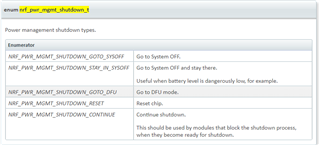
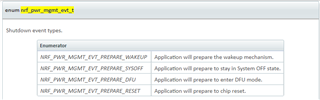
What does the 1st and 2nd 0 mean? I only found nrf_pwr_mgmt_shutdown_t shutdown_type and nrf_pwr_mgmt_evt_t m_pwr_mgmt_evt has the following definition
Thanks in advance!