NRF52840 QSPI IFTIMING Problem

Dear,

We are working on our custom boards to develop a watch product which need external flash memory connected by QSPI interface. In this product, the UI images and font bitmaps store in the external memory. We found the screen of some watch samples display noise content(the data source comes from the external flash memory).  We tried to change IFTIMING register value, and we found the problem watches display problem been fixed. But some other watches no need to change the default value of IFTIMING (the default whole register value 0x00000200). The proportion of problem products is about 6%. 
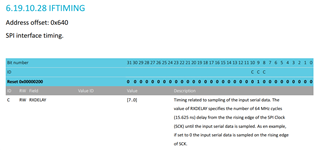
We want to know why the problem products can fix this issue by change IFTIMING register while some most of the product (the other 96%) no need to change this register. And whether the IFTIMING register change would lead other unknown issues.

The following is my understanding about IFTIMING, seems the default value is not fit the the CLOCK mode=0 (CPOL=0, CPHA=0) with the QSPI clock=32MHz.
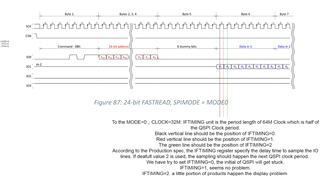
Our the external flash memory is XT25F128BWOIGT.

Parents
  • I also encountered this problem during production. The strange thing is that after I replaced the new 52840 chip, its read and write errors disappeared, but the wrong chip still continues to read and write errors. I haven't changed any registers, or it is normal if I change the frequency to 16MHZ? Is it due to the differences in the chip itself?

  • In both cases (Bing and Youcan) it can be the result of ESD damage. A blown ESD fuse on one of the SPI pins will cause signal integrity issues. 

    But I think it's more likely an issue with the HW design, poor grounding will lead signal intergrity issues. 

    The device-to-device variation from our factory is insignificant. In order to make these variations significant there must be another factor like ESD issue during manufacturing or a spesific GND issue in the design. 

Reply
  • In both cases (Bing and Youcan) it can be the result of ESD damage. A blown ESD fuse on one of the SPI pins will cause signal integrity issues. 

    But I think it's more likely an issue with the HW design, poor grounding will lead signal intergrity issues. 

    The device-to-device variation from our factory is insignificant. In order to make these variations significant there must be another factor like ESD issue during manufacturing or a spesific GND issue in the design. 

Children
No Data
Related