This discussion has been locked.
You can no longer post new replies to this discussion. If you have a question you can start a new discussion

GPIO toggling frequency

Hi,

I am toggling a GPIO using the below code and trying to find out the relation of the frequency and the code statements. I know that GPIO peripheral is running at 16MHz and I have added the 'nop' instructions to make sure that the changes take effect before I change the pin state again.

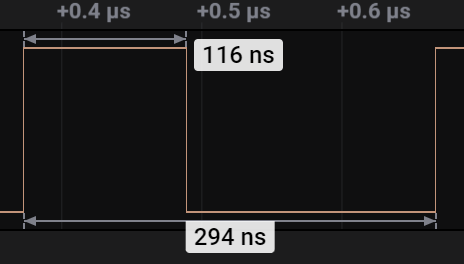
1)  How can we relate '116 ns' and '294 ns' from the below code. I understand that each nop takes 1/(64*10^6) second.

2) I read in the forum that 8 MHz is the maximum frequency which can be achieved on a GPIO even though it has 16 MHz. Why is it so ?  

C code:

while(1)
{
NRF_P0->OUTSET = 0x04000000;
__NOP();
__NOP();
__NOP();
__NOP();
NRF_P0->OUTCLR = 0x04000000;
__NOP();
__NOP();
__NOP();
__NOP();
}

Equivalent Disassembly:

NRF_P0->OUTSET = 0x04000000;
F8C32508 str.w r2, [r3, #0x0508]
__NOP();
BF00 nop
__NOP();
BF00 nop
__NOP();
BF00 nop
__NOP();
BF00 nop
NRF_P0->OUTCLR = 0x04000000;
F8C3250C str.w r2, [r3, #0x050C]
__NOP();
BF00 nop
__NOP();
BF00 nop
__NOP();
BF00 nop
__NOP();
BF00 nop
while(1)
E7F2 b 0x0001AECA

  • NOP is not guaranteed to be time consuming and also discussed here

    I have seen what you see many times and the lesson I learnt is NOT to rely on NOP for very time sensitive delays.

    You can for example use ISB to create 4 processor cycles of delay to fill the pipeline or you can actually write some ASM code using other dummy arithmetic operation for a very predictable halt of logic in your code, but do not rely on NOP alone as that wont give you predictable delays.

  • thank you for your reply.

    I have replaced NOP by ISB as given below.

    __ISB();
    NRF_P0->OUTSET = 0x04000000;
    __ISB();
    NRF_P0->OUTCLR = 0x04000000;
    __ISB();
    NRF_P0->OUTSET = 0x04000000;
    __ISB();
    NRF_P0->OUTCLR = 0x04000000;

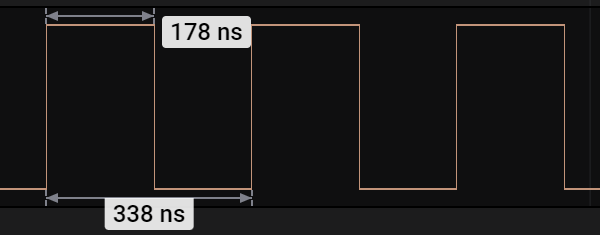
    This is what I see in analyser now.

    It is taking ~178ns to change the state from high to low.

    __ISB() takes four processor cycles = (1/(64 * 10^6)) * 4 =  62.5 ns

    str.w r2, [r3, #0x050C] --> This is the instruction to change the pin state to low. Does this instruction consume the remaining time of 115.5 ns (178 - 62.5) ?

    Is this how it works or am I missing anything ?

  • Can you post the generated assembly code for this code you made with the __ISB?

  • Here is it:

    while(1)
    {
    NRF_P0->OUTSET = 0x04000000;
    F8C32508 str.w r2, [r3, #0x0508]
    __ISB();
    F3BF8F6F isb
    NRF_P0->OUTCLR = 0x04000000;
    F8C3250C str.w r2, [r3, #0x050C]
    __ISB();
    F3BF8F6F isb
    NRF_P0->OUTSET = 0x04000000;
    F8C32508 str.w r2, [r3, #0x0508]
    __ISB();
    F3BF8F6F isb
    NRF_P0->OUTCLR = 0x04000000;
    F8C3250C str.w r2, [r3, #0x050C]
    __ISB();
    F3BF8F6F isb
    NRF_P0->OUTSET = 0x04000000;
    F8C32508 str.w r2, [r3, #0x0508]
    __ISB();
    F3BF8F6F isb
    NRF_P0->OUTCLR = 0x04000000;
    F8C3250C str.w r2, [r3, #0x050C]
    __ISB();
    F3BF8F6F isb
    NRF_P0->OUTSET = 0x04000000;
    F8C32508 str.w r2, [r3, #0x0508]
    __ISB();
    F3BF8F6F isb
    NRF_P0->OUTCLR = 0x04000000;
    F8C3250C str.w r2, [r3, #0x050C]
    __ISB();
    F3BF8F6F isb
    E7DE b 0x0001A142

  • I would recommend __DSB() instead of __ISB(); don't care about the instruction cache just peripheral memory access fully completing

    /**
      \brief   Data Synchronization Barrier
      \details Acts as a special kind of Data Memory Barrier.
               It completes when all explicit memory accesses before this instruction complete.
     */
    // Ensure all explicit memory accesses before this instruction complete - avoid inline definition as a function
    #define __DSB() __ASM volatile ("dsb 0xF":::"memory")

Related