This discussion has been locked.
You can no longer post new replies to this discussion. If you have a question you can start a new discussion

GPIO toggling frequency

Hi,

I am toggling a GPIO using the below code and trying to find out the relation of the frequency and the code statements. I know that GPIO peripheral is running at 16MHz and I have added the 'nop' instructions to make sure that the changes take effect before I change the pin state again.

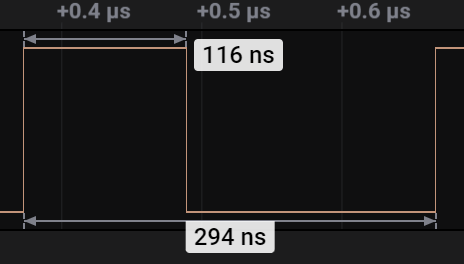
1)  How can we relate '116 ns' and '294 ns' from the below code. I understand that each nop takes 1/(64*10^6) second.

2) I read in the forum that 8 MHz is the maximum frequency which can be achieved on a GPIO even though it has 16 MHz. Why is it so ?  

C code:

while(1)
{
NRF_P0->OUTSET = 0x04000000;
__NOP();
__NOP();
__NOP();
__NOP();
NRF_P0->OUTCLR = 0x04000000;
__NOP();
__NOP();
__NOP();
__NOP();
}

Equivalent Disassembly:

NRF_P0->OUTSET = 0x04000000;
F8C32508 str.w r2, [r3, #0x0508]
__NOP();
BF00 nop
__NOP();
BF00 nop
__NOP();
BF00 nop
__NOP();
BF00 nop
NRF_P0->OUTCLR = 0x04000000;
F8C3250C str.w r2, [r3, #0x050C]
__NOP();
BF00 nop
__NOP();
BF00 nop
__NOP();
BF00 nop
__NOP();
BF00 nop
while(1)
E7F2 b 0x0001AECA

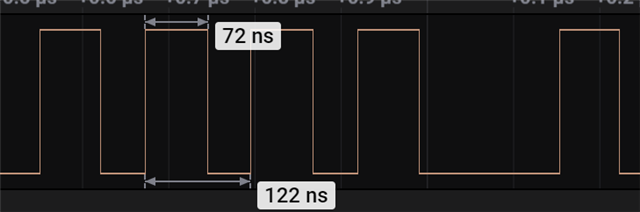
  • I have changed it to DSB and the timing now is as given below. Could you please explain me how to derive 72 ns and 50 ns from the code ? How many CPU cycles does DSB take ?

  • __DSB() causes the MPU to wait until the port write high instruction completes, which although the port pin 16MHz clock is synchronous to the instruction 64MHz clock the two may be out-of-phase with the port action depending on previous instructions, and the state of the instruction pipeline. Let's say that takes 62.5nSec + n = 72 nSecs where 62.5 nSec is a single cycle at 16MHz. Same for the port write low. What next? A jump instruction, as  you are using a while(1) loop. That may be taking (122-72) - 60 nSecs to complete.

    Prove this by a series of port set high / reset low instructions and then see what timing you get. 100 such high/low pairs in the while(1) loop might be closer to (72+72)x100 nSecs or perhaps slightly better.

    Finally results assume the crystal-derived HFCLK is enabled. Enabling instruction cache will change from 2 wait states to 0 wait states in the instruction timing, though in this loop that may not change timing, I'd have to check in the ARM Cortex-M4 manual.

    If you really want 8MHz use the hardware PWM peripheral which can give 8MHz max rate, no timing issues

  • Yes avoiding while(1) delay works; cache also speeds up to 8MHz

        // Enable cache and hit/miss tracking
        while(NRF_NVMC->READY == 0) ;
        NRF_NVMC->ICACHECNF = 0x101;
        while(1)
        {
            NRF_P0->OUTSET = 1UL << SCOPE_PROBE_2;
            NRF_P0->OUTCLR = 1UL << SCOPE_PROBE_2;
            NRF_P0->OUTSET = 1UL << SCOPE_PROBE_2;
            NRF_P0->OUTCLR = 1UL << SCOPE_PROBE_2;
            NRF_P0->OUTSET = 1UL << SCOPE_PROBE_2;
            NRF_P0->OUTCLR = 1UL << SCOPE_PROBE_2;
            NRF_P0->OUTSET = 1UL << SCOPE_PROBE_2;
            NRF_P0->OUTCLR = 1UL << SCOPE_PROBE_2;
            NRF_P0->OUTSET = 1UL << SCOPE_PROBE_2;
            NRF_P0->OUTCLR = 1UL << SCOPE_PROBE_2;
        }

Related