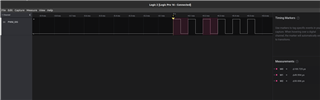
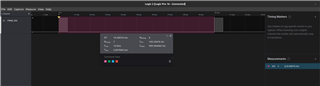
I am using v7.0.1 S132 SDK on the nRF52832 processor for BlueTooth Light coded in Segger.
I have a high speed output (50uS) to drive an external device using an internal timer (timer[3]).
There seems to be jitter on the GPIO output.
Many posts seem to refer to forcing the use of the external 32MHz crystal using sd_clock_hfclk_request();
But querying the state using sd_clock_hfclk_is_running(p_is_running); never returns true.
I know the HF clock is running because I'm using the 16MHz clock for the timer (and using the radio to send BLE pkts).
How do I know which clock (INT or XO) is being used?
How do I force it to use the external 32MHz crystal?
Code Snippets
NOTE: The timer works but has Jitter

==============================================================================
// Main() startup calls for BLE using SDK S132 v7.0.1
	// 1) HFXO Startup fails here
	// Basic startup
    log_init();
    timers_init();  // Application timers in OS (1Hz)
    buttons_leds_init(&erase_bonds);
    power_management_init();
	// BLE Startup
    ble_stack_init();
    memset(&mac_addr, 0, sizeof(mac_addr));
    sd_ble_gap_addr_get(&mac_addr);
    gap_params_init();
    gatt_init();
    advertising_init();
    services_init();
    conn_params_init();
    peer_manager_init();
	init_my_timer();
	// 2) HFXO Startup fails here
    application_timers_start();
    advertising_start(erase_bonds);
	// 3) HFXO Startup fails here

==============================================================================
// Attempt to start the HFClock using HFXO
//  Fails in all 3 locations above
//  The while loop never quits ???

static uint32_t * p_is_running;
    sd_clock_hfclk_is_running(p_is_running);
    if (!p_is_running){
        //NRF_CLOCK->TASKS_HFCLKSTART = 1;

        sd_clock_hfclk_request();   // Force the use of the external HFXO?
        while (!p_is_running)
            sd_clock_hfclk_is_running(p_is_running);
    }

==============================================================================
//  Timer init code
static const nrf_drv_timer_t m_timer3 = NRF_DRV_TIMER_INSTANCE(3);   // Internal timer[3]
nrf_drv_timer_config_t timer_cfg = NRFX_TIMER_DEFAULT_CONFIG;
void init_my_timer()
{
    timer_cfg.frequency = NRF_TIMER_FREQ_16MHz; // Use the HF Clock
    timer_cfg.bit_width = NRF_TIMER_BIT_WIDTH_32;
    err_code = nrfx_timer_init(&m_timer3, &timer_cfg, timer3_event_handler);
    APP_ERROR_CHECK(err_code);

	nrfx_timer_extended_compare(&m_timer3,
							   NRF_TIMER_CC_CHANNEL0,
							   nrf_drv_timer_us_to_ticks(&m_timer3, 50) // Init 50uS timer NOTE: This is off by about 2uS
							   NRF_TIMER_SHORT_COMPARE0_CLEAR_MASK,
							   true);

}

==============================================================================
// Note I can use buttons to start/stop this timer on the nRF52 SD
    nrfx_timer_enable(&m_timer3);   // Start the timer
    nrfx_timer_disable(&m_timer3);  // Stop the timer

==============================================================================
//  Timer IRQ handler
static bool timer3_trig_state = false;
static void timer3_event_handler(nrf_timer_event_t event_type, void * p_context)
{
	// Toggle PO.13 (D2) every 50uS
	if (timer3_trig_state){
		*gpio_outclr_cfg = 1UL<<ARDUINO_2_PIN;
		timer3_trig_state = false;
	} else {
		*gpio_outset_cfg = 1UL<<ARDUINO_2_PIN;
		timer3_trig_state = true;
	}
}