

Hi,
I'm running into a frustrating issue where I can get the NRFX_SPIM and my own BSP examples to work, but when I try to combine them - the buttons stop triggering their interrupt handlers. At first, I thought I was overwriting the GPIO button pins but after looking at pca10056.h, that doesn't seem to be the problem.
I am using an nrf52840 dev kit, starting with the nrfx_spim example and adding button support code from the ble_app_blinky. The resulting main is below:
/**
 * Copyright (c) 2017 - 2021, Nordic Semiconductor ASA
 *
 */

#include <stdint.h>
#include "nordic_common.h"
#include "nrf.h"
#include "app_timer.h"
#include "app_button.h"
////////////////////////////


#include "nrfx_spim.h"
#include "app_util_platform.h"
#include "nrf_gpio.h"
#include "nrf_delay.h"
#include "boards.h"
#include "app_error.h"
#include <string.h>
#include "nrf_log.h"
#include "nrf_log_ctrl.h"
#include "nrf_log_default_backends.h"

#define NRFX_SPIM_SCK_PIN  3
#define NRFX_SPIM_MOSI_PIN 4
#define NRFX_SPIM_MISO_PIN 28
#define NRFX_SPIM_SS_PIN   29
#define NRFX_SPIM_DCX_PIN  30

#define BUTTON_DETECTION_DELAY          APP_TIMER_TICKS(100)

    // APP_SPIS_CS_PIN 31
    // APP_SPIS_MISO_PIN 30
    // APP_SPIS_MOSI_PIN 29
    // APP_SPIS_SCK_PIN 26

#define SPI_INSTANCE  3                                           /**< SPI instance index. */
static const nrfx_spim_t spi = NRFX_SPIM_INSTANCE(SPI_INSTANCE);  /**< SPI instance. */

static volatile bool spi_xfer_done;  /**< Flag used to indicate that SPI instance completed the transfer. */

#define TEST_STRING "Nordic123456789012345678901234567890"
static uint8_t       m_tx_buf[] = TEST_STRING;           /**< TX buffer. */
static uint8_t       m_rx_buf[sizeof(TEST_STRING) + 1];  /**< RX buffer. */
static const uint8_t m_length = sizeof(m_tx_buf);        /**< Transfer length. */

void spim_event_handler(nrfx_spim_evt_t const * p_event,
                       void *                  p_context)
{
    spi_xfer_done = true;
    NRF_LOG_INFO("Transfer completed.");
    if (m_rx_buf[0] != 0)
    {
        NRF_LOG_INFO(" Received:");
        NRF_LOG_HEXDUMP_INFO(m_rx_buf, strlen((const char *)m_rx_buf));
    }
}

/////////////////////////////////////
static void log_init(void)
{
    ret_code_t err_code = NRF_LOG_INIT(NULL);
    APP_ERROR_CHECK(err_code);

    NRF_LOG_DEFAULT_BACKENDS_INIT();
}

static void button_event_handler(uint8_t pin_no, uint8_t button_action)
{
    ret_code_t err_code;
    switch (pin_no)
    {
        case BSP_BUTTON_0:
            NRF_LOG_INFO("Send button state change.");
            break;
        case BSP_BUTTON_1:
            if (button_action == APP_BUTTON_PUSH)
              {
                NRF_LOG_INFO("BSP_BUTTON_2 clicked - start SPI TRX Timer");
                bsp_board_led_invert(BSP_BOARD_LED_0);
              }
            break;
        case BSP_BUTTON_2:
            if (button_action == APP_BUTTON_PUSH)
              {
                NRF_LOG_INFO("BSP_BUTTON_3 clicked - TOGGLE LED 1");
                bsp_board_led_invert(BSP_BOARD_LED_1);
              }
            break;

        default:
            APP_ERROR_HANDLER(pin_no);
            break;
    }
}

static void leds_init(void)
{
    bsp_board_init(BSP_INIT_LEDS);
}

static void timers_init(void)
{
    // Initialize timer module, making it use the scheduler
    ret_code_t err_code = app_timer_init();
    APP_ERROR_CHECK(err_code);
}


static void buttons_init(void)
{
    ret_code_t err_code;

    //The array must be static because a pointer to it will be saved in the button handler module.
    static app_button_cfg_t buttons[] =
    {
        {BSP_BUTTON_0, false, BUTTON_PULL, button_event_handler},
        {BSP_BUTTON_1, false, BUTTON_PULL, button_event_handler},
        {BSP_BUTTON_2, false, BUTTON_PULL, button_event_handler}
    };

    err_code = app_button_init(buttons, ARRAY_SIZE(buttons),
                               BUTTON_DETECTION_DELAY);
    APP_ERROR_CHECK(err_code);
}

////////////////////////////////////

int main(void)
{
    log_init();
    leds_init();
    timers_init();
    buttons_init();


    nrfx_spim_xfer_desc_t xfer_desc = NRFX_SPIM_XFER_TRX(m_tx_buf, m_length, m_rx_buf, m_length);

    nrfx_spim_config_t spi_config = NRFX_SPIM_DEFAULT_CONFIG;
    spi_config.frequency      = NRF_SPIM_FREQ_1M;
    spi_config.ss_pin         = NRFX_SPIM_SS_PIN;
    spi_config.miso_pin       = NRFX_SPIM_MISO_PIN;
    spi_config.mosi_pin       = NRFX_SPIM_MOSI_PIN;
    spi_config.sck_pin        = NRFX_SPIM_SCK_PIN;
    //spi_config.dcx_pin        = NRFX_SPIM_DCX_PIN;
    spi_config.dcx_pin        = NRFX_SPIM_PIN_NOT_USED;
    spi_config.use_hw_ss      = true;
    spi_config.ss_active_high = false;
    APP_ERROR_CHECK(nrfx_spim_init(&spi, &spi_config, spim_event_handler, NULL));

    NRF_LOG_INFO("NRFX SPIM example started.");

    while (1)
    {
        // Reset rx buffer and transfer done flag
        memset(m_rx_buf, 0, m_length);
        spi_xfer_done = false;

        //APP_ERROR_CHECK(nrfx_spim_xfer_dcx(&spi, &xfer_desc, 0, 15));
        APP_ERROR_CHECK(nrfx_spim_xfer(&spi, &xfer_desc, 0));

        while (!spi_xfer_done)
        {
            __WFE();
        }

        NRF_LOG_FLUSH();

        //bsp_board_led_invert(BSP_BOARD_LED_0);
        nrf_delay_ms(500);
    }
}
my pca10056.h is:
/**
 * Copyright (c) 2016 - 2019, Nordic Semiconductor ASA
 *
 * All rights reserved.
 *
 * Redistribution and use in source and binary forms, with or without modification,
 * are permitted provided that the following conditions are met:
 *
 * 1. Redistributions of source code must retain the above copyright notice, this
 *    list of conditions and the following disclaimer.
 *
 * 2. Redistributions in binary form, except as embedded into a Nordic
 *    Semiconductor ASA integrated circuit in a product or a software update for
 *    such product, must reproduce the above copyright notice, this list of
 *    conditions and the following disclaimer in the documentation and/or other
 *    materials provided with the distribution.
 *
 * 3. Neither the name of Nordic Semiconductor ASA nor the names of its
 *    contributors may be used to endorse or promote products derived from this
 *    software without specific prior written permission.
 *
 * 4. This software, with or without modification, must only be used with a
 *    Nordic Semiconductor ASA integrated circuit.
 *
 * 5. Any software provided in binary form under this license must not be reverse
 *    engineered, decompiled, modified and/or disassembled.
 *
 * THIS SOFTWARE IS PROVIDED BY NORDIC SEMICONDUCTOR ASA "AS IS" AND ANY EXPRESS
 * OR IMPLIED WARRANTIES, INCLUDING, BUT NOT LIMITED TO, THE IMPLIED WARRANTIES
 * OF MERCHANTABILITY, NONINFRINGEMENT, AND FITNESS FOR A PARTICULAR PURPOSE ARE
 * DISCLAIMED. IN NO EVENT SHALL NORDIC SEMICONDUCTOR ASA OR CONTRIBUTORS BE
 * LIABLE FOR ANY DIRECT, INDIRECT, INCIDENTAL, SPECIAL, EXEMPLARY, OR
 * CONSEQUENTIAL DAMAGES (INCLUDING, BUT NOT LIMITED TO, PROCUREMENT OF SUBSTITUTE
 * GOODS OR SERVICES; LOSS OF USE, DATA, OR PROFITS; OR BUSINESS INTERRUPTION)
 * HOWEVER CAUSED AND ON ANY THEORY OF LIABILITY, WHETHER IN CONTRACT, STRICT
 * LIABILITY, OR TORT (INCLUDING NEGLIGENCE OR OTHERWISE) ARISING IN ANY WAY OUT
 * OF THE USE OF THIS SOFTWARE, EVEN IF ADVISED OF THE POSSIBILITY OF SUCH DAMAGE.
 *
 */
#ifndef PCA10056_H
#define PCA10056_H

#ifdef __cplusplus
extern "C" {
#endif

#include "nrf_gpio.h"

// LEDs definitions for PCA10056
#define LEDS_NUMBER    4

#define LED_1          NRF_GPIO_PIN_MAP(0,13)
#define LED_2          NRF_GPIO_PIN_MAP(0,14)
#define LED_3          NRF_GPIO_PIN_MAP(0,15)
#define LED_4          NRF_GPIO_PIN_MAP(0,16)//24
#define LED_START      LED_1
#define LED_STOP       LED_4

#define LEDS_ACTIVE_STATE 0

#define LEDS_LIST { LED_1, LED_2, LED_3, LED_4 }

#define LEDS_INV_MASK  LEDS_MASK

#define BSP_LED_0      13
#define BSP_LED_1      14
#define BSP_LED_2      15
#define BSP_LED_3      16 // 24-on our board

#define BUTTONS_NUMBER 4

#define BUTTON_1       11 //11
#define BUTTON_2       12 //12
#define BUTTON_3       24 //24
#define BUTTON_4       25 //25
#define BUTTON_PULL    NRF_GPIO_PIN_PULLUP

#define BUTTONS_ACTIVE_STATE 0

#define BUTTONS_LIST { BUTTON_1, BUTTON_2, BUTTON_3, BUTTON_4 }

#define BSP_BUTTON_0   BUTTON_1
#define BSP_BUTTON_1   BUTTON_2
#define BSP_BUTTON_2   BUTTON_3
#define BSP_BUTTON_3   BUTTON_4

#define RX_PIN_NUMBER  8
#define TX_PIN_NUMBER  6
#define CTS_PIN_NUMBER 7
#define RTS_PIN_NUMBER 5
#define HWFC           true

#define BSP_QSPI_SCK_PIN   19
#define BSP_QSPI_CSN_PIN   17
#define BSP_QSPI_IO0_PIN   20
#define BSP_QSPI_IO1_PIN   21
#define BSP_QSPI_IO2_PIN   22
#define BSP_QSPI_IO3_PIN   23


// serialization APPLICATION board - temp. setup for running serialized MEMU tests
#define SER_APP_RX_PIN              NRF_GPIO_PIN_MAP(1,13)    // UART RX pin number.
#define SER_APP_TX_PIN              NRF_GPIO_PIN_MAP(1,14)    // UART TX pin number.
#define SER_APP_CTS_PIN             NRF_GPIO_PIN_MAP(0,2)     // UART Clear To Send pin number.
#define SER_APP_RTS_PIN             NRF_GPIO_PIN_MAP(1,15)    // UART Request To Send pin number.

#define SER_APP_SPIM0_SCK_PIN       NRF_GPIO_PIN_MAP(0,27)     // SPI clock GPIO pin number.
#define SER_APP_SPIM0_MOSI_PIN      NRF_GPIO_PIN_MAP(0,2)      // SPI Master Out Slave In GPIO pin number
#define SER_APP_SPIM0_MISO_PIN      NRF_GPIO_PIN_MAP(0,26)     // SPI Master In Slave Out GPIO pin number
#define SER_APP_SPIM0_SS_PIN        NRF_GPIO_PIN_MAP(1,13)     // SPI Slave Select GPIO pin number
#define SER_APP_SPIM0_RDY_PIN       NRF_GPIO_PIN_MAP(1,15)     // SPI READY GPIO pin number
#define SER_APP_SPIM0_REQ_PIN       NRF_GPIO_PIN_MAP(1,14)     // SPI REQUEST GPIO pin number

// serialization CONNECTIVITY board
#define SER_CON_RX_PIN              NRF_GPIO_PIN_MAP(1,14)    // UART RX pin number.
#define SER_CON_TX_PIN              NRF_GPIO_PIN_MAP(1,13)    // UART TX pin number.
#define SER_CON_CTS_PIN             NRF_GPIO_PIN_MAP(1,15)    // UART Clear To Send pin number. Not used if HWFC is set to false.
#define SER_CON_RTS_PIN             NRF_GPIO_PIN_MAP(0,2)     // UART Request To Send pin number. Not used if HWFC is set to false.


#define SER_CON_SPIS_SCK_PIN        NRF_GPIO_PIN_MAP(0,27)    // SPI SCK signal.
#define SER_CON_SPIS_MOSI_PIN       NRF_GPIO_PIN_MAP(0,2)     // SPI MOSI signal.
#define SER_CON_SPIS_MISO_PIN       NRF_GPIO_PIN_MAP(0,26)    // SPI MISO signal.
#define SER_CON_SPIS_CSN_PIN        NRF_GPIO_PIN_MAP(1,13)    // SPI CSN signal.
#define SER_CON_SPIS_RDY_PIN        NRF_GPIO_PIN_MAP(1,15)    // SPI READY GPIO pin number.
#define SER_CON_SPIS_REQ_PIN        NRF_GPIO_PIN_MAP(1,14)    // SPI REQUEST GPIO pin number.

#define SER_CONN_CHIP_RESET_PIN     NRF_GPIO_PIN_MAP(1,1)    // Pin used to reset connectivity chip

// Arduino board mappings
#define ARDUINO_SCL_PIN             27    // SCL signal pin
#define ARDUINO_SDA_PIN             26    // SDA signal pin
#define ARDUINO_AREF_PIN            2     // Aref pin

#define ARDUINO_13_PIN              NRF_GPIO_PIN_MAP(1, 15)  // Digital pin 13
#define ARDUINO_12_PIN              NRF_GPIO_PIN_MAP(1, 14)  // Digital pin 12
#define ARDUINO_11_PIN              NRF_GPIO_PIN_MAP(1, 13)  // Digital pin 11
#define ARDUINO_10_PIN              NRF_GPIO_PIN_MAP(1, 12)  // Digital pin 10
#define ARDUINO_9_PIN               NRF_GPIO_PIN_MAP(1, 11)  // Digital pin 9
#define ARDUINO_8_PIN               NRF_GPIO_PIN_MAP(1, 10)  // Digital pin 8

#define ARDUINO_7_PIN               NRF_GPIO_PIN_MAP(1, 8) // Digital pin 7
#define ARDUINO_6_PIN               NRF_GPIO_PIN_MAP(1, 7) // Digital pin 6
#define ARDUINO_5_PIN               NRF_GPIO_PIN_MAP(1, 6) // Digital pin 5
#define ARDUINO_4_PIN               NRF_GPIO_PIN_MAP(1, 5) // Digital pin 4
#define ARDUINO_3_PIN               NRF_GPIO_PIN_MAP(1, 4) // Digital pin 3
#define ARDUINO_2_PIN               NRF_GPIO_PIN_MAP(1, 3) // Digital pin 2
#define ARDUINO_1_PIN               NRF_GPIO_PIN_MAP(1, 2) // Digital pin 1
#define ARDUINO_0_PIN               NRF_GPIO_PIN_MAP(1, 1) // Digital pin 0

#define ARDUINO_A0_PIN              3     // Analog channel 0
#define ARDUINO_A1_PIN              4     // Analog channel 1
#define ARDUINO_A2_PIN              28    // Analog channel 2
#define ARDUINO_A3_PIN              29    // Analog channel 3
#define ARDUINO_A4_PIN              30    // Analog channel 4
#define ARDUINO_A5_PIN              31    // Analog channel 5


#ifdef __cplusplus
}
#endif

#endif // PCA10056_H
Also just in case it's helpful, here is a screenshot of my project directory:
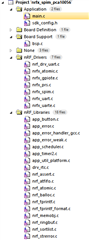
I've spent 2 days on this and am feeling pretty dumb at this point - writing and re-writing just trying to get a demo where I can start SPIM/easyDMA transfers with a push button! Any/all advice would be much much appreciated. Why would I pull in code from ble_app_blinky? Well I'm putting together some firmware that essentially turns an nrf52840 into a SPI <-> BLE pipe. I have all the BLE side of things working in another project, I wanted to spin up the SPI side of things separate but I wanted to use similar blocks that already exist in my BLE firmware.

