This discussion has been locked.
You can no longer post new replies to this discussion. If you have a question you can start a new discussion

Powering nRF52810 with 3.6V Lithium battery

I have designed some beacons based on nRF52810. The software uses the minimum functionality of the radio to transmit some packets every second and sleep.

In their sleep period the beacon consumes around 2-5uA.

I chose to power the beacons with an ER14250 3.6V Lithium battery, 1200mAh.

During an application testing I deployed around 10 beacons that transmitted a packet to a receiver every second. I noticed some of them drained the battery within days which is not reasonable as they should last over 2 years with that battery.

I tried to investigate the problem further. I programmed a beacon to transmit every 100ms.

A week after I found it dead. The battery was completely drained and also the chip was damaged.

I replaced the battery and it didn't work.

I used a bench power supply at 3.5V to check what was going on and I noticed its current consumption was around 150mA which is an indicator of a faulty chip.

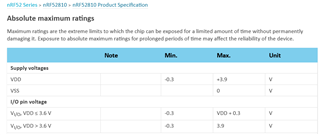
The question is can that battery be used for nRF52810? In the datasheet it says absolute maximum at 3.6V yet in the recommended voltage range it mentions up to 3.6V.

So that's a little confusing as the absolute maximum voltage is the same as the recommended operating voltage.

Can that battery cause damage to the chip?

  • Hi george,

    Edit: A 3.6V battery voltage should normally not cause any problems. (However, as Pål points out, a 3.6V rechargeable battery could potentially be charged to a higher voltage.)

    Table 131 on page 410 in the product specification for nRF52810 specifies VDD max. to +3.9V.

    Would you be able to share the schematics for your design?

    Have you inspected the boards for any assembly errors? Would you be able to share a photo of the board?

  • Hi helsing,

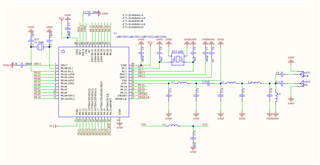
    The beacon board is based on a chinese module E73-2G4M04S1AX of Ebyte

    Below you can see its internal schematic.

    The version we have makes use of an nRF52810 with an external BLE antenna attached to it. We also added an extra 10uF capacitance.

    I also use the integrated DC/DC after following the reference circuit.

    First, do you think that this capacitance is enough?

    Second, What do you think would cause that damage to the module? I mentioned again that it was found dead after a week.

  • Please do note that a rechargeable Li-Ion battery marked 3.6V normally comes with a fully charged voltage of 4.1V to 4.2V (3.6V is the average value during the discharge curve). This means that you can't use any such batteries with the 3.6V nRF5 devices. Any devices that have been attached to such a battery should be considered broken.

  • It is not rechargable. The battery has 3.6V brand new.

  • Hi george

    George555 said:
    We also added an extra 10uF capacitance.

    Where did you add this capacitor?

    George555 said:
    Below you can see its internal schematic.

    Thanks. Would you be able to share anything from the external schematic?

    George555 said:
    What do you think would cause that damage to the module?

    Since not all devices are failing, I would start by visually inspecting the hardware assembly and check the soldering. It would also be interesting to know more about the rest of your unit. Have you done any comparison between the failing beacons with the ones which are not failing? What is the current consumption of the units which are not failing? How much current is drawn in the various operating modes? PPKII is a great tool for these type of measurements.

Related