This discussion has been locked.
You can no longer post new replies to this discussion. If you have a question you can start a new discussion

Powering nRF52810 with 3.6V Lithium battery

I have designed some beacons based on nRF52810. The software uses the minimum functionality of the radio to transmit some packets every second and sleep.

In their sleep period the beacon consumes around 2-5uA.

I chose to power the beacons with an ER14250 3.6V Lithium battery, 1200mAh.

During an application testing I deployed around 10 beacons that transmitted a packet to a receiver every second. I noticed some of them drained the battery within days which is not reasonable as they should last over 2 years with that battery.

I tried to investigate the problem further. I programmed a beacon to transmit every 100ms.

A week after I found it dead. The battery was completely drained and also the chip was damaged.

I replaced the battery and it didn't work.

I used a bench power supply at 3.5V to check what was going on and I noticed its current consumption was around 150mA which is an indicator of a faulty chip.

The question is can that battery be used for nRF52810? In the datasheet it says absolute maximum at 3.6V yet in the recommended voltage range it mentions up to 3.6V.

So that's a little confusing as the absolute maximum voltage is the same as the recommended operating voltage.

Can that battery cause damage to the chip?

  • Hi helsing,

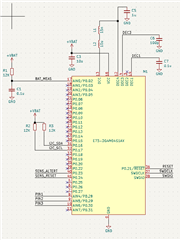
    Below you can see the rest of the schematic

    I2C bus and SENSE_ pins are connected to a integrated temp/humid sensor. The sensor can work up to 5.5V

    The rest of the pins you see on the schematic are not connected anywhere.

    I could not find any reason the module died.

    Do you think the total capacitance on the power rail is enough for the transmission peaks?

    Also, I checked with an oscilloscope the current consumption during transmission and the results are very similar to what I see on

     devzone.nordicsemi.com/.../online-power-profiler-for-bluetooth-le

  • Thank you for sharing the schematics.

    It appears as if you might have doubled the capacitance on DEC1. The reference design for nRF52810 recommends a 100nF capacitor on DEC1. However, both the internal schematics of E73-2G4M04S1A that you posted previously(C18), and your own schematics(C7) shows a 100nF capacitor on DEC1. Using the right capacitance on the DEC pins is highly important. I do not know how doubling the capacitance of DEC1 will effect the circuit, however, at this stage I can not rule out this being the cause of your problem.

    Here are a few other thoughts:

    George555 said:
    I2C bus and SENSE_ pins are connected to a integrated temp/humid sensor. The sensor can work up to 5.5V

    How is the temp/humid sensor powered? What is the voltage on the I2C pins from the sensor?

    BAT_MEAS

    How is AIN0 configured internally?

    Could you please measure AIN0 on both the broken and working units? Is it shorted?

    ER14250 3.6V Lithium battery, 1200mAh

    Have you measured the battery voltage in various conditions when brand new? Would you be able to share the datasheet for your specific battery?

    A picture of your PCB or a report from when you are visually inspecting your PCB would still be interesting to hear about.

  • Hi again,

    I also noticed that the schematics that you provided for the module has a 100nF capacitor connected to DEC3. The recommended value according to the reference design is 100pF. As far as I know, this could potentially also cause problems. Could you please somehow try to verify that the schematic you provided for the module is showing exactly what is inside the module?

  • The question is can that battery be used for nRF52810? In the datasheet it says absolute maximum at 3.6V yet in the recommended voltage range it mentions up to 3.6V.

    Yes, this could be the main issue here. The nRF52810 itself may handle 3.9V max. However, since the datasheet of the module says 3.6V max., then it is important to stay safely below this voltage.

  • I also had a look at DEC4 in your schematic and in the internal schematic of the module. It looks as a the capacitance at DEC4 also deviates from the recommended values in the reference design. The reference design recommends 1.0uF, however, the module is listed with 100nF. If this is the case, nRF52810 is then provided with 1000nF + 100nF instead of 1000nF.

    It is hard to guess exactly what will happen if the capacitance at the DEC pins deviate from the reference design. However, this would be among the most important issues to improve in the design.

    You could try to modify one of the working beacons in order to provide the DEC pins with the correct capacitances, although this is difficult when the module already deviates from the recommendations. You could perhaps contact the module manufacturer in order to get their comments on the DEC pins.

Related