Problem of calculating the value of MPU6050

 MPU6050 cannot calculating the value of 3 axis and the value return is 0. What is problem? How can I fix it ? Thanks for helping me.

AD0 open.Adress is 0x68
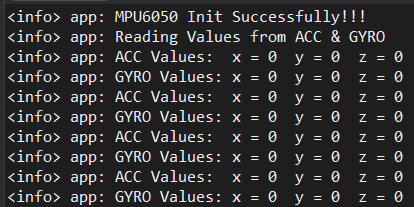
Here is my code

#include <stdio.h>
#include "boards.h"
#include "app_util_platform.h"
#include "app_error.h"
#include "nrf_drv_twi.h"
#include "mpu6050.h"
#include "nrf_log.h"
#include "nrf_log_ctrl.h"
#include "nrf_log_default_backends.h"

int main(void)
{

  // initialize the logger
  APP_ERROR_CHECK(NRF_LOG_INIT(NULL));
  NRF_LOG_DEFAULT_BACKENDS_INIT();

  // create arrays which will hold x,y & z co-ordinates values of acc and gyro
  static int16_t AccValue[3], GyroValue[3];

  bsp_board_init(BSP_INIT_LEDS | BSP_INIT_BUTTONS); // initialize the leds and buttons
                                                    // global function in mpu6050.c
  twi_master_init();                                // initialize the twi
  nrf_delay_ms(1000);                               // give some delay

  while (mpu6050_init() == false) // wait until MPU6050 sensor is successfully initialized
  {
    NRF_LOG_INFO("MPU_6050 initialization failed!!!"); // if it failed to initialize then print a message
    nrf_delay_ms(1000);
  }

  NRF_LOG_INFO("MPU6050 Init Successfully!!!");
  NRF_LOG_INFO("Reading Values from ACC & GYRO"); // display a message to let the user know that the device is starting to read the values
  nrf_delay_ms(2000);

  while (true)
  {                                                                        // global function in mpu6050.c
    if (MPU6050_ReadAcc(&AccValue[0], &AccValue[1], &AccValue[2]) == true) // Read acc value from mpu6050 internal registers and save them in the array
    {
      NRF_LOG_INFO("ACC Values:  x = %d  y = %d  z = %d", AccValue[0], AccValue[1], AccValue[2]); // display the read values
    }
    else
    {
      NRF_LOG_INFO("Reading ACC values Failed!!!"); // if reading was unsuccessful then let the user know about it
    }

    if (MPU6050_ReadGyro(&GyroValue[0], &GyroValue[1], &GyroValue[2]) == true) // read the gyro values from mpu6050's internal registers and save them in another array
    {
      NRF_LOG_INFO("GYRO Values: x = %d  y = %d  z = %d", GyroValue[0], GyroValue[1], GyroValue[2]); // display then values
    }

    else
    {
      NRF_LOG_INFO("Reading GYRO values Failed!!!");
    }

    nrf_delay_ms(100); // give some delay
  }
}
36

  • Hi 

    Can you provide the implementation of the MPU6050_ReadAcc(..) and MPU6050_ReadGyro(..) functions as well? 

    I don't believe these are a part of the standard library in the SDK. 

    In general I would recommend not changing the SDK files directly, but rather make a separate module/file that wraps the SDK files with additional functionality. 

    Best regards
    Torbjørn

  • here is mpu6050.c

    #include <stdbool.h>
    #include <stdint.h>
    #include <string.h>
    #include "nrf_drv_twi.h"
    #include "mpu6050.h"


    //Initializing TWI0 instance
    #define TWI_INSTANCE_ID     0
    
    // A flag to indicate the transfer state
    static volatile bool m_xfer_done = false;
    
    
    // Create a Handle for the twi communication
    static const nrf_drv_twi_t m_twi = NRF_DRV_TWI_INSTANCE(TWI_INSTANCE_ID);


    //Event Handler
    void twi_handler(nrf_drv_twi_evt_t const * p_event, void * p_context)
    {
        //Check the event to see what type of event occurred
        switch (p_event->type)
        {
            //If data transmission or receiving is finished
    	case NRF_DRV_TWI_EVT_DONE:
            m_xfer_done = true;//Set the flag
            break;
            
            default:
            // do nothing
              break;
        }
    }


    //Initialize the TWI as Master device
    void twi_master_init(void)
    {
        ret_code_t err_code;
    
        // Configure the settings for twi communication
        const nrf_drv_twi_config_t twi_config = {
           .scl                = TWI_SCL_M,  //SCL Pin
           .sda                = TWI_SDA_M,  //SDA Pin
           .frequency          = NRF_DRV_TWI_FREQ_400K, //Communication Speed
           .interrupt_priority = APP_IRQ_PRIORITY_HIGH, //Interrupt Priority(Note: if using Bluetooth then select priority carefully)
           .clear_bus_init     = false //automatically clear bus
        };
    
    
        //A function to initialize the twi communication
        err_code = nrf_drv_twi_init(&m_twi, &twi_config, twi_handler, NULL);
        APP_ERROR_CHECK(err_code);
        
        //Enable the TWI Communication
        nrf_drv_twi_enable(&m_twi);
    }


    /*
       A function to write a Single Byte to MPU6050's internal Register
    */ 
    bool mpu6050_register_write(uint8_t register_address, uint8_t value)
    {
        ret_code_t err_code;
        uint8_t tx_buf[MPU6050_ADDRESS_LEN+1];
    	
        //Write the register address and data into transmit buffer
        tx_buf[0] = register_address;
        tx_buf[1] = value;
    
        //Set the flag to false to show the transmission is not yet completed
        m_xfer_done = false;
        
        //Transmit the data over TWI Bus
        err_code = nrf_drv_twi_tx(&m_twi, MPU6050_ADDRESS, tx_buf, MPU6050_ADDRESS_LEN+1, false);
        
        //Wait until the transmission of the data is finished
        while (m_xfer_done == false)
        {
          }
    
        // if there is no error then return true else return false
        if (NRF_SUCCESS != err_code)
        {
            return false;
        }
        
        return true;	
    }


    /*
      A Function to read data from the MPU6050
    */ 
    bool mpu6050_register_read(uint8_t register_address, uint8_t * destination, uint8_t number_of_bytes)
    {
        ret_code_t err_code;
    
        //Set the flag to false to show the receiving is not yet completed
        m_xfer_done = false;
        
        // Send the Register address where we want to write the data
        err_code = nrf_drv_twi_tx(&m_twi, MPU6050_ADDRESS, &register_address, 1, true);
    	  
        //Wait for the transmission to get completed
        while (m_xfer_done == false){}
        
        // If transmission was not successful, exit the function with false as return value
        if (NRF_SUCCESS != err_code)
        {
            return false;
        }
    
        //set the flag again so that we can read data from the MPU6050's internal register
        m_xfer_done = false;
    	  
        // Receive the data from the MPU6050
        err_code = nrf_drv_twi_rx(&m_twi, MPU6050_ADDRESS, destination, number_of_bytes);
    		
        //wait until the transmission is completed
        while (m_xfer_done == false){}
    	
        // if data was successfully read, return true else return false
        if (NRF_SUCCESS != err_code)
        {
            return false;
        }
        
        return true;
    }


    /*
      A Function to verify the product id
      (its a basic test to check if we are communicating with the right slave, every type of I2C Device has 
      a special WHO_AM_I register which holds a specific value, we can read it from the MPU6050 or any device
      to confirm we are communicating with the right device)
    */ 
    bool mpu6050_verify_product_id(void)
    {
        uint8_t who_am_i; // create a variable to hold the who am i value
    
    
        // Note: All the register addresses including WHO_AM_I are declared in 
        // MPU6050.h file, you can check these addresses and values from the
        // datasheet of your slave device.
        if (mpu6050_register_read(ADDRESS_WHO_AM_I, &who_am_i, 1))
        {
            if (who_am_i != MPU6050_WHO_AM_I)
            {
                return false;
            }
            else
            {
                return true;
            }
        }
        else
        {
            return false;
        }
    }
    
    
    /*
      Function to initialize the mpu6050
    */ 
    bool mpu6050_init(void)
    {   
      bool transfer_succeeded = true;
    	
      //Check the id to confirm that we are communicating with the right device
      transfer_succeeded &= mpu6050_verify_product_id();
    	
      if(mpu6050_verify_product_id() == false)
        {
    	return false;
          }
    
      // Set the registers with the required values, see the datasheet to get a good idea of these values
      (void)mpu6050_register_write(MPU_PWR_MGMT1_REG , 0x00); 
      (void)mpu6050_register_write(MPU_SAMPLE_RATE_REG , 0x07); 
      (void)mpu6050_register_write(MPU_CFG_REG , 0x06); 						
      (void)mpu6050_register_write(MPU_INT_EN_REG, 0x00); 
      (void)mpu6050_register_write(MPU_GYRO_CFG_REG , 0x18); 
      (void)mpu6050_register_write(MPU_ACCEL_CFG_REG,0x00); 
        		
    
      return transfer_succeeded;
    }


    /*
      Read the Gyro values from the MPU6050's internal Registers
    */ 
    bool MPU6050_ReadGyro(int16_t *pGYRO_X , int16_t *pGYRO_Y , int16_t *pGYRO_Z )
    {
      uint8_t buf[6]; 
      
      bool ret = false;	
    	
      if(mpu6050_register_read(MPU6050_GYRO_OUT,  buf, 6) == true)
      {
        *pGYRO_X = (buf[0] << 8) | buf[1];
        if(*pGYRO_X & 0x8000) *pGYRO_X-=65536;
    		
        *pGYRO_Y= (buf[2] << 8) | buf[3];
        if(*pGYRO_Y & 0x8000) *pGYRO_Y-=65536;
    	
        *pGYRO_Z = (buf[4] << 8) | buf[5];
        if(*pGYRO_Z & 0x8000) *pGYRO_Z-=65536;
    		
        ret = true;
    	}
    
      return ret;
    }	


    /*
      A Function to read accelerometer's values from the internal registers of MPU6050
    */ 
    bool MPU6050_ReadAcc( int16_t *pACC_X , int16_t *pACC_Y , int16_t *pACC_Z )
    {
      uint8_t buf[6];
      bool ret = false;		
      
      if(mpu6050_register_read(MPU6050_ACC_OUT, buf, 6) == true)
      {
        mpu6050_register_read(MPU6050_ACC_OUT, buf, 6);
        
        *pACC_X = (buf[0] << 8) | buf[1];
        if(*pACC_X & 0x8000) *pACC_X-=65536;
    
        *pACC_Y= (buf[2] << 8) | buf[3];
        if(*pACC_Y & 0x8000) *pACC_Y-=65536;
    
        *pACC_Z = (buf[4] << 8) | buf[5];
        if(*pACC_Z & 0x8000) *pACC_Z-=65536;
    		
        ret = true;
        }
      
      return ret;
    }

    And here is mpu6050.h

    #ifndef AT24C02_H__
    #define AT24C02_H__
    #include "nrf_delay.h"
    
    //I2C Pins Settings, you change them to any other pins
    #define TWI_SCL_M           21         //I2C SCL Pin
    #define TWI_SDA_M           11         //I2C SDA Pin
    
    
    #define MPU6050_ADDRESS_LEN  1         //MPU6050
    #define MPU6050_ADDRESS     (0x68U)  //MPU6050 Device Address
    #define MPU6050_WHO_AM_I     0x68U     //MPU6050 ID
    
    
    #define MPU6050_GYRO_OUT        0x43
    #define MPU6050_ACC_OUT         0x3B
    
    #define ADDRESS_WHO_AM_I          (0x75U) //  WHO_AM_I register identifies the device. Expected value is 0x68.
    #define ADDRESS_SIGNAL_PATH_RESET (0x68U) // 
    
    //MPU6050 Registers addresses, see datasheet for more info and each register's function
    #define MPU_SELF_TESTX_REG		0x0D	
    #define MPU_SELF_TESTY_REG		0x0E	
    #define MPU_SELF_TESTZ_REG		0x0F	
    #define MPU_SELF_TESTA_REG		0x10	
    #define MPU_SAMPLE_RATE_REG		0x19	
    #define MPU_CFG_REG                     0x1A	
    #define MPU_GYRO_CFG_REG		0x1B	
    #define MPU_ACCEL_CFG_REG		0x1C	
    #define MPU_MOTION_DET_REG		0x1F	
    #define MPU_FIFO_EN_REG			0x23	
    #define MPU_I2CMST_CTRL_REG		0x24	
    #define MPU_I2CSLV0_ADDR_REG            0x25	
    #define MPU_I2CSLV0_REG			0x26	
    #define MPU_I2CSLV0_CTRL_REG            0x27	
    #define MPU_I2CSLV1_ADDR_REG            0x28	
    #define MPU_I2CSLV1_REG			0x29	
    #define MPU_I2CSLV1_CTRL_REG            0x2A	
    #define MPU_I2CSLV2_ADDR_REG            0x2B	
    #define MPU_I2CSLV2_REG			0x2C	
    #define MPU_I2CSLV2_CTRL_REG            0x2D	
    #define MPU_I2CSLV3_ADDR_REG            0x2E	
    #define MPU_I2CSLV3_REG			0x2F	
    #define MPU_I2CSLV3_CTRL_REG            0x30	
    #define MPU_I2CSLV4_ADDR_REG            0x31	
    #define MPU_I2CSLV4_REG			0x32	
    #define MPU_I2CSLV4_DO_REG		0x33	
    #define MPU_I2CSLV4_CTRL_REG            0x34	
    #define MPU_I2CSLV4_DI_REG		0x35	
    
    
    #define MPU_PWR_MGMT1_REG		0x6B	
    #define MPU_PWR_MGMT2_REG		0x6C	
    
    #define MPU_I2CMST_STA_REG		0x36	
    #define MPU_INTBP_CFG_REG		0x37	
    #define MPU_INT_EN_REG			0x38	
    #define MPU_INT_STA_REG			0x3A	
    
    #define MPU_I2CMST_DELAY_REG            0x67	
    #define MPU_SIGPATH_RST_REG		0x68	
    #define MPU_MDETECT_CTRL_REG            0x69	
    #define MPU_USER_CTRL_REG		0x6A	
    #define MPU_PWR_MGMT1_REG		0x6B	
    #define MPU_PWR_MGMT2_REG		0x6C	
    #define MPU_FIFO_CNTH_REG		0x72	
    #define MPU_FIFO_CNTL_REG		0x73	
    #define MPU_FIFO_RW_REG			0x74	
    #define MPU_DEVICE_ID_REG		0x75	
    
    void twi_master_init(void); // initialize the twi communication
    bool mpu6050_init(void);    // initialize the mpu6050
    
    /**
      @brief Function for writing a MPU6050 register contents over TWI.
      @param[in]  register_address Register address to start writing to
      @param[in] value Value to write to register
      @retval true Register write succeeded
      @retval false Register write failed
    */
    bool mpu6050_register_write(uint8_t register_address, const uint8_t value);
    
    /**
      @brief Function for reading MPU6050 register contents over TWI.
      Reads one or more consecutive registers.
      @param[in]  register_address Register address to start reading from
      @param[in]  number_of_bytes Number of bytes to read
      @param[out] destination Pointer to a data buffer where read data will be stored
      @retval true Register read succeeded
      @retval false Register read failed
    */
    bool mpu6050_register_read(uint8_t register_address, uint8_t *destination, uint8_t number_of_bytes);
    
    /**
      @brief Function for reading and verifying MPU6050 product ID.
      @retval true Product ID is what was expected
      @retval false Product ID was not what was expected
    */
    bool mpu6050_verify_product_id(void);
    
    
    bool MPU6050_ReadGyro(int16_t *pGYRO_X , int16_t *pGYRO_Y , int16_t *pGYRO_Z );
    bool MPU6050_ReadAcc( int16_t *pACC_X , int16_t *pACC_Y , int16_t *pACC_Z );
    
    #endif

  • Hi 

    Have you tried to check with a scope or logic analyzer what is being sent/received over the I2C bus?

    If yes, would you be able to share the traces?

    Best regards
    Torbjørn

Related