Hi,
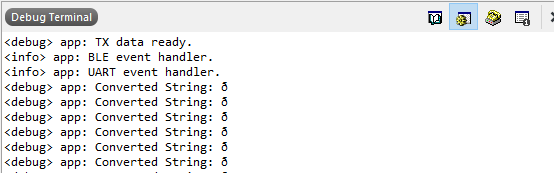
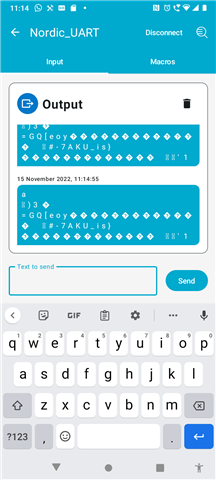
I am writing a program that sends numbers counting up sequentially from my dev board to my phone on 500ms intervals. I used the ble_app_uart example as my base. I am trying to use the command ble_nus_data_send(&m_nus, up_counter, &length, m_conn_handle); to send the data to my phone. When I start the process, I can successfully send the string "Counting up." to my phone, but the counting numbers do not display properly. Instead, some unreadable text shows up on my phone; it looks like a problem when a device cannot interpret an ascii code. Does anyone know why I might be encountering this problem? For reference, my code and a screenshot of the output are posted below; the problem is on line 903.
/**
* Copyright (c) 2014 - 2021, Nordic Semiconductor ASA
*
* All rights reserved.
*
* Redistribution and use in source and binary forms, with or without modification,
* are permitted provided that the following conditions are met:
*
* 1. Redistributions of source code must retain the above copyright notice, this
* list of conditions and the following disclaimer.
*
* 2. Redistributions in binary form, except as embedded into a Nordic
* Semiconductor ASA integrated circuit in a product or a software update for
* such product, must reproduce the above copyright notice, this list of
* conditions and the following disclaimer in the documentation and/or other
* materials provided with the distribution.
*
* 3. Neither the name of Nordic Semiconductor ASA nor the names of its
* contributors may be used to endorse or promote products derived from this
* software without specific prior written permission.
*
* 4. This software, with or without modification, must only be used with a
* Nordic Semiconductor ASA integrated circuit.
*
* 5. Any software provided in binary form under this license must not be reverse
* engineered, decompiled, modified and/or disassembled.
*
* THIS SOFTWARE IS PROVIDED BY NORDIC SEMICONDUCTOR ASA "AS IS" AND ANY EXPRESS
* OR IMPLIED WARRANTIES, INCLUDING, BUT NOT LIMITED TO, THE IMPLIED WARRANTIES
* OF MERCHANTABILITY, NONINFRINGEMENT, AND FITNESS FOR A PARTICULAR PURPOSE ARE
* DISCLAIMED. IN NO EVENT SHALL NORDIC SEMICONDUCTOR ASA OR CONTRIBUTORS BE
* LIABLE FOR ANY DIRECT, INDIRECT, INCIDENTAL, SPECIAL, EXEMPLARY, OR
* CONSEQUENTIAL DAMAGES (INCLUDING, BUT NOT LIMITED TO, PROCUREMENT OF SUBSTITUTE
* GOODS OR SERVICES; LOSS OF USE, DATA, OR PROFITS; OR BUSINESS INTERRUPTION)
* HOWEVER CAUSED AND ON ANY THEORY OF LIABILITY, WHETHER IN CONTRACT, STRICT
* LIABILITY, OR TORT (INCLUDING NEGLIGENCE OR OTHERWISE) ARISING IN ANY WAY OUT
* OF THE USE OF THIS SOFTWARE, EVEN IF ADVISED OF THE POSSIBILITY OF SUCH DAMAGE.
*
*/
/** @file
*
* @defgroup ble_sdk_uart_over_ble_main main.c
* @{
* @ingroup ble_sdk_app_nus_eval
* @brief UART over BLE application main file.
*
* This file contains the source code for a sample application that uses the Nordic UART service.
* This application uses the @ref srvlib_conn_params module.
*/
#include <stdint.h>
#include <string.h>
#include <time.h>
#include "nrf_delay.h"
#include "nordic_common.h"
#include "nrf.h"
#include "ble_hci.h"
#include "ble_advdata.h"
#include "ble_advertising.h"
#include "ble_conn_params.h"
#include "nrf_sdh.h"
#include "nrf_sdh_soc.h"
#include "nrf_sdh_ble.h"
#include "nrf_ble_gatt.h"
#include "nrf_ble_qwr.h"
#include "app_timer.h"
//#include "app_scheduler.h"
#include "nrf_drv_clock.h"
#include "ble_nus.h"
#include "app_uart.h"
#include "app_util_platform.h"
#include "bsp_btn_ble.h"
#include "nrf_pwr_mgmt.h"
#if defined (UART_PRESENT)
#include "nrf_uart.h"
#endif
#if defined (UARTE_PRESENT)
#include "nrf_uarte.h"
#endif
#include "nrf_log.h"
#include "nrf_log_ctrl.h"
#include "nrf_log_default_backends.h"
/*
#include "nrf_cli.h"
#include "nrf_cli_rtt.h"
#include "nrf_cli_types.h"
*/
#define APP_BLE_CONN_CFG_TAG 1 /**< A tag identifying the SoftDevice BLE configuration. */
#define DEVICE_NAME "Nordic_UART" /**< Name of device. Will be included in the advertising data. */
#define NUS_SERVICE_UUID_TYPE BLE_UUID_TYPE_VENDOR_BEGIN /**< UUID type for the Nordic UART Service (vendor specific). */
#define APP_BLE_OBSERVER_PRIO 3 /**< Application's BLE observer priority. You shouldn't need to modify this value. */
#define APP_ADV_INTERVAL 64 /**< The advertising interval (in units of 0.625 ms. This value corresponds to 40 ms). */
#define APP_ADV_DURATION 18000 /**< The advertising duration (180 seconds) in units of 10 milliseconds. */
#define MIN_CONN_INTERVAL MSEC_TO_UNITS(20, UNIT_1_25_MS) /**< Minimum acceptable connection interval (20 ms), Connection interval uses 1.25 ms units. */
#define MAX_CONN_INTERVAL MSEC_TO_UNITS(75, UNIT_1_25_MS) /**< Maximum acceptable connection interval (75 ms), Connection interval uses 1.25 ms units. */
#define SLAVE_LATENCY 0 /**< Slave latency. */
#define CONN_SUP_TIMEOUT MSEC_TO_UNITS(4000, UNIT_10_MS) /**< Connection supervisory timeout (4 seconds), Supervision Timeout uses 10 ms units. */
#define FIRST_CONN_PARAMS_UPDATE_DELAY APP_TIMER_TICKS(5000) /**< Time from initiating event (connect or start of notification) to first time sd_ble_gap_conn_param_update is called (5 seconds). */
#define NEXT_CONN_PARAMS_UPDATE_DELAY APP_TIMER_TICKS(30000) /**< Time between each call to sd_ble_gap_conn_param_update after the first call (30 seconds). */
#define MAX_CONN_PARAMS_UPDATE_COUNT 3 /**< Number of attempts before giving up the connection parameter negotiation. */
#define DEAD_BEEF 0xDEADBEEF /**< Value used as error code on stack dump, can be used to identify stack location on stack unwind. */
#define UART_TX_BUF_SIZE 256 /**< UART TX buffer size. */
#define UART_RX_BUF_SIZE 256 /**< UART RX buffer size. */
#define UP_HIGH_LIM 255
#define UP_LOW_LIM 0
#define UP_DELAY_TIME 50
#define DN_HIGH_LIM 1000
#define DN_LOW_LIM 1
#define DN_DELAY_TIME 500
#define DELAY_TIME 500
BLE_NUS_DEF(m_nus, NRF_SDH_BLE_TOTAL_LINK_COUNT); /**< BLE NUS service instance. */
NRF_BLE_GATT_DEF(m_gatt); /**< GATT module instance. */
NRF_BLE_QWR_DEF(m_qwr); /**< Context for the Queued Write module.*/
BLE_ADVERTISING_DEF(m_advertising); /**< Advertising module instance. */
APP_TIMER_DEF(m_repeated_timer_id);
APP_TIMER_DEF(m_single_shot_timer_id);
uint8_t timer_flag = 0;
static uint16_t m_conn_handle = BLE_CONN_HANDLE_INVALID; /**< Handle of the current connection. */
static uint16_t m_ble_nus_max_data_len = BLE_GATT_ATT_MTU_DEFAULT - 3; /**< Maximum length of data (in bytes) that can be transmitted to the peer by the Nordic UART service module. */
static ble_uuid_t m_adv_uuids[] = /**< Universally unique service identifier. */
{
{BLE_UUID_NUS_SERVICE, NUS_SERVICE_UUID_TYPE}
};
/**@brief Function for assert macro callback.
*
* @details This function will be called in case of an assert in the SoftDevice.
*
* @warning This handler is an example only and does not fit a final product. You need to analyse
* how your product is supposed to react in case of Assert.
* @warning On assert from the SoftDevice, the system can only recover on reset.
*
* @param[in] line_num Line number of the failing ASSERT call.
* @param[in] p_file_name File name of the failing ASSERT call.
*/
void assert_nrf_callback(uint16_t line_num, const uint8_t * p_file_name)
{
app_error_handler(DEAD_BEEF, line_num, p_file_name);
}
/**@brief Function for initializing the timer module.
*/
static void timers_init(void)
{
ret_code_t err_code = app_timer_init();
APP_ERROR_CHECK(err_code);
}
/**@brief Function starting the internal LFCLK oscillator.
*
* @details This is needed by RTC1 which is used by the Application Timer
* (When SoftDevice is enabled the LFCLK is always running and this is not needed).
*/
static void lfclk_request(void)
{
ret_code_t err_code = nrf_drv_clock_init();
APP_ERROR_CHECK(err_code);
nrf_drv_clock_lfclk_request(NULL);
}
/**@brief Timeout handler for the repeated timer.
*/
static void repeated_timer_handler(void * p_context)
{
//nrf_drv_gpiote_out_toggle(LED_1);
//nrf_delay_ms(500);
//app_timer_stop(m_repeated_timer_id);
//timer_flag = 1;
count_up();
}
/**@brief Timeout handler for the single shot timer.
*/
static void single_shot_timer_handler(void * p_context)
{
//nrf_drv_gpiote_out_clear(LED_2);
timer_flag = 1;
}
/**@brief Create timers.
*/
static void create_timers()
{
ret_code_t err_code;
// Create timers
err_code = app_timer_create(&m_repeated_timer_id,
APP_TIMER_MODE_REPEATED,
repeated_timer_handler);
APP_ERROR_CHECK(err_code);
}
/**@brief Function for the GAP initialization.
*
* @details This function will set up all the necessary GAP (Generic Access Profile) parameters of
* the device. It also sets the permissions and appearance.
*/
APP_SCHED_INIT(SCHED_MAX_EVENT_DATA_SIZE, SCHED_QUEUE_SIZE);
static void gap_params_init(void)
{
uint32_t err_code;
ble_gap_conn_params_t gap_conn_params;
ble_gap_conn_sec_mode_t sec_mode;
BLE_GAP_CONN_SEC_MODE_SET_OPEN(&sec_mode);
err_code = sd_ble_gap_device_name_set(&sec_mode,
(const uint8_t *) DEVICE_NAME,
strlen(DEVICE_NAME));
APP_ERROR_CHECK(err_code);
memset(&gap_conn_params, 0, sizeof(gap_conn_params));
gap_conn_params.min_conn_interval = MIN_CONN_INTERVAL;
gap_conn_params.max_conn_interval = MAX_CONN_INTERVAL;
gap_conn_params.slave_latency = SLAVE_LATENCY;
gap_conn_params.conn_sup_timeout = CONN_SUP_TIMEOUT;
err_code = sd_ble_gap_ppcp_set(&gap_conn_params);
APP_ERROR_CHECK(err_code);
}
/**@brief Function for handling Queued Write Module errors.
*
* @details A pointer to this function will be passed to each service which may need to inform the
* application about an error.
*
* @param[in] nrf_error Error code containing information about what went wrong.
*/
static void nrf_qwr_error_handler(uint32_t nrf_error)
{
APP_ERROR_HANDLER(nrf_error);
}
/**@brief Function for handling the data from the Nordic UART Service.
*
* @details This function will process the data received from the Nordic UART BLE Service and send
* it to the UART module.
*
* @param[in] p_evt Nordic UART Service event.
*/
/**@snippet [Handling the data received over BLE] */
static void nus_data_handler(ble_nus_evt_t * p_evt)
{
NRF_LOG_DEBUG("NUS data handler.");
uint8_t data_array[BLE_NUS_MAX_DATA_LEN];
uint8_t b[BLE_NUS_MAX_DATA_LEN];
if (p_evt->type == BLE_NUS_EVT_RX_DATA)
{
uint32_t err_code;
NRF_LOG_DEBUG("Received data from BLE NUS. Writing data on UART.");
NRF_LOG_HEXDUMP_DEBUG(p_evt->params.rx_data.p_data, p_evt->params.rx_data.length);
for (uint32_t i = 0; i < p_evt->params.rx_data.length; i++)
{
//b[i] = app_uart_get(&data_array[i]);
b[i] = app_uart_get(&data_array[i]);
do
{
err_code = app_uart_put(p_evt->params.rx_data.p_data[i]);
if ((err_code != NRF_SUCCESS) && (err_code != NRF_ERROR_BUSY))
{
NRF_LOG_ERROR("Failed receiving NUS message. Error 0x%x. ", err_code);
APP_ERROR_CHECK(err_code);
}
} while (err_code == NRF_ERROR_BUSY);
}
if (p_evt->params.rx_data.p_data[p_evt->params.rx_data.length - 1] == '\r')
{
while (app_uart_put('\n') == NRF_ERROR_BUSY);
}
if((memcmp(p_evt->params.rx_data.p_data,"0x01", p_evt->params.rx_data.length) == 0))
{
NRF_LOG_DEBUG("Sending response.");
char a[BLE_NUS_MAX_DATA_LEN] = "Counting up.";
int length = BLE_NUS_MAX_DATA_LEN;
ble_nus_data_send(&m_nus, a, &length, m_conn_handle);
uint32_t time_err_code;
static uint32_t timeout = 0;
NRF_LOG_DEBUG("TX data ready.");
for(int i = 0; i <= 255; ++i)
{
timeout += 500;
time_err_code = app_timer_start(m_repeated_timer_id, APP_TIMER_TICKS(timeout), NULL);
//count_up((uint8_t *)i);
}
}else if((memcmp(p_evt->params.rx_data.p_data,"0x02", p_evt->params.rx_data.length) == 0))
{
NRF_LOG_DEBUG("Sending response.");
char a[BLE_NUS_MAX_DATA_LEN] = "Counting down.";
int length = BLE_NUS_MAX_DATA_LEN;
//ble_nus_data_send(&m_nus, a, &length, m_conn_handle);
}
}
}
/**@snippet [Handling the data received over BLE] */
/**@brief Function for initializing services that will be used by the application.
*/
static void services_init(void)
{
uint32_t err_code;
ble_nus_init_t nus_init;
nrf_ble_qwr_init_t qwr_init = {0};
// Initialize Queued Write Module.
qwr_init.error_handler = nrf_qwr_error_handler;
err_code = nrf_ble_qwr_init(&m_qwr, &qwr_init);
APP_ERROR_CHECK(err_code);
// Initialize NUS.
memset(&nus_init, 0, sizeof(nus_init));
nus_init.data_handler = nus_data_handler;
err_code = ble_nus_init(&m_nus, &nus_init);
APP_ERROR_CHECK(err_code);
}
/**@brief Function for handling an event from the Connection Parameters Module.
*
* @details This function will be called for all events in the Connection Parameters Module
* which are passed to the application.
*
* @note All this function does is to disconnect. This could have been done by simply setting
* the disconnect_on_fail config parameter, but instead we use the event handler
* mechanism to demonstrate its use.
*
* @param[in] p_evt Event received from the Connection Parameters Module.
*/
static void on_conn_params_evt(ble_conn_params_evt_t * p_evt)
{
uint32_t err_code;
if (p_evt->evt_type == BLE_CONN_PARAMS_EVT_FAILED)
{
err_code = sd_ble_gap_disconnect(m_conn_handle, BLE_HCI_CONN_INTERVAL_UNACCEPTABLE);
APP_ERROR_CHECK(err_code);
}
}
/**@brief Function for handling errors from the Connection Parameters module.
*
* @param[in] nrf_error Error code containing information about what went wrong.
*/
static void conn_params_error_handler(uint32_t nrf_error)
{
APP_ERROR_HANDLER(nrf_error);
}
/**@brief Function for initializing the Connection Parameters module.
*/
static void conn_params_init(void)
{
uint32_t err_code;
ble_conn_params_init_t cp_init;
memset(&cp_init, 0, sizeof(cp_init));
cp_init.p_conn_params = NULL;
cp_init.first_conn_params_update_delay = FIRST_CONN_PARAMS_UPDATE_DELAY;
cp_init.next_conn_params_update_delay = NEXT_CONN_PARAMS_UPDATE_DELAY;
cp_init.max_conn_params_update_count = MAX_CONN_PARAMS_UPDATE_COUNT;
cp_init.start_on_notify_cccd_handle = BLE_GATT_HANDLE_INVALID;
cp_init.disconnect_on_fail = false;
cp_init.evt_handler = on_conn_params_evt;
cp_init.error_handler = conn_params_error_handler;
err_code = ble_conn_params_init(&cp_init);
APP_ERROR_CHECK(err_code);
}
/**@brief Function for putting the chip into sleep mode.
*
* @note This function will not return.
*/
static void sleep_mode_enter(void)
{
uint32_t err_code = bsp_indication_set(BSP_INDICATE_IDLE);
APP_ERROR_CHECK(err_code);
// Prepare wakeup buttons.
err_code = bsp_btn_ble_sleep_mode_prepare();
APP_ERROR_CHECK(err_code);
// Go to system-off mode (this function will not return; wakeup will cause a reset).
err_code = sd_power_system_off();
APP_ERROR_CHECK(err_code);
}
/**@brief Function for handling advertising events.
*
* @details This function will be called for advertising events which are passed to the application.
*
* @param[in] ble_adv_evt Advertising event.
*/
static void on_adv_evt(ble_adv_evt_t ble_adv_evt)
{
uint32_t err_code;
switch (ble_adv_evt)
{
case BLE_ADV_EVT_FAST:
err_code = bsp_indication_set(BSP_INDICATE_ADVERTISING);
APP_ERROR_CHECK(err_code);
break;
case BLE_ADV_EVT_IDLE:
sleep_mode_enter();
break;
default:
break;
}
}
/**@brief Function for handling BLE events.
*
* @param[in] p_ble_evt Bluetooth stack event.
* @param[in] p_context Unused.
*/
volatile uint8_t m_last_successful_conn_handle = 0;
static void ble_evt_handler(ble_evt_t const * p_ble_evt, void * p_context)
{
uint32_t err_code;
NRF_LOG_INFO("BLE event handler.");
switch (p_ble_evt->header.evt_id)
{
case BLE_GAP_EVT_CONNECTED:
NRF_LOG_INFO("Connected");
err_code = bsp_indication_set(BSP_INDICATE_CONNECTED);
APP_ERROR_CHECK(err_code);
m_conn_handle = p_ble_evt->evt.gap_evt.conn_handle;
err_code = nrf_ble_qwr_conn_handle_assign(&m_qwr, m_conn_handle);
APP_ERROR_CHECK(err_code);
break;
case BLE_GAP_EVT_DISCONNECTED:
NRF_LOG_INFO("Disconnected");
// LED indication will be changed when advertising starts.
m_conn_handle = BLE_CONN_HANDLE_INVALID;
break;
/*case BLE_GATTS_EVT_HVN_TX_COMPLETE:
{
uint32_t time_err_code;
static uint32_t timeout = 0;
NRF_LOG_DEBUG("TX data ready.");
for(int i = 0; i <= 255; ++i)
{
timeout += 500;
time_err_code = app_timer_start(m_repeated_timer_id, APP_TIMER_TICKS(timeout), NULL);
//count_up((uint8_t *)i);
}
} break;*/
case BLE_GAP_EVT_PHY_UPDATE_REQUEST:
{
NRF_LOG_INFO("PHY update request.");
ble_gap_phys_t const phys =
{
.rx_phys = BLE_GAP_PHY_AUTO,
.tx_phys = BLE_GAP_PHY_AUTO,
};
err_code = sd_ble_gap_phy_update(p_ble_evt->evt.gap_evt.conn_handle, &phys);
APP_ERROR_CHECK(err_code);
} break;
case BLE_GAP_EVT_SEC_PARAMS_REQUEST:
// Pairing not supported
NRF_LOG_INFO("Pairing not supported.");
err_code = sd_ble_gap_sec_params_reply(m_conn_handle, BLE_GAP_SEC_STATUS_PAIRING_NOT_SUPP, NULL, NULL);
APP_ERROR_CHECK(err_code);
break;
case BLE_GATTS_EVT_SYS_ATTR_MISSING:
// No system attributes have been stored.
NRF_LOG_INFO("No system attributes have been stored.");
err_code = sd_ble_gatts_sys_attr_set(m_conn_handle, NULL, 0, 0);
APP_ERROR_CHECK(err_code);
break;
case BLE_GATTC_EVT_TIMEOUT:
// Disconnect on GATT Client timeout event.
NRF_LOG_INFO("Timeout from client.");
err_code = sd_ble_gap_disconnect(p_ble_evt->evt.gattc_evt.conn_handle,
BLE_HCI_REMOTE_USER_TERMINATED_CONNECTION);
APP_ERROR_CHECK(err_code);
break;
case BLE_GATTS_EVT_TIMEOUT:
// Disconnect on GATT Server timeout event.
NRF_LOG_INFO("Timeout from server.");
err_code = sd_ble_gap_disconnect(p_ble_evt->evt.gatts_evt.conn_handle,
BLE_HCI_REMOTE_USER_TERMINATED_CONNECTION);
APP_ERROR_CHECK(err_code);
break;
default:
// No implementation needed.
break;
}
}
/**@brief Function for the SoftDevice initialization.
*
* @details This function initializes the SoftDevice and the BLE event interrupt.
*/
static void ble_stack_init(void)
{
ret_code_t err_code;
err_code = nrf_sdh_enable_request();
APP_ERROR_CHECK(err_code);
// Configure the BLE stack using the default settings.
// Fetch the start address of the application RAM.
uint32_t ram_start = 0;
err_code = nrf_sdh_ble_default_cfg_set(APP_BLE_CONN_CFG_TAG, &ram_start);
APP_ERROR_CHECK(err_code);
// Enable BLE stack.
err_code = nrf_sdh_ble_enable(&ram_start);
APP_ERROR_CHECK(err_code);
// Register a handler for BLE events.
NRF_SDH_BLE_OBSERVER(m_ble_observer, APP_BLE_OBSERVER_PRIO, ble_evt_handler, NULL);
}
/**@brief Function for handling events from the GATT library. */
void gatt_evt_handler(nrf_ble_gatt_t * p_gatt, nrf_ble_gatt_evt_t const * p_evt)
{
if ((m_conn_handle == p_evt->conn_handle) && (p_evt->evt_id == NRF_BLE_GATT_EVT_ATT_MTU_UPDATED))
{
m_ble_nus_max_data_len = p_evt->params.att_mtu_effective - OPCODE_LENGTH - HANDLE_LENGTH;
NRF_LOG_INFO("Data len is set to 0x%X(%d)", m_ble_nus_max_data_len, m_ble_nus_max_data_len);
}
NRF_LOG_DEBUG("ATT MTU exchange completed. central 0x%x peripheral 0x%x",
p_gatt->att_mtu_desired_central,
p_gatt->att_mtu_desired_periph);
}
/**@brief Function for initializing the GATT library. */
void gatt_init(void)
{
ret_code_t err_code;
err_code = nrf_ble_gatt_init(&m_gatt, gatt_evt_handler);
APP_ERROR_CHECK(err_code);
err_code = nrf_ble_gatt_att_mtu_periph_set(&m_gatt, NRF_SDH_BLE_GATT_MAX_MTU_SIZE);
APP_ERROR_CHECK(err_code);
}
/**@brief Function for handling events from the BSP module.
*
* @param[in] event Event generated by button press.
*/
void bsp_event_handler(bsp_event_t event)
{
uint32_t err_code;
switch (event)
{
case BSP_EVENT_SLEEP:
sleep_mode_enter();
break;
case BSP_EVENT_DISCONNECT:
err_code = sd_ble_gap_disconnect(m_conn_handle, BLE_HCI_REMOTE_USER_TERMINATED_CONNECTION);
if (err_code != NRF_ERROR_INVALID_STATE)
{
APP_ERROR_CHECK(err_code);
}
break;
case BSP_EVENT_WHITELIST_OFF:
if (m_conn_handle == BLE_CONN_HANDLE_INVALID)
{
err_code = ble_advertising_restart_without_whitelist(&m_advertising);
if (err_code != NRF_ERROR_INVALID_STATE)
{
APP_ERROR_CHECK(err_code);
}
}
break;
default:
break;
}
}
/**@brief Function for handling app_uart events.
*
* @details This function will receive a single character from the app_uart module and append it to
* a string. The string will be be sent over BLE when the last character received was a
* 'new line' '\n' (hex 0x0A) or if the string has reached the maximum data length.
*/
/**@snippet [Handling the data received over UART] */
void uart_event_handle(app_uart_evt_t * p_event)
{
static uint8_t data_array[BLE_NUS_MAX_DATA_LEN];
static uint8_t index = 0;
uint32_t err_code;
NRF_LOG_INFO("UART event handler.");
switch (p_event->evt_type)
{
case APP_UART_DATA_READY:
NRF_LOG_INFO("Data is ready.");
UNUSED_VARIABLE(app_uart_get(&data_array[index]));
index++;
if ((data_array[index - 1] == '\n') ||
(data_array[index - 1] == '\r') ||
(index >= m_ble_nus_max_data_len))
{
if (index > 1)
{
NRF_LOG_DEBUG("Ready to send data over BLE NUS");
NRF_LOG_HEXDUMP_DEBUG(data_array, index);
do
{
uint16_t length = (uint16_t)index;
err_code = ble_nus_data_send(&m_nus, data_array, &length, m_conn_handle);
if ((err_code != NRF_ERROR_INVALID_STATE) &&
(err_code != NRF_ERROR_RESOURCES) &&
(err_code != NRF_ERROR_NOT_FOUND))
{
APP_ERROR_CHECK(err_code);
}
} while (err_code == NRF_ERROR_RESOURCES);
}
index = 0;
}
break;
case APP_UART_COMMUNICATION_ERROR:
NRF_LOG_INFO("App UART communicatino error.");
APP_ERROR_HANDLER(p_event->data.error_communication);
break;
case APP_UART_FIFO_ERROR:
NRF_LOG_INFO("App UART FIFO error.");
APP_ERROR_HANDLER(p_event->data.error_code);
break;
default:
break;
}
}
/**@snippet [Handling the data received over UART] */
/**@brief Function for initializing the UART module.
*/
/**@snippet [UART Initialization] */
static void uart_init(void)
{
uint32_t err_code;
app_uart_comm_params_t const comm_params =
{
.rx_pin_no = RX_PIN_NUMBER,
.tx_pin_no = TX_PIN_NUMBER,
.rts_pin_no = RTS_PIN_NUMBER,
.cts_pin_no = CTS_PIN_NUMBER,
.flow_control = APP_UART_FLOW_CONTROL_DISABLED,
.use_parity = false,
#if defined (UART_PRESENT)
.baud_rate = NRF_UART_BAUDRATE_115200
#else
.baud_rate = NRF_UARTE_BAUDRATE_115200
#endif
};
APP_UART_FIFO_INIT(&comm_params,
UART_RX_BUF_SIZE,
UART_TX_BUF_SIZE,
uart_event_handle,
APP_IRQ_PRIORITY_LOWEST,
err_code);
APP_ERROR_CHECK(err_code);
}
/**@snippet [UART Initialization] */
/**@brief Function for initializing the Advertising functionality.
*/
static void advertising_init(void)
{
uint32_t err_code;
ble_advertising_init_t init;
memset(&init, 0, sizeof(init));
init.advdata.name_type = BLE_ADVDATA_FULL_NAME;
init.advdata.include_appearance = false;
init.advdata.flags = BLE_GAP_ADV_FLAGS_LE_ONLY_LIMITED_DISC_MODE;
init.srdata.uuids_complete.uuid_cnt = sizeof(m_adv_uuids) / sizeof(m_adv_uuids[0]);
init.srdata.uuids_complete.p_uuids = m_adv_uuids;
init.config.ble_adv_fast_enabled = true;
init.config.ble_adv_fast_interval = APP_ADV_INTERVAL;
init.config.ble_adv_fast_timeout = APP_ADV_DURATION;
init.evt_handler = on_adv_evt;
err_code = ble_advertising_init(&m_advertising, &init);
APP_ERROR_CHECK(err_code);
ble_advertising_conn_cfg_tag_set(&m_advertising, APP_BLE_CONN_CFG_TAG);
}
/**@brief Function for initializing buttons and leds.
*
* @param[out] p_erase_bonds Will be true if the clear bonding button was pressed to wake the application up.
*/
static void buttons_leds_init(bool * p_erase_bonds)
{
bsp_event_t startup_event;
uint32_t err_code = bsp_init(BSP_INIT_LEDS | BSP_INIT_BUTTONS, bsp_event_handler);
APP_ERROR_CHECK(err_code);
err_code = bsp_btn_ble_init(NULL, &startup_event);
APP_ERROR_CHECK(err_code);
*p_erase_bonds = (startup_event == BSP_EVENT_CLEAR_BONDING_DATA);
}
/**@brief Function for initializing the nrf log module.
*/
static void log_init(void)
{
ret_code_t err_code = NRF_LOG_INIT(NULL);
APP_ERROR_CHECK(err_code);
NRF_LOG_DEFAULT_BACKENDS_INIT();
}
/**@brief Function for initializing power management.
*/
static void power_management_init(void)
{
ret_code_t err_code;
err_code = nrf_pwr_mgmt_init();
APP_ERROR_CHECK(err_code);
}
/**@brief Function for handling the idle state (main loop).
*
* @details If there is no pending log operation, then sleep until next the next event occurs.
*/
static void idle_state_handle(void)
{
if (NRF_LOG_PROCESS() == false)
{
nrf_pwr_mgmt_run();
}
}
/*
static void cli_process(void)
{
#if CLI_OVER_USB_CDC_ACM
nrf_cli_process(&m_cli_cdc_acm);
#endif
#if CLI_OVER_UART
nrf_cli_process(&m_cli_uart);
#endif
nrf_cli_process(&m_cli_rtt);
}*/
/**@brief Function for starting advertising.
*/
static void advertising_start(void)
{
uint32_t err_code = ble_advertising_start(&m_advertising, BLE_ADV_MODE_FAST);
APP_ERROR_CHECK(err_code);
}
/*
void write_response(char message);
void count_up(void);
static void count_dn();
void write_response(char message)
{
if (message == '0x01')
{
count_up();
}else if (message == '0x02')
{
count_dn();
}else
{
printf("%c\n", message);
NRF_LOG_INFO("Your message is: %c",message);
}
}
void count_up(void)
{
for(int i = UP_LOW_LIM; i <= UP_HIGH_LIM; ++i)
{
NRF_LOG_DEBUG("%d", i);
sleep(2);
}
}
static void count_dn()
{
for(int i = DN_HIGH_LIM; i >= UP_LOW_LIM; --i)
{
printf("%d", i);
//delay(DN_DELAY_TIME);
}
}
void delay(int number_of_milliseconds);
void delay(int number_of_milliseconds)
{
// Storing start time
clock_t start_time = clock();
// looping while required time is not achieved
while(clock() < start_time + number_of_milliseconds)
;
}*/
void count_up();
uint8_t up_counter = 0;
void count_up()
{
int length = BLE_NUS_MAX_DATA_LEN;
ble_conn_state_conn_handle_list_t conn_handles = ble_conn_state_periph_handles();
uint32_t err_code;
//uint32_t time_err_code;
//static uint32_t timeout = 0;
for (uint8_t i=m_last_successful_conn_handle; i<conn_handles.len; i++)
{
err_code = ble_nus_data_send(&m_nus, up_counter, &length, m_conn_handle);
NRF_LOG_DEBUG("%d", up_counter);
if(err_code == NRF_SUCCESS)
{
m_last_successful_conn_handle++;
}
else if (err_code == NRF_ERROR_RESOURCES)
{
// Queue is full. Break the loop, and countinue with the m_last_successful_conn_handle after TX_COMPLETE
break;
}
}
if (m_last_successful_conn_handle == conn_handles.len)
{
m_last_successful_conn_handle = 0;
}
if(up_counter == 255)
{
up_counter == 0;
} else
{
up_counter++;
}
}
/**@brief Application main function.
*/
int main(void)
{
bool erase_bonds;
// Initialize.
uart_init();
log_init();
timers_init();
lfclk_request();
create_timers();
//app_sched_execute();
buttons_leds_init(&erase_bonds);
power_management_init();
ble_stack_init();
gap_params_init();
gatt_init();
services_init();
advertising_init();
conn_params_init();
// Start execution.
printf("\r\nUART started.\r\n");
NRF_LOG_INFO("Debug logging for UART over RTT started.");
advertising_start();
// Enter main loop.
for (;;)
{
idle_state_handle();
if(timer_flag)
{
// Run code previously in timeout handler
//timer_flag = 0;
}
}
}
/**
* @}
*/
Thank you