GPIO P1.xx Interrupt Configuration

Hello,

I 're configuring GPIO pin for interrupt application.using EVK-NORA-B106 board.

My setup requires pin P1.05 then, I update the .dts file as follow:
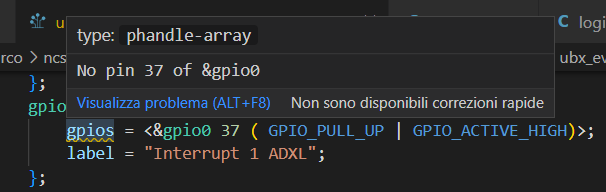
Despite, the GPIO configuration using the functions:

gpio_pin_configure
gpio_pin_interrupt_configure
gpio_init_callback
gpio_add_callback
Interrupt doesn't work.
Issue could be genereted from warning displyed in the image? Implementation in .dts is correct?
For verification, I tried to use different pins and with P1.xx result is the same instead using pin P0.xx, interrupt works.
Thank you.
MP
Parents Reply Children
  • Hello,

    I used the button example adding interrupt signal configuration in main.c file 

    /*
     * Copyright (c) 2016 Open-RnD Sp. z o.o.
     * Copyright (c) 2020 Nordic Semiconductor ASA
     *
     * SPDX-License-Identifier: Apache-2.0
     */
    
    #include <zephyr.h>
    #include <device.h>
    #include <drivers/gpio.h>
    #include <sys/util.h>
    #include <sys/printk.h>
    #include <inttypes.h>
    #include <irq.h>
    
    
    #define SLEEP_TIME_MS	1000
    
    
    #define INT_NODE DT_PHANDLE(DT_PATH(zephyr_user), interrupt_gpios)
    
    #define MY_DEV_IRQ  22       /* device uses IRQ 24 */
    #define MY_DEV_PRIO  2       /* device uses interrupt priority 2 */
    /* argument passed to my_isr(), in this case a pointer to the device */
    #define MY_ISR_ARG  DEVICE_DT_GET(INT_NODE)
    #define MY_IRQ_FLAGS 0       /* IRQ flags. Unused on non-x86 */
    
    const struct device *int_dev = DEVICE_DT_GET(INT_NODE);
    
    /*
     * Get button configuration from the devicetree sw0 alias. This is mandatory.
     */
    #define SW0_NODE	DT_ALIAS(sw0)
    #if !DT_NODE_HAS_STATUS(SW0_NODE, okay)
    #error "Unsupported board: sw0 devicetree alias is not defined"
    #endif
    static const struct gpio_dt_spec button = GPIO_DT_SPEC_GET_OR(SW0_NODE, gpios,{0});
    static struct gpio_callback button_cb_data;
    
    static const struct gpio_dt_spec int_gen = GPIO_DT_SPEC_GET_BY_IDX(DT_PATH(zephyr_user), interrupt_gpios, 0);
    static struct gpio_callback int_cb_data;
    
    /*
     * The led0 devicetree alias is optional. If present, we'll use it
     * to turn on the LED whenever the button is pressed.
     */
    static struct gpio_dt_spec led = GPIO_DT_SPEC_GET_OR(DT_ALIAS(led0), gpios, {0});
    
    
    void button_pressed(const struct device *dev, struct gpio_callback *cb,
    		    uint32_t pins)
    {
    	printk("Button pressed at %" PRIu32 "\n", k_cycle_get_32());
    }
    
    void interrupt_service(const struct device *dev, struct gpio_callback *cb,
    		    uint32_t pins)
    {
    	printk("Button pressed at %" PRIu32 "\n", k_cycle_get_32());
    }
    
    /*void my_isr(void *arg)
    {
       printk("Button ");
    }*/
    
    void main(void)
    {
    	int ret;
    
    	/*if (!device_is_ready(int_dev)) {
    		  printk("ADC device not found\n");
    		return;
    	}*/
    
    	if (!device_is_ready(button.port)) {
    		printk("Error: button device %s is not ready\n",
    		       button.port->name);
    		return;
    	}
    
    	ret = gpio_pin_configure_dt(&int_gen, GPIO_INPUT);
    	//ret = gpio_pin_configure(int_dev, MY_DEV_IRQ, GPIO_INPUT);
    	if (ret != 0) {
    		printk("Error ");
    		return;
    	}
    	ret = gpio_pin_interrupt_configure_dt(&int_gen, GPIO_INT_EDGE_TO_ACTIVE);
    	//ret = gpio_pin_interrupt_configure(int_dev, MY_DEV_IRQ, GPIO_INT_EDGE_RISING);
    	if (ret != 0) {
    		printk("Error ");
    		return;
    	}
    
    
    	ret = gpio_pin_configure_dt(&button, GPIO_INPUT);
    	if (ret != 0) {
    		printk("Error %d: failed to configure %s pin %d\n",
    		       ret, button.port->name, button.pin);
    		return;
    	}
    
    	ret = gpio_pin_interrupt_configure_dt(&button,
    					      GPIO_INT_EDGE_TO_ACTIVE);
    	if (ret != 0) {
    		printk("Error %d: failed to configure interrupt on %s pin %d\n",
    			ret, button.port->name, button.pin);
    		return;
    	}
    
    	gpio_init_callback(&button_cb_data, button_pressed, BIT(button.pin));
    	gpio_add_callback(button.port, &button_cb_data);
    	printk("Set up button at %s pin %d\n", button.port->name, button.pin);
    
    	gpio_init_callback(&int_cb_data, interrupt_service, BIT(int_gen.pin));
    	gpio_add_callback(int_gen.port, &int_cb_data);
    	printk("Set up button at %s pin %d\n", int_gen.port->name, int_gen.pin);
    
    	if (led.port && !device_is_ready(led.port)) {
    		printk("Error %d: LED device %s is not ready; ignoring it\n",
    		       ret, led.port->name);
    		led.port = NULL;
    	}
    	if (led.port) {
    		ret = gpio_pin_configure_dt(&led, GPIO_OUTPUT);
    		if (ret != 0) {
    			printk("Error %d: failed to configure LED device %s pin %d\n",
    			       ret, led.port->name, led.pin);
    			led.port = NULL;
    		} else {
    			printk("Set up LED at %s pin %d\n", led.port->name, led.pin);
    		}
    	}
    	
    	//IRQ_CONNECT(MY_DEV_IRQ, MY_DEV_PRIO, my_isr, MY_ISR_ARG, MY_IRQ_FLAGS);
        //irq_enable(MY_DEV_IRQ);
    
    	printk("Press the button\n");
    	if (led.port) {
    		while (1) {
    			/* If we have an LED, match its state to the button's. */
    			int val = gpio_pin_get_dt(&button);
    
    			if (val >= 0) {
    				gpio_pin_set_dt(&led, val);
    			}
    			k_msleep(SLEEP_TIME_MS);
    		}
    	}
    }


    and added in .dts file the following declaration:

    zephyr,user{
    		interrupt-gpios = <&gpio1 4 (GPIO_PULL_UP | GPIO_ACTIVE_HIGH)>;		
    	};

    Then, I found the root cause in gpio channel.

    Using gpio1 I have access to P1.xx.

    Thank you for your support,

Related