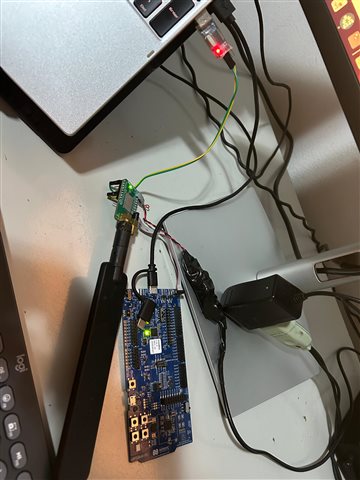
I am using a Mikroe development board with the nRF9160 to establish an LTE connection and send MQTT messages to a broker. The application successfully connects to the network, establishes the MQTT connection, and sends messages with a 60-second interval between each message. During this interval, the RRC (Radio Resource Control) mode enters Idle.
However, I am experiencing sporadic reboots when the modem is in Idle mode. These reboots happen irregularly, sometimes after a few minutes or even hours. Here’s a sample log:
*** Booting nRF Connect SDK v2.7.0-5cb85570ca43 ***
*** Using Zephyr OS v3.6.99-100befc70c74 ***
[00:00:00.354,156] <inf> lte: lteInit ..
[00:00:03.477,233] <inf> lte: RRC mode: Connected
[00:00:05.015,319] <inf> lte: Network registration status: Connected - home network
[00:00:05.015,441] <inf> lte: Connected to LTE network
[00:00:05.115,509] <inf> mqtt: mqttInit ..
[00:00:05.385,498] <inf> mqtt: IPv4 Address found 91.121.93.94
[00:00:05.385,925] <inf> mqtt: client_id = nrf-358******
[00:00:05.385,986] <inf> mqtt: Connection to broker using mqtt_connect
[00:00:05.971,221] <inf> mqtt: MQTT client connected
[00:00:05.971,252] <inf> mqtt: Subscribing on "stlab/down/cmd"
[00:00:06.271,270] <inf> mqtt: SUBACK packet id: 1234
[00:00:18.187,927] <inf> lte: RRC mode: Idle
[00:00:30.254,638] <inf> mqtt: Publishing "on" on "stlab/up/status"
...
[00:35:00.510,650] <inf> mqtt: Publishing "on" on "stlab/up/status"
[00:35:00.603,118] <inf> lte: RRC mode: Connected
[00:35:12.477,630] <inf> lte: RRC mode: Idle
[00:35:30.520,050] <inf> mqtt: Publishing "on" on "stlab/up/status"
[00:35:30.614,532] <inf> lte: RRC mode: Connected
[00:35:42.397,613] <inf> lte: RRC mode: Idle
*** Booting nRF Connect SDK v2.7.0-5cb85570ca43 ***
*** Using Zephyr OS v3.6.99-100befc70c74 ***
[00:00:00.354,156] <inf> lte: lteInit ..
[00:00:03.477,233] <inf> lte: RRC mode: Connected
[00:00:05.015,319] <inf> lte: Network registration status: Connected - home network
[00:00:05.015,441] <inf> lte: Connected to LTE network
[00:00:05.115,509] <inf> mqtt: mqttInit ..
[00:00:05.385,498] <inf> mqtt: IPv4 Address found 91.121.93.94
...
As you can see, the application boots again after some time when the modem enters Idle mode. This occurs intermittently, and I haven’t identified a clear pattern.
My questions are:
- What could be causing these reboots, particularly when the modem is in Idle mode?
- Is it normal for the application to restart if there's an issue with the modem?
- How can I debug this issue and pinpoint the cause of the restarts? Are there specific steps or diagnostics I should be focusing on?
Any insights or advice on how to address this would be greatly appreciated!
My prj.conf is:
#
# Copyright (c) 2020 Nordic Semiconductor ASA
#
# SPDX-License-Identifier: LicenseRef-Nordic-5-Clause
#

# Logging
CONFIG_LOG=y

# Button and LED support
CONFIG_DK_LIBRARY=y

# Newlib
CONFIG_NEWLIB_LIBC=y

# Networking
CONFIG_NETWORKING=y
CONFIG_NET_NATIVE=n
CONFIG_NET_SOCKETS_OFFLOAD=y
CONFIG_NET_SOCKETS=y
CONFIG_NET_SOCKETS_POSIX_NAMES=y

# Memory
CONFIG_MAIN_STACK_SIZE=4096
CONFIG_HEAP_MEM_POOL_SIZE=4096

# Modem library
#WWCONFIG_SOC_SERIES_NRF91X=y
CONFIG_TRUSTED_EXECUTION_NONSECURE=y
CONFIG_NRF_MODEM_LIB=y

# LTE link control
CONFIG_LTE_LINK_CONTROL=y
CONFIG_LTE_NETWORK_MODE_LTE_M_NBIOT=y

# MQTT
# STEP 2.1 - Enable and configure the MQTT library
CONFIG_MQTT_LIB=y
CONFIG_MQTT_CLEAN_SESSION=y

# Application
# STEP 2.2 - Configure the broker name, TCP port, topic names, and message
CONFIG_MQTT_PUB_TOPIC="stlab/up/status"
CONFIG_MQTT_SUB_TOPIC="stlab/down/cmd"
CONFIG_BUTTON_EVENT_PUBLISH_MSG="Hi from the nRF91 Series device"
CONFIG_MQTT_BROKER_HOSTNAME="test.mosquitto.org"
CONFIG_MQTT_BROKER_PORT=1883
CONFIG_MQTT_PUBLISH_PERIOD_S=30
My lte source is:
#include "lte.h"
#include <stdio.h>
#include <ncs_version.h>
#include <zephyr/kernel.h>
#include <zephyr/net/socket.h>
#include <zephyr/logging/log.h>
#include <modem/nrf_modem_lib.h>
#include <modem/lte_lc.h>
/* Semaphore for LTE connection */
static K_SEM_DEFINE(lte_connected, 0, 1);
LOG_MODULE_REGISTER(lte, LOG_LEVEL_INF);
/**
* @brief LTE event handler
*
* This function is called by the modem on LTE events.
*
* @param evt LTE event
*/
static void lte_handler(const struct lte_lc_evt *const evt) {
switch (evt->type) {
case LTE_LC_EVT_NW_REG_STATUS:
if ((evt->nw_reg_status != LTE_LC_NW_REG_REGISTERED_HOME) &&
(evt->nw_reg_status != LTE_LC_NW_REG_REGISTERED_ROAMING)) {
break;
}
LOG_INF("Network registration status: %s",
evt->nw_reg_status == LTE_LC_NW_REG_REGISTERED_HOME ?
"Connected - home network" : "Connected - roaming");
k_sem_give(<e_connected);
break;
case LTE_LC_EVT_RRC_UPDATE:
LOG_INF("RRC mode: %s", evt->rrc_mode == LTE_LC_RRC_MODE_CONNECTED ?
"Connected" : "Idle");
break;
default:
break;
}
}
/**
* @brief Configure the modem and connect to the LTE network.
*
* This function initializes the modem library and the LTE link control library,
* and then connects to the LTE network using the lte_lc_connect_async function.
* It waits for the connection to complete using a semaphore.
*
* @return 0 if successful, a negative value if an error occurred.
*/
void lteInit(void) {
LOG_INF("lteInit ..");
int err;
err = nrf_modem_lib_init();
if (err) {
LOG_ERR("Failed to initialize the modem library, error: %d", err);
return;
}
/* lte_lc_init deprecated in >= v2.6.0 */
#if NCS_VERSION_NUMBER < 0x20600
err = lte_lc_init();
if (err) {
LOG_ERR("Failed to initialize LTE link control library, error: %d", err);
return;
}
#endif
err = lte_lc_connect_async(lte_handler);
if (err) {
LOG_ERR("Error in lte_lc_connect_async, error: %d", err);
return;
}
k_sem_take(<e_connected, K_FOREVER);
LOG_INF("Connected to LTE network");
return;
}
and my mqtt source is:
#include "mqtt.h"
/* Buffers for MQTT client. */
static uint8_t rx_buffer[CONFIG_MQTT_MESSAGE_BUFFER_SIZE];
static uint8_t tx_buffer[CONFIG_MQTT_MESSAGE_BUFFER_SIZE];
static uint8_t payload_buf[CONFIG_MQTT_PAYLOAD_BUFFER_SIZE];
/* MQTT client instance. */
static struct mqtt_client client;
/* MQTT Broker details. */
static struct sockaddr_storage broker;
/* File descriptor structure used by poll. */
static struct pollfd fds;
/* Stack size and priority for the MQTT connection thread */
#define MQTT_CONNECTION_THREAD_STACK_SIZE 2048
#define MQTT_CONNECTION_THREAD_PRIORITY 6
K_THREAD_STACK_DEFINE(mqttConnection_Stack, MQTT_CONNECTION_THREAD_STACK_SIZE);
struct k_thread mqttConnection_Thread;
/* Stack size and priority for the MQTT publisher thread */
#define MQTT_PUBLISHER_THREAD_STACK_SIZE 1024
#define MQTT_PUBLISHER_THREAD_PRIORITY 7
/* Thread definition */
static void mqttPublishThread(void);
/* Create the thread */
K_THREAD_DEFINE(mqttPublish_Thread, MQTT_PUBLISHER_THREAD_STACK_SIZE,
mqttPublishThread, NULL, NULL, NULL,
MQTT_PUBLISHER_THREAD_PRIORITY, 0, 0);
LOG_MODULE_REGISTER(mqtt, LOG_LEVEL_INF);
static bool mqtt_connected = false;
K_MUTEX_DEFINE(mqtt_mutex);
/**
* @brief Reads the received payload from the MQTT server.
*
* @param c MQTT client instance.
* @param length Length of the payload to read.
*
* @return 0 on success, negative errno on error.
*
* @details If the payload is larger than the payload buffer, it is truncated to
* fit into the buffer. If the payload is longer than the buffer, it
* is read in chunks of the buffer size until it fits. The function
* will return -EMSGSIZE if the payload is larger than the buffer, or
* -EIO if there is an error reading the payload.
*/
static int mqttGetReceivedPayload(struct mqtt_client *c, size_t length) {
int ret;
int err = 0;
/* Return an error if the payload is larger than the payload buffer.
* Note: To allow new messages, we have to read the payload before returning.
*/
if (length > sizeof(payload_buf)) {
err = -EMSGSIZE;
}
/* Truncate payload until it fits in the payload buffer. */
while (length > sizeof(payload_buf)) {
ret = mqtt_read_publish_payload_blocking(
c, payload_buf, (length - sizeof(payload_buf)));
if (ret == 0) {
return -EIO;
} else if (ret < 0) {
return ret;
}
length -= ret;
}
ret = mqtt_readall_publish_payload(c, payload_buf, length);
if (ret) {
return ret;
}
return err;
}
/**
* @brief Subscribe to a topic.
*
* @param c The MQTT client instance.
*
* @return 0 on success, negative error code on failure.
*
* @details This function subscribes to the topic specified in the
* CONFIG_MQTT_SUB_TOPIC setting.
*
* The function will return 0 on success, or a negative error
* code on failure.
*/
static int mqttSubscribe(struct mqtt_client *const c) {
struct mqtt_topic subscribe_topic = {
.topic = {
.utf8 = CONFIG_MQTT_SUB_TOPIC,
.size = strlen(CONFIG_MQTT_SUB_TOPIC)
},
.qos = MQTT_QOS_1_AT_LEAST_ONCE
};
const struct mqtt_subscription_list subscription_list = {
.list = &subscribe_topic,
.list_count = 1,
.message_id = 1234
};
LOG_INF("Subscribing on \"%s\"", CONFIG_MQTT_SUB_TOPIC);
return mqtt_subscribe(c, &subscription_list);
}
/**
* @brief Print a buffer to the log as a string.
*
* @param prefix A string to print before the buffer.
* @param data The buffer to print.
* @param len The length of the buffer.
*
* @details The buffer is null-terminated and the resulting string is
* printed using LOG_INF.
*/
static void mqttDataPrint(uint8_t *prefix, uint8_t *data, size_t len, uint8_t* topic) {
char buf[len + 1];
memcpy(buf, data, len);
buf[len] = 0;
LOG_INF("%s\"%s\" on \"%s\"", (char *)prefix, (char *)buf, topic);
}
/**
* @brief Publish a message to an MQTT topic.
*
* @param c MQTT client instance.
* @param qos QOS level of the message.
* @param data Buffer containing the payload.
* @param len Length of the payload buffer.
*
* @return 0 on success, negative error code on failure.
*
* @details Publish a message to the topic specified in the
* CONFIG_MQTT_PUB_TOPIC setting. The QOS level of the message
* is set to @p qos. The payload is taken from the buffer
* @p data, with length @p len.
*
* The function will also return -EIO if there is an error
* reading the payload.
*/
int mqttDataPublish(struct mqtt_client *c, enum mqtt_qos qos,
uint8_t *data, size_t len) {
struct mqtt_publish_param param;
param.message.topic.qos = qos;
param.message.topic.topic.utf8 = CONFIG_MQTT_PUB_TOPIC;
param.message.topic.topic.size = strlen(CONFIG_MQTT_PUB_TOPIC);
param.message.payload.data = data;
param.message.payload.len = len;
param.message_id = sys_rand32_get();
param.dup_flag = 0;
param.retain_flag = 0;
mqttDataPrint("Publishing ", data, len, CONFIG_MQTT_PUB_TOPIC);
return mqtt_publish(c, ¶m);
}
/**
* @brief MQTT event handler.
*
* This function is called by the MQTT client API when an event occurs.
*
* @param c MQTT client instance.
* @param evt MQTT event structure.
*/
void mqttEvtHandler(struct mqtt_client *const c, const struct mqtt_evt *evt) {
int err;
switch (evt->type) {
case MQTT_EVT_CONNACK:
if (evt->result != 0) {
LOG_ERR("MQTT connect failed: %d", evt->result);
break;
}
LOG_INF("MQTT client connected");
k_mutex_lock(&mqtt_mutex, K_FOREVER);
mqtt_connected = true;
k_mutex_unlock(&mqtt_mutex);
mqttSubscribe(c);
break;
case MQTT_EVT_DISCONNECT:
LOG_INF("MQTT client disconnected: %d", evt->result);
k_mutex_lock(&mqtt_mutex, K_FOREVER);
mqtt_connected = false;
k_mutex_unlock(&mqtt_mutex);
break;
case MQTT_EVT_PUBLISH: {
const struct mqtt_publish_param *p = &evt->param.publish;
LOG_INF("MQTT PUBLISH result=%d",
evt->result);
err = mqttGetReceivedPayload(c, p->message.payload.len);
//Send acknowledgment to the broker on receiving QoS1 publish message
if (p->message.topic.qos == MQTT_QOS_1_AT_LEAST_ONCE) {
const struct mqtt_puback_param ack = {
.message_id = p->message_id
};
/* Send acknowledgment. */
mqtt_publish_qos1_ack(c, &ack);
}
if (err >= 0) {
mqttDataPrint("Received: ", payload_buf, p->message.payload.len, (uint8_t *)p->message.topic.topic.utf8);
// Payload buffer is smaller than the received data
} else if (err == -EMSGSIZE) {
LOG_ERR("Received payload (%d bytes) is larger than the payload buffer size (%d bytes).",
p->message.payload.len, sizeof(payload_buf));
// Failed to extract data, disconnect
} else {
LOG_ERR("get_received_payload failed: %d", err);
LOG_INF("Disconnecting MQTT client...");
err = mqtt_disconnect(c);
if (err) {
LOG_ERR("Could not disconnect: %d", err);
}
}
} break;
case MQTT_EVT_PUBACK:
if (evt->result != 0) {
LOG_ERR("MQTT PUBACK error: %d", evt->result);
break;
}
//LOG_INF("PUBACK packet id: %u", evt->param.puback.message_id);
break;
case MQTT_EVT_SUBACK:
if (evt->result != 0) {
LOG_ERR("MQTT SUBACK error: %d", evt->result);
break;
}
LOG_INF("SUBACK packet id: %u", evt->param.suback.message_id);
break;
case MQTT_EVT_PINGRESP:
if (evt->result != 0) {
LOG_ERR("MQTT PINGRESP error: %d", evt->result);
}
break;
default:
LOG_INF("Unhandled MQTT event type: %d", evt->type);
break;
}
}
/**
* @brief Initialize the MQTT broker address.
*
* @details This function resolves the hostname of the MQTT broker using
* getaddrinfo() and sets the address of the broker in the global
* 'broker' variable.
*
* @return 0 on success, or a negative error code on failure.
*/
static int mqtt_broker_init(void) {
int err;
struct addrinfo *result;
struct addrinfo *addr;
struct addrinfo hints = {
.ai_family = AF_INET,
.ai_socktype = SOCK_STREAM
};
err = getaddrinfo(CONFIG_MQTT_BROKER_HOSTNAME, NULL, &hints, &result);
if (err) {
LOG_ERR("getaddrinfo failed: %d", err);
return -ECHILD;
}
addr = result;
/* Look for address of the broker. */
while (addr != NULL) {
/* IPv4 Address. */
if (addr->ai_addrlen == sizeof(struct sockaddr_in)) {
struct sockaddr_in *broker4 =
((struct sockaddr_in *)&broker);
char ipv4_addr[NET_IPV4_ADDR_LEN];
broker4->sin_addr.s_addr =
((struct sockaddr_in *)addr->ai_addr)
->sin_addr.s_addr;
broker4->sin_family = AF_INET;
broker4->sin_port = htons(CONFIG_MQTT_BROKER_PORT);
inet_ntop(AF_INET, &broker4->sin_addr.s_addr,
ipv4_addr, sizeof(ipv4_addr));
LOG_INF("IPv4 Address found %s", (char *)(ipv4_addr));
break;
} else {
LOG_ERR("ai_addrlen = %u should be %u or %u",
(unsigned int)addr->ai_addrlen,
(unsigned int)sizeof(struct sockaddr_in),
(unsigned int)sizeof(struct sockaddr_in6));
}
addr = addr->ai_next;
}
/* Free the address. */
freeaddrinfo(result);
return err;
}
/**
* @brief Get the client id to use for the MQTT connection.
*
* @details If CONFIG_MQTT_CLIENT_ID is set, that value is used.
* Otherwise, the function attempts to obtain the IMEI of the device
* using the AT+CGSN command and generates a client id string
* of the form "nrf-<imei>".
*
* @return The client id to use for the MQTT connection.
*/
static const uint8_t* mqttClientIdGet(void) {
static uint8_t client_id[MAX(sizeof(CONFIG_MQTT_CLIENT_ID),
CLIENT_ID_LEN)];
if (strlen(CONFIG_MQTT_CLIENT_ID) > 0) {
snprintf(client_id, sizeof(client_id), "%s",
CONFIG_MQTT_CLIENT_ID);
goto exit;
}
char imei_buf[CGSN_RESPONSE_LENGTH + 1];
int err;
err = nrf_modem_at_cmd(imei_buf, sizeof(imei_buf), "AT+CGSN");
if (err) {
LOG_ERR("Failed to obtain IMEI, error: %d", err);
goto exit;
}
imei_buf[IMEI_LEN] = '\0';
snprintf(client_id, sizeof(client_id), "nrf-%.*s", IMEI_LEN, imei_buf);
LOG_INF("client_id = %s", (char *)(client_id));
exit:
LOG_DBG("client_id = %s", (char *)(client_id));
return client_id;
}
/**
* @brief Initialize the MQTT client
*
* This function initializes the MQTT client instance. It resolves the configured
* hostname and initializes the MQTT broker structure. It configures the MQTT
* client with the broker details and the event handler. It also configures the
* MQTT buffers and the transport type.
*
* @param client MQTT client instance to be initialized
*
* @return 0 on success, negative error code on failure
*/
int mqttClientInit(struct mqtt_client *client) {
int err;
/* Initializes the client instance. */
mqtt_client_init(client);
/* Resolves the configured hostname and initializes the MQTT broker structure */
err = mqtt_broker_init();
if (err) {
LOG_ERR("Failed to initialize broker connection");
return err;
}
/* MQTT client configuration */
client->broker = &broker;
client->evt_cb = mqttEvtHandler;
client->client_id.utf8 = mqttClientIdGet();
client->client_id.size = strlen(client->client_id.utf8);
client->password = NULL;
client->user_name = NULL;
client->protocol_version = MQTT_VERSION_3_1_1;
/* MQTT buffers configuration */
client->rx_buf = rx_buffer;
client->rx_buf_size = sizeof(rx_buffer);
client->tx_buf = tx_buffer;
client->tx_buf_size = sizeof(tx_buffer);
/* We are not using TLS in Exercise 1 */
client->transport.type = MQTT_TRANSPORT_NON_SECURE;
return err;
}
/**
* @brief Initialize pollfd for MQTT client
*
* @param c MQTT client instance
* @param fds pollfd structure to be initialized
*
* @return 0 on success, -ENOTSUP if MQTT client is configured to use TLS
*
* This function initializes the pollfd structure with the file descriptor
* of the MQTT client's TCP socket. The events are set to POLLIN.
*/
int mqttFdsInit(struct mqtt_client *c, struct pollfd *fds) {
if (c->transport.type == MQTT_TRANSPORT_NON_SECURE) {
fds->fd = c->transport.tcp.sock;
} else {
return -ENOTSUP;
}
fds->events = POLLIN;
return 0;
}
/**
* @brief Initialize the MQTT client and start the main loop.
*
* This function initializes the MQTT client and starts the main loop where it
* will connect to the broker, wait for incoming data, and send keepalive
* messages. If the connection is lost, it will try to reconnect.
*
* @note If the function returns, it means that an error occurred.
*/
void mqttInit(void) {
LOG_INF("mqttInit ..");
int err;
err = mqttClientInit(&client);
if (err) {
LOG_ERR("Failed to initialize MQTT client: %d", err);
return;
}
k_thread_create(&mqttConnection_Thread, mqttConnection_Stack, MQTT_CONNECTION_THREAD_STACK_SIZE,
mqttConnectionThread, NULL, NULL, NULL,
MQTT_CONNECTION_THREAD_PRIORITY, 0, K_NO_WAIT);
}
void mqttConnectionThread(void *p1, void *p2, void *p3) {
int err;
uint16_t connect_attempt = 0;
while (1) {
do_connect:
if (connect_attempt++ > 0) {
LOG_INF("Reconnecting in %d seconds...",
CONFIG_MQTT_RECONNECT_DELAY_S);
k_sleep(K_SECONDS(CONFIG_MQTT_RECONNECT_DELAY_S));
}
LOG_INF("Connection to broker using mqtt_connect");
err = mqtt_connect(&client);
if (err) {
LOG_ERR("Error in mqtt_connect: %d", err);
goto do_connect;
}
err = mqttFdsInit(&client,&fds);
if (err) {
LOG_ERR("Error in mqttFdsInit: %d", err);
return;
}
while (1) {
err = poll(&fds, 1, mqtt_keepalive_time_left(&client));
if (err < 0) {
LOG_ERR("Error in poll(): %d", errno);
break;
}
err = mqtt_live(&client);
if ((err != 0) && (err != -EAGAIN)) {
LOG_ERR("Error in mqtt_live: %d", err);
break;
}
if ((fds.revents & POLLIN) == POLLIN) {
err = mqtt_input(&client);
if (err != 0) {
LOG_ERR("Error in mqtt_input: %d", err);
break;
}
}
if ((fds.revents & POLLERR) == POLLERR) {
LOG_ERR("POLLERR");
break;
}
if ((fds.revents & POLLNVAL) == POLLNVAL) {
LOG_ERR("POLLNVAL");
break;
}
}
LOG_INF("Disconnecting MQTT client");
err = mqtt_disconnect(&client);
if (err) {
LOG_ERR("Could not disconnect MQTT client: %d", err);
}
k_sleep(K_MSEC(50));
goto do_connect;
}
}
/**
* @brief Thread to publish a message periodically to the configured topic.
*
* @details This function is run in a separate thread and will publish a message
* to the configured topic every n seconds, if the MQTT client is
* connected.
*/
static void mqttPublishThread(void) {
while (1) {
k_mutex_lock(&mqtt_mutex, K_FOREVER);
if (mqtt_connected) {
char status[] = "on";
int err = mqttDataPublish(&client, MQTT_QOS_1_AT_LEAST_ONCE,
status, sizeof(status)-1);
if (err) {
LOG_ERR("Failed to publish message: %d", err);
}
}
k_mutex_unlock(&mqtt_mutex);
k_sleep(K_SECONDS(CONFIG_MQTT_PUBLISH_PERIOD_S));
}
}