nRF52810 Antenna review

Hello!

I'm preparing a second revision of my first BLE PCB with nRF52810 MCU.

The first iteration worked ok, but BLE range was worse than a ready-made module with PCB antenna. The project is a PCB to control tiny RC models, so PCB size is 10x14mm.

I used a chip antenna that can be mounted in the corner of PCB with a radiating element PCB trace. I chose it for minimal footprint required (5x3mm). Antenna impedance is stated to be 50 ohm.

RF matching part is taken from MCU datasheet.

PCB is 4 layers with GND below RF path (and another GND below that). Width of the wires inside Pi network up to antenna footprint is impedance-matched (I just used JLCPCB calculator)
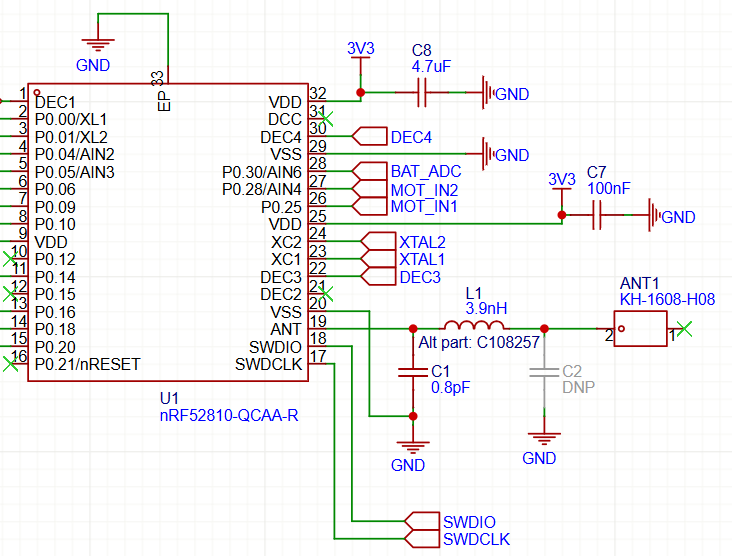
schematic (relevant part)
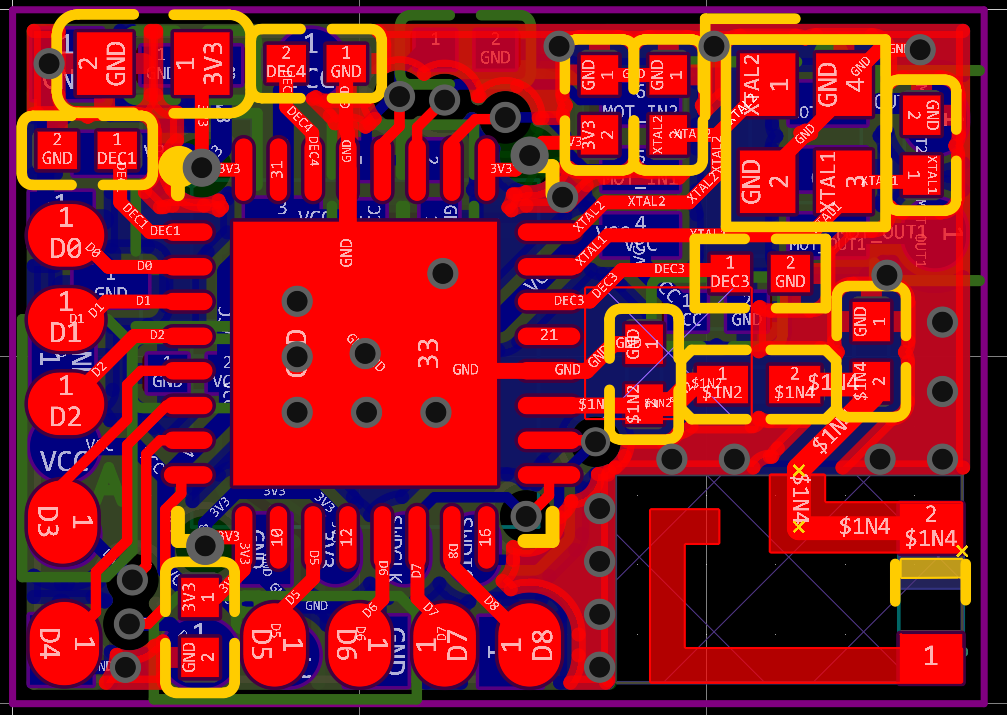
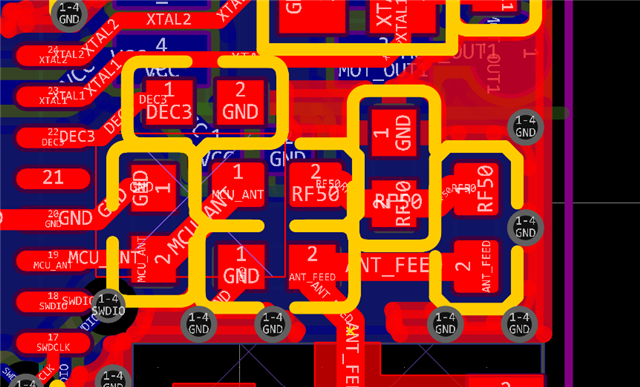
top
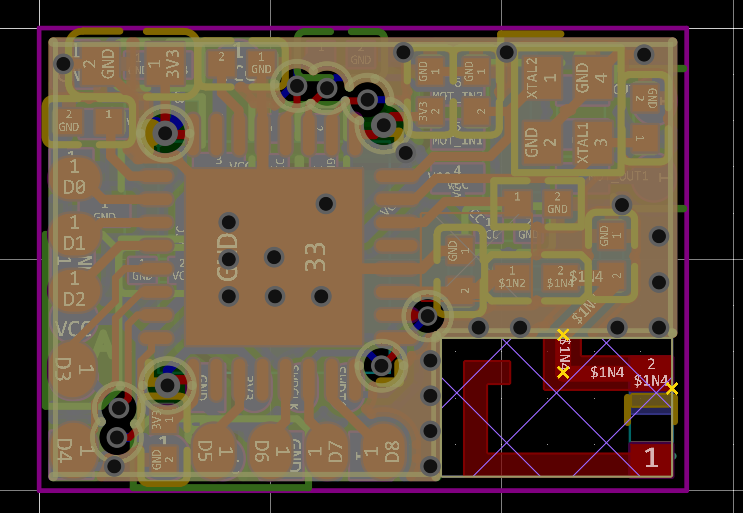
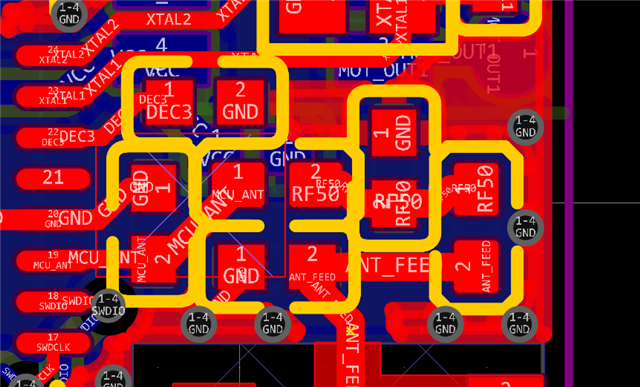
inner 1
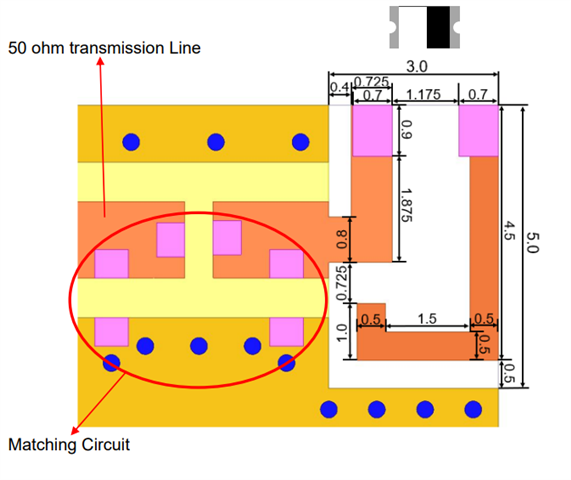
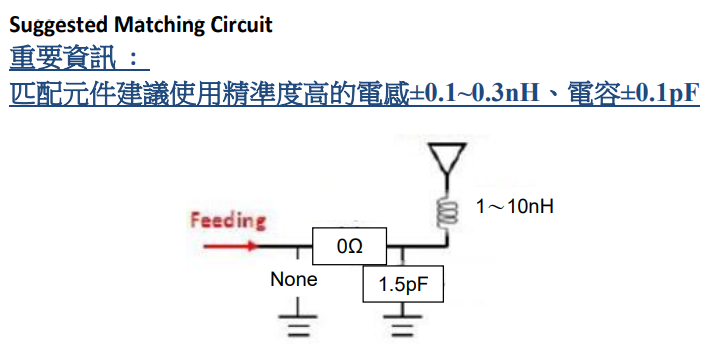
Antenna datasheet, for reference. 1-10nH inductor is required for other variants of placement (and is missing from this edge-mounted variant).

Please suggest what can be improved here. Are there any low-hanging fruits? Considering that: 

1) I don't have a vector analyzer

2) PCB space is very limited, so no space for another full Pi network (in addition to existing one that matches MCU pin to 50 Ohm from datasheet). And I have no way of tuning it anyway due to p1. I added a DNP capacitor though, can place a 1.5pF capacitor from antenna datasheet there.

3) I want to stick to minimum components size of 0402.

Parents
  • Hi,

    Apologies for the delay.

    C9 and L1 can't be used for antenna matching, these components are used for matching the impedance of the ANT to 50 Ohm, and as a low-pass filter used for attenuating the harmonic distortion. Two additional components must be added(along with C2) to make the Pi network recommended in the antenna datasheet.

    Other than this the design looks good.

    We can help with tuning the antenna, please make a private ticket requesting this when the board is produced and refer to this ticket. 


    Best regards,

    Bendik

  • Hello Bendik, thank you for answer! Can you suggest what's the best way to cram two additional 0402s in the layout? At best I can fit an in-series inductor, but an additional capacitor,.. I don't see any space at all.

    Can you elaborate on how you help with tuning? Do you need to PCB to be shipped to Nordic, and you'll do the analysis there? And finally, private tickets are only for organizations, right?

  • Positron said:
    Can you suggest what's the best way to cram two additional 0402s in the layout? At best I can fit an in-series inductor, but an additional capacitor,.. I don't see any space at all.

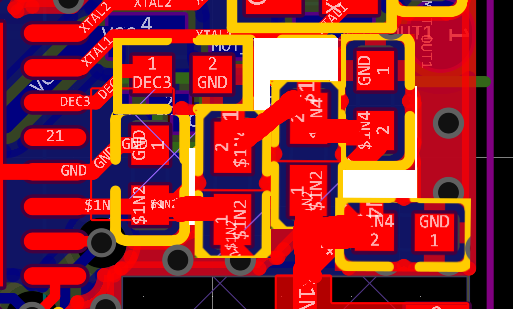
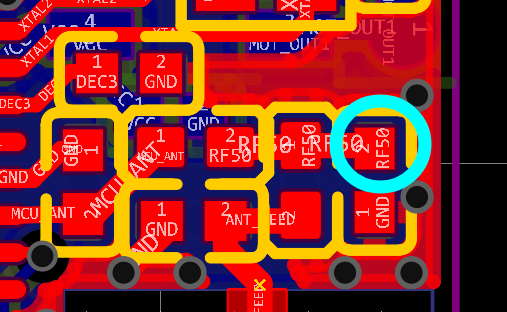
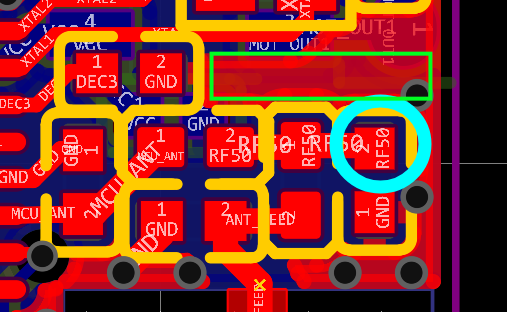
    It's tricky using 0402, but something like this could work:

    The mockup is a bit rough, but it looks like there should be room if stubs are used for the shunt capacitors and the capacitor on DEC3 is moved closer to the SoC. This configuration isn't ideal, but with tuning it should work Ok.

    Switching to 0201 would give a lot more space, and still be hand solder able with a microscope and some patience.

    Positron said:
    Can you elaborate on how you help with tuning? Do you need to PCB to be shipped to Nordic, and you'll do the analysis there?

    For tuning you would need to ship a couple samples of the PCB to our lab here in Norway. We measure the antenna impedance and SWR and adjust the matching network to optimize the performance in the 2.4GHz band. We will also check the radio output, and tune the radio matching network if the output power is low or the power on the harmonic frequencies are too high to pass certification testing. For the best antenna tuning results we also recommend sending a sample of the enclosure the PCB will be mounted in as it may affect the antenna impedance, this can be compensated for when tuning.

    Positron said:
    And finally, private tickets are only for organizations, right?

    Anyone can create private tickets, but you need to fill out the company field in your profile, just writing self employed is acceptable. Alternatively you can just ask for a ticket to made private.

  • Thanks! Indeed it looks possible with 0402s!

    Just to confirm, is this support free? In any case, I'll keep the support option in mind, but it seems a bit excessive for what essentially is a hobby project.

    But for the sake of learning, suppose I had access to a vector analyzer, could I myself "measure the antenna impedance and SWR and adjust the matching network to optimize the performance in the 2.4GHz band"?

    Do I understand correctly that for this I need to: have PCB with antenna and its matching network (and nothing else, no MCU nor MCU matching network), connect analyzer to the point between 2 matching networks and do S11 measurement (and tune antenna network for 50 Ohm)?

    Does MCU matching network need to also be tuned in a similar way? 

  • Positron said:
    Just to confirm, is this support free? In any case, I'll keep the support option in mind, but it seems a bit excessive for what essentially is a hobby project.

    This tuning is free. If you are not planning on getting this certified(CE, FCC, etc.) then the tuning isn't strictly necessary, as long as you get good enough performance for your use case.

    Positron said:

    But for the sake of learning, suppose I had access to a vector analyzer, could I myself "measure the antenna impedance and SWR and adjust the matching network to optimize the performance in the 2.4GHz band"?

    Do I understand correctly that for this I need to: have PCB with antenna and its matching network (and nothing else, no MCU nor MCU matching network), connect analyzer to the point between 2 matching networks and do S11 measurement (and tune antenna network for 50 Ohm)?

    Yes, if you have a VNA this shouldn't be impossible. We have a white paper on the antenna tuning process here:

    https://docs.nordicsemi.com/bundle/nwp_017/resource/nwp_017.pdf

    There are some relatively inexpensive VNAs available, like the NanoVNA. which can be used for 2.4GHz antenna tuning.

    Positron said:
    Does MCU matching network need to also be tuned in a similar way? 

    The MCU matching network is tuned using a spectrum analyzer, as it is more important that the power of the harmonic frequencies are lower than the regulatory limits. If you are not getting this certified this isn't really necessary.

Reply
  • Positron said:
    Just to confirm, is this support free? In any case, I'll keep the support option in mind, but it seems a bit excessive for what essentially is a hobby project.

    This tuning is free. If you are not planning on getting this certified(CE, FCC, etc.) then the tuning isn't strictly necessary, as long as you get good enough performance for your use case.

    Positron said:

    But for the sake of learning, suppose I had access to a vector analyzer, could I myself "measure the antenna impedance and SWR and adjust the matching network to optimize the performance in the 2.4GHz band"?

    Do I understand correctly that for this I need to: have PCB with antenna and its matching network (and nothing else, no MCU nor MCU matching network), connect analyzer to the point between 2 matching networks and do S11 measurement (and tune antenna network for 50 Ohm)?

    Yes, if you have a VNA this shouldn't be impossible. We have a white paper on the antenna tuning process here:

    https://docs.nordicsemi.com/bundle/nwp_017/resource/nwp_017.pdf

    There are some relatively inexpensive VNAs available, like the NanoVNA. which can be used for 2.4GHz antenna tuning.

    Positron said:
    Does MCU matching network need to also be tuned in a similar way? 

    The MCU matching network is tuned using a spectrum analyzer, as it is more important that the power of the harmonic frequencies are lower than the regulatory limits. If you are not getting this certified this isn't really necessary.

Children
  • Ok, thank you! I'll study the document!

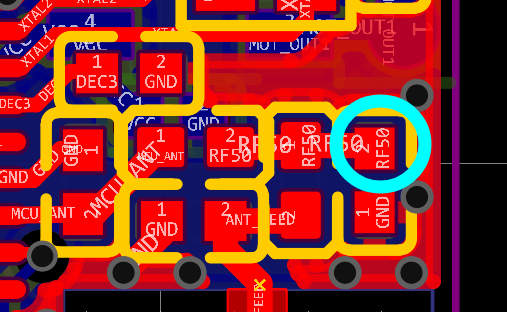
    Meanwhile, I've tried to fit 2nd matching network as you suggested, and found ways to add this without stubs (or with 1 stub, or with 2), at the cost of a bit more bendy antenna trace and a capacitor sticking out into decoupling area. 


    Which do you think is preferrable? Should I prioritize removing stubs or it's not a big deal because they are small? 

    On a similar note, considering traces between components are about 1mm long, much less than quarter wavelength, how important is impedance-matching them? I can't even decide whether to treat them as microstrip or coplanar waveguide as there is not much ground around them.

  • Positron said:


    Which do you think is preferrable? Should I prioritize removing stubs or it's not a big deal because they are small? 

    Either option should be OK. I would go for the layout with the one stub, as this allows for GND vias to be added between the RF section and the 32MHz crystal, improving the shielding between them:

    Positron said:
    On a similar note, considering traces between components are about 1mm long, much less than quarter wavelength, how important is impedance-matching them? I can't even decide whether to treat them as microstrip or coplanar waveguide as there is not much ground around them.

    There's no need to make the RF traces impedance controlled. The only part of the circuit that would be matched to an 50 ohm impedance is the trace between the radio and antenna matching circuit. Since there is no significant length of transmission line between the matching networks there won't be any losses to to impedance missmatch.

Related