nRF5340: Do you need to configure with high voltage mode to get +3 dBm power?

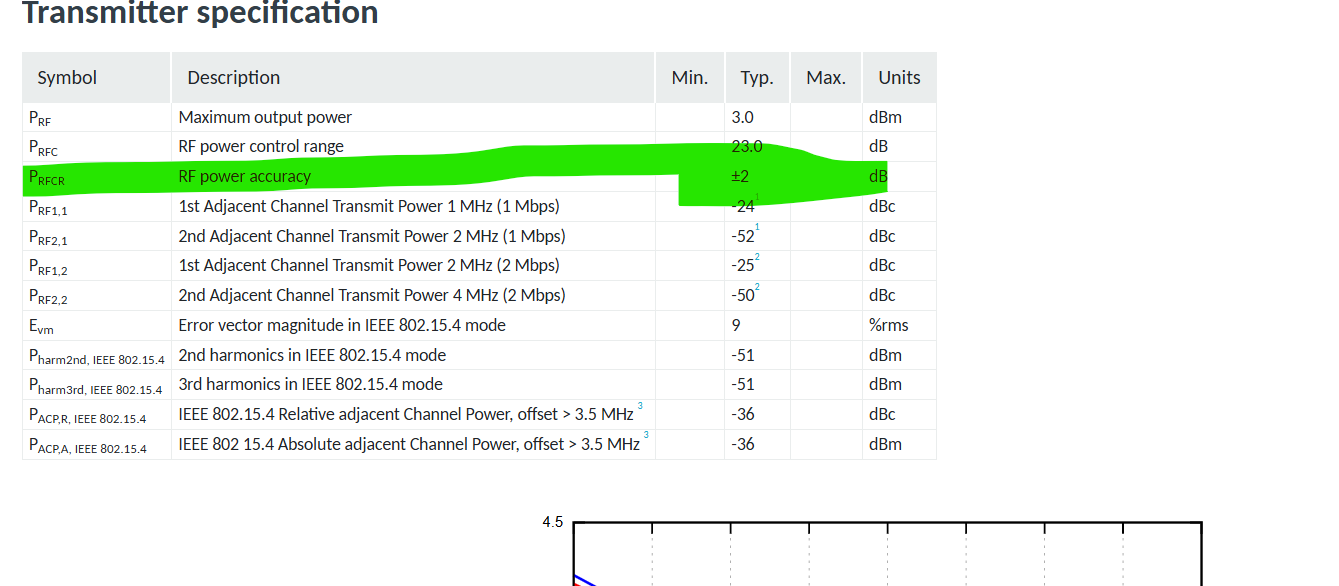
It isn't clear from the nRF5340 documentation and the only related post doesn't answer it but if we want +3 dBm output power, do we need to wire the nRF5340 in high voltage mode or is normal voltage mode sufficient?

Why I ask is we have a device in EMC/EMI preliminary tests at a lab and when they look at the output power, it doesn't seem to get up to +3 dBm at the end of a 1 m SMA cable (see 1.65 dBm) so a 1.35 dBm loss. At lower power modes below 0 dBm, we see less than 0.5 dBm.

Parents
  • Hi,

    Thanks for contacting us. Have you calculated the cables and connectors loss in your measurements? It can go up to around 1.5 dB depending on connectors and cables. The high voltage mode you are referring to is chip level and does not impact radio directly. There is an internal and radio specific high voltage request to get power up to 3 dBm. It is different than chip level high voltage you are referring to. 
    RADIO — 2.4 GHz radio
    VREQCTRL — Voltage request control

    Best regards,
    Ressa

  • OK, so if we have wired the nRF5340 in normal voltage mode, we could still use `VREQCTRL` to be able to get output radio power to +3 dBm?

    Six years ago there was a post on getting to +3 dBm with a final reply for Nordic:

    "

    I get 1.42dBm output power with the high power hex and -0.55dBm with the standard hex. Everything indicates that you've been successful^^

    There's probably ~1dB lost in conducted transmission losses between DUT and spectrum analyzer so these measurements are on par with what we expect.
    "

    This is a non-linear loss (more loss at higher dBm than with a lower dBm) - is that expected?

Reply
  • OK, so if we have wired the nRF5340 in normal voltage mode, we could still use `VREQCTRL` to be able to get output radio power to +3 dBm?

    Six years ago there was a post on getting to +3 dBm with a final reply for Nordic:

    "

    I get 1.42dBm output power with the high power hex and -0.55dBm with the standard hex. Everything indicates that you've been successful^^

    There's probably ~1dB lost in conducted transmission losses between DUT and spectrum analyzer so these measurements are on par with what we expect.
    "

    This is a non-linear loss (more loss at higher dBm than with a lower dBm) - is that expected?

Children
Related