This post is older than 2 years and might not be relevant anymore
More Info: Consider searching for newer posts

Simple_on_off model on nRF52832

Hello to everyonel.

I am working with the Light_switch example of Mesh 3.1 on nRF52832 (PCA10040).
At this moment, I am trying to understand how I can send a message from the server to the client in the network. I found this publication on Github that explains how to create new models for mesh technology. On that page, indicate which functions: access_model_publish () and send_reply () (of the models simple_on_off), is used to send a message from the server to the client as a callback of the client's message.
There is a problem with that. The Simple_on_off models (".c" and ".h" files) are not included in the server and client projects. What I want to know is, if I add (in the main.c code of the server) the function "send_reply ()" (with the correct path, the function and the declaration of the library, etc.), It could works.

In addition, the user of this question modified the simple_on_off_server.c code to create a function called "publish_state2 ()" (I believe that before Mesh 3.1, there is a function called "publish_state ()" but now it is called "simple_on_off_server_status_publish ()", I suppose). I tried to do the same, but when I compile the program, it throws these errors:
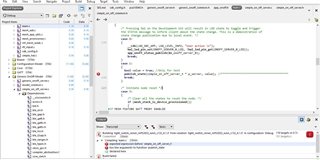
Does anyone knows why the code throws those error?

I hope you can help me.

Best regards,
John

Parents
  • There is no such thing as a "server node" and a "client node". A node contains elements which contain models. A model can be a server or a client. So a node can have server models in it and client models in it. A server model does not send messages to a client model but instead a client model publishes to an address and a server model subscribes to that address. If you want two way communication between your nodes I suggest you add both a client model and a server model to both your nodes. The best way to achieve adding a new model is to open the example light switch server and clients main.c file side by side and copy over the definitions/functions needed for each type of model. You will need to include the .c and .h files of each generic model. 

    Servers send a reply to a client if using an acknowledged messages and the response will contain the on/off message that it received. This allows the client to resend the message if the server model received the incorrect value or didn't receive the value at all. It seems like you are on the right path. 

    Hopes this help a little until the Nordic Devs can get to it. 

  • BubDev, thank you very mucho for your fast answer.
    Yeah, I did a mistake calling "nodes" to the models. Is already corrected.
    I've tried to add the client model to the server project before, but It did't work well.
    So, what I thought is, if the server only answers when the clients send a message, I have to understand how I can modify this answer to put-in the status that I want, not the default.

  • So I don't think modifying the status message will work as it is define in the mesh specification to act in a certain way.


    What I've been doing is using generic_level client to publish a value between -32k and 32k then on the server side I convert that value to the message that I want. This way you won't have to make a custom model to handle the custom message you want. 

  • So for the generic client model use the function

    generic_level_client_set(&m_clients, &set_params, &transition_params);
    to publish the level/message you want to send.


    Then on the server side use the function
    static void app_level_server_set_cb(const app_level_server_t * p_server, int16_t present_level){}

    to handle the message you received.


    Also this may help you as this is something I needed to do to successfully be able to publish messages inside the main

    uint8_t is_nested;

    ERROR_CHECK(sd_nvic_critical_region_enter(&is_nested));
    generic_level_client_set(&m_clients, &set_params, &transition_params);
    ERROR_CHECK(sd_nvic_critical_region_exit(is_nested));


    This makes sure you are not in a critical region when publishing the message and avoids a mesh assert error.

    Check here for more info on critical region
    devzone.nordicsemi.com/.../mesh-sdk-2-2-0-bug-in-mesh_opt_core_adv_set
Reply
  • So for the generic client model use the function

    generic_level_client_set(&m_clients, &set_params, &transition_params);
    to publish the level/message you want to send.


    Then on the server side use the function
    static void app_level_server_set_cb(const app_level_server_t * p_server, int16_t present_level){}

    to handle the message you received.


    Also this may help you as this is something I needed to do to successfully be able to publish messages inside the main

    uint8_t is_nested;

    ERROR_CHECK(sd_nvic_critical_region_enter(&is_nested));
    generic_level_client_set(&m_clients, &set_params, &transition_params);
    ERROR_CHECK(sd_nvic_critical_region_exit(is_nested));


    This makes sure you are not in a critical region when publishing the message and avoids a mesh assert error.

    Check here for more info on critical region
    devzone.nordicsemi.com/.../mesh-sdk-2-2-0-bug-in-mesh_opt_core_adv_set
Children
  • Ok, so, the clients function send a request of callback and, then, the server responses with the another function.
    I have three questions:
    1) the client/server functions that you made, are going to be created on main.c file or I have to create them on another file?
    2) The same with the nested function, where do I have to create it?
    3) To handle the server's answer, what's the variable I have to modify?
    Thank you for your support!

  • 1. Those function that I sent you are part of the stock generic level models. To be able to use them you have to include the .c and .h files for the models. Once the models have been included in your project you can call the functions in your main.  The example dimming programs already contain those functions and would be a good place to start when trying to understand how the models work. 

    2. You use the nested functions when calling a client function in the main.c file 

    3.You don't need to handle the status message from the server. However the variable that you will modify  are the "set_params" structure in the client and the "present_level" on the server.

  • Ok, I´ll try it. With generic level models, you mean generic_onoff_client and generic_onoff_server, right?
    If I get a problem, I´ll tell you.
    Thank you very much!

  • I putted the "generic_level_client_set" inside a button in the event handler (//***** signal):

    static void button_event_handler(uint32_t button_number)
    {
        __LOG(LOG_SRC_APP, LOG_LEVEL_INFO, "Button %u pressed\n", button_number);
    
        uint32_t status = NRF_SUCCESS;
        generic_onoff_set_params_t set_params;
        model_transition_t transition_params;
        static uint8_t tid = 0;
    
        /* Button 1: On, Button 2: Off, Client[0]
         * Button 2: On, Button 3: Off, Client[1]
         */
    
        switch(button_number)
        {
            case 0:
            case 2:
                set_params.on_off = APP_STATE_ON;
                break;
    
            case 1:
            case 3:
                set_params.on_off = APP_STATE_OFF;
                break;
        }
    
        set_params.tid = tid++;
        transition_params.delay_ms = APP_CONFIG_ONOFF_DELAY_MS;
        transition_params.transition_time_ms = APP_CONFIG_ONOFF_TRANSITION_TIME_MS;
        __LOG(LOG_SRC_APP, LOG_LEVEL_INFO, "Sending msg: ONOFF SET %d\n", set_params.on_off);
        //int VAL = 0;
    
        switch (button_number)
        {
            case 0:
            case 1:
                /* Demonstrate acknowledged transaction, using 1st client model instance */
                /* In this examples, users will not be blocked if the model is busy */
                (void)access_model_reliable_cancel(m_clients[0].model_handle);
                status = generic_onoff_client_set(&m_clients[0], &set_params, &transition_params);
                hal_led_pin_set(BSP_LED_0, set_params.on_off);
    
                uint8_t is_nested; //**************************************************************************************
                ERROR_CHECK(sd_nvic_critical_region_enter(&is_nested));
                generic_level_client_set(&m_clients, &set_params, &transition_params);
                ERROR_CHECK(sd_nvic_critical_region_exit(is_nested));
                break;
    
            case 2:
            case 3:
                /* Demonstrate acknowledged transaction, using 1st client model instance */
                /* In this examples, users will not be blocked if the model is busy */
                (void)access_model_reliable_cancel(m_clients[1].model_handle);
                status = generic_onoff_client_set(&m_clients[1], &set_params, &transition_params);
                hal_led_pin_set(BSP_LED_1, set_params.on_off);
                break;
        }
    
        switch (status)
        {
            case NRF_SUCCESS:
                break;
    
            case NRF_ERROR_NO_MEM:
            case NRF_ERROR_BUSY:
            case NRF_ERROR_INVALID_STATE:
                __LOG(LOG_SRC_APP, LOG_LEVEL_INFO, "Client %u cannot send\n", button_number);
                hal_led_blink_ms(LEDS_MASK, LED_BLINK_SHORT_INTERVAL_MS, LED_BLINK_CNT_NO_REPLY);
                break;
    
            case NRF_ERROR_INVALID_PARAM:
                /* Publication not enabled for this client. One (or more) of the following is wrong:
                 * - An application key is missing, or there is no application key bound to the model
                 * - The client does not have its publication state set
                 *
                 * It is the provisioner that adds an application key, binds it to the model and sets
                 * the model's publication state.
                 */
                __LOG(LOG_SRC_APP, LOG_LEVEL_INFO, "Publication not configured for client %u\n", button_number);
                break;
    
            default:
                ERROR_CHECK(status);
                break;
        }
    }
    

    Is it correct? When the press the button 0, the function works, right?

  • I mean the generic_levels, you can see examples of them if you go to the dimming folder in the Mesh SDK. To use those function you have to first define them in the main. This is all shown in the example dimming client and server programs. the example light switch programs also demonstrate how to use the on_off models.

Related