

I have installed the latest SDK 1.3.0 using the Toolchain Manager.
I would now like to open nRF Connect SDK Projekt and get the follwoing error:
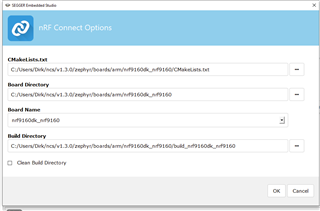
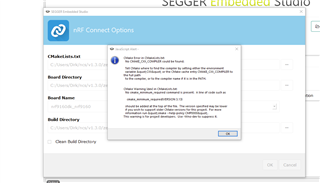
I have added the CXX environment variable, but it did not help 
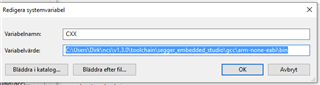
I have installed the latest SDK 1.3.0 using the Toolchain Manager.
I would now like to open nRF Connect SDK Projekt and get the follwoing error:
I have added the CXX environment variable, but it did not help
Hi,
The "CMakeLists.txt" field should point to the CMakeLists.txt of your project, not the board.
E.g. if you want to build the asset_tracker project, the path should be <your NCS folder>/nrf/applications/asset_tracker/CMakeLists.txt.
In addition, if you want to use the modem in the nRF9160, you must build your application as non-secure. To do that, you must select the non-secure version of the board.
I.e. nrf9160dk_nrf9160ns (notice the "ns" at the end).
Finally, in case you are not already doing it, when you install NCS using the Toolchain Manager, you must open SES (or bash/cmd) from the Toolchain Manager for the environment to be configured correctly.
Best regards,
Didrik

Hi Didrik,
thank you for your swift reply and help. now I can build the asset tracker and even the lwm2m_client which will be the base for our application.
Later yesterday the toolchain manager downloaded SDK 1.3.1, but it seems incomplete. When I select the lwm2m_client in the 1.3.1 folder the build process fails again:
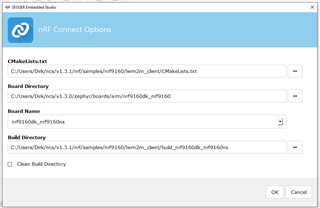
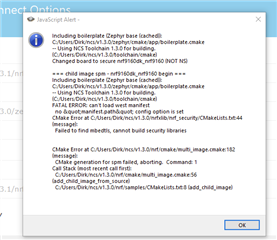
For the time being I will continue with lwm2m_client from the 1.3.0 folder which works. Just to let you know there is a problem with 1.3.1.
Best regards
Dirk
Yes, indeed it seems the 10 MB on the iBasis SIM have already been used up when I check the SIM status on nRF Cloud. That is a surprise. We plan to use LwM2M for our application (remote door control) which normally uses very little data, but if TLS handshaking can use a lot of data that might have a big impact on the dataplan we are planning to use. Is there any way to avoid this? Can the use of DTLS and CID reduce that? Is this implemented in Nordics LwM2M client?

LwM2M uses UDP, not TCP so you would use a DTLS not TLS. Not that the difference is very significant in this case.
The modem (where the DTLS stack resides) makes no assumptions on the validity of the DTLS session, and will try to continue the old session unless the server rejects it.
So, if you can control the disconnect timeout on the server, you can increase it to reduce the number of DTLS handshakes necessary. Another way would be to keep the connection alive from the client side, but that would mean sending data more often which also means increased power usage.
The data usage might also depend on the key types used. I just checked an IP trace I have from some previous LwM2M experimentation I did using DTLS with PSKs, and the handshake ended up with a total of 766 bytes, counting data in both directions. I expect that number to be bigger if you are using a public/private key pair, as those keys can be large themselves (often ~1.5KB).
Hi Didrik,
I have changed to the Telia eSIM and the asset tracker app is working again. RSRP is a bit strange showing values from -120dBm to -133dBm and nRF9160 datasheets says -108 dBm sensitivity for low bands. This means signal strength is far below sensitivity level??
Hi Didrik,
I have now switched to the LwM2M_client from the 1.3.1 SDK and when using Target>Download zephyr/merged.hex I am getting a strange error at the end of the build process:

dhandzic said:I have now switched to the LwM2M_client from the 1.3.1 SDK and when using Target>Download zephyr/merged.hex I am getting a strange error at the end of the build process:
Did you re-open the project after changing SDK?
It is often also recommended to check the "Clean build directory"
dhandzic said:I have now switched to the LwM2M_client from the 1.3.1 SDK and when using Target>Download zephyr/merged.hex I am getting a strange error at the end of the build process:
Did you re-open the project after changing SDK?
It is often also recommended to check the "Clean build directory"
Hi Didrik,
I got the LwM2M client example from SKD 1.3.1 working now as well after a "clean build directory".
I have almost finished the hardware design of our own board now. What would be needed in order to be able to use the LTE Link Monitor even with our board? Would it be enough to reserve 2 pins for RxD & TxD and use an seriell to USB converter?
Yes, exposing two pins used as TX and RX should be enough.
I would also recommend that you expose a second UART, that can be used to take modem traces, as those are very helpful if you encounter any network related issues.
Thanks Didrik,
will provide a header for two UART connections.
I got a comment from our developer supposed to take care of the LwM2M server part. He says he could not find open source examples for servers supporting DTLS and being scalable to be used for a production server. We tried the Leshan demo server and it works fine but is obviously just a demo not for production. Do you have any suggestions where to look for a start to build a production LwM2M server with DTLS support?
I only know of the Leshan server myself. My understanding was that it should be usable for more than just demo purposes.
You should obviously not use the demo server, but host an instance yourself. What makes your developer say that the Leshan server is not suitable for a production environment?
Ok, thank you. Is it possible that my colleague writes to this ticket in order to communicate with you? He has set up a LwM2M server on his side and I am not able to connect to it with the DK board. I have entered his IP address directly at CONFIG_APP_LWM2M_SERVER and set CONFIG_LWM2M_DNS to n and even CONFIG_LWM2M_DTLS_SUPPORT to n to make things as simple as possible.
The DK board does connect to the Leshan Demo Server so SIM and LTE part seem to work fine.