This post is older than 2 years and might not be relevant anymore
More Info: Consider searching for newer posts

Reducing current peaks

Hi!

We are trying to maximize the battery life of our product and have come across this white paper: High pulse drain impact on CR2032 coin cell battery capacity which suggest flattening the peak current draws should help.

To that end, we measured an nRF52833 current draw in 3 use cases:

1. No capacitors added to board.

2. a 47uF capacitor added in parallel to the battery.

3. 2x 47uF capacitors added in parallel to the battery.

here are the results, in graphs obtained from the PPK:

No capacitors added:

In system off- ~1uA average with ~12uA peaks.

While transmitting (There is some overhead of current because of a peripheral but its current draw is more or less constant, so it can be ignored):
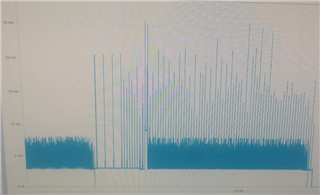
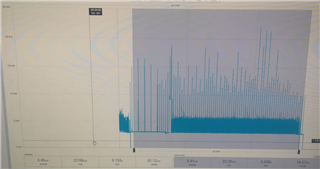

47uF capacitor added:
In system off- ~1uA average with ~4uA peaks.

While transmitting (There is some overhead of current because of a peripheral but its current draw is more or less constant, so it can be ignored):
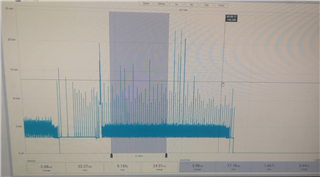
2x47uF capacitor added:

In system off- ~1uA average with ~3.1uA peaks.

While transmitting (There is some overhead of current because of a peripheral but its current draw is more or less constant, so it can be ignored):

Conclusion:

Adding capacitors in parallel definitely reduces the current peaks in system off mode, and it looks like it also helps reduce the current peaks while transmitting.

Questions:
1. Is there a 'recommended' capacitor value to add in parallel to the battery which anyone has tested? If not, is there a way to calculate the capacitance needed for a given Tx, load size etc?
2. Is there a more 'accurate' way to measure the impact a capacitor has on current peaks than to roughly average the result given out by the PPK?
3. When selecting a capacitor, what are the values we must pay close attention to? We've selected for a low ESR and calculated the current draw an advertising event will require, and tried matching the capacitance after DC-bias to match the required charge.

Any insight will be helpful.
Thanks!

  • Hi!

    I can not recommend anything to you I'm afraid, as this is not my area of expertise.

    I believe we chose a 47 uF, 6 volt capacitor as our solution to flatten these peaks, as it suited our needs well enough. We had considered the expected conditions our product is targeted to work at (working voltage, temperature, current peak draw, maximum expected battery life etc) and concluded the overhead price and/or space for a larger capacitor is not worth it.

    Hope this helps

  • Hello,
    thanks for your reply.
    Did you apply any more filtering to your device than the two 47uF capacitors?
    Did you get rid of this current peaks at any point?
    Best regards,
    Michael

  • Hi!
    We didn't apply any other filtering to the device.

    The peaks are not entirely gone, but they have been 'flattened down', which is the improvement we were looking for. These peaks are caused by the RTC and so are acceptable current draws. This power mode allows our units to 'wake up' from an external interrupt, which is what we'd like them to do.

    Asaf

  • No, the 47uF was just the example; minimum in our experience is 3 x 47uF so 220uF is a good choice. Note good practice is to isolate the drain from the battery by the nRF52 from other significant current drains where possible. A schottky diode works but wastes power; a better choice is an ideal diode such as the max40203

    The nRF52 has a 150uF separated from the battery by an always-enabled ideal diode; other loads connect to the battery with further capacitance and periodically pulse the battery voltage low for brief periods but the nRF52 is isolated from this drop in voltage and thus avoids brownouts or resets. Analogue circuits such as an AFE may be isolated from voltage pulses on their supply in a similar manner.

Related