This post is older than 2 years and might not be relevant anymore
More Info: Consider searching for newer posts

No sleep during nrf_drv_twi_rx with LIS3DH

I have been converting my TWI calls to be asynchronous by specifying a twi_handler, but my NRF52840 does not sleep during the TWI calls.

I use SDK15.3 and s140 softdevice. (I plan to upgrade to SDK17 soon)

When reading the 32 latest XYZ values (192 bytes) from my accelerometer (LIS3DH) I see overall power usage of ~6.6mA for 7.3ms on my PPK2 power profiler. 
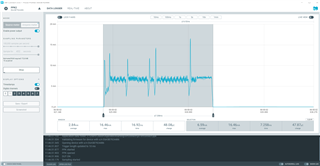
When I profile the LIS3DH power usage in isolation I see that it is using ~1mA for ~5ms.
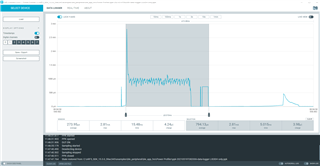
I have tested with my custom board and also with a breadboarded NRF52840 Dongle + Sparkfun LIS3DH. I see almost exactly the same on my custom board as on the breadboard with a NRF52840 dongle + Sparkfun LIS3DH

I do not understand why the NRF52840 is not sleeping.

I see ~11uA power usage before and after the TWI calls.

To talk to the LIS3DH I wrote a state machine which runs every ~1100ms, started by a timer. I make the following TWI calls in the state machine.

  if (twi_LIS3DH_step == 100)
  {
    uint8_t reg = LIS3DH_FIFO_SRC_REG;
    nrf_drv_twi_tx(&m_twi, LIS3DH_ADDRESS , &reg, 1, false);                     // ask for fifo_src
  }                                                                             
  else if (twi_LIS3DH_step == 101)                                              
  {
    nrf_drv_twi_rx(&m_twi, LIS3DH_ADDRESS , &fifo_src, 1);                      // read fifo_src to get num_samples to read
  }                                                                             
  else if (twi_LIS3DH_step == 102)                                              
  {
    num_samples = fifo_src & 0b00011111;                                        
    uint8_t reg = LIS3DH_OUT_X_L | 0x80;                                        
    nrf_drv_twi_tx(&m_twi, LIS3DH_ADDRESS , &reg, 1, true);                     // ask for samples
  }                                                                             
  else if (twi_LIS3DH_step == 103)                                              
  {                         
    nrf_drv_twi_rx(&m_twi, LIS3DH_ADDRESS , byte_array, 6*num_samples);         // read samples (6*num_samples)
  }
  else if (twi_LIS3DH_step == 104)
  {
    //Here I normally call a function to process the samples we received but it is commented out at the moment

    twi_LIS3DH_step = 0;
  }

  twi_LIS3DH_step++;
  twi_LIS3DH_can_step = false;    //wait until twi_handler sets this to true before doing next step

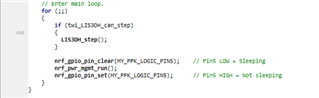
 My main loop steps the state machine.

    // Enter main loop.
    for (;;)
    {
//       send_data_to_peers();
        if (twi_LIS3DH_can_step)
        {
          LIS3DH_step();
        }
        if (twi_TMP112_can_step)
        {
          TMP112_step();
        }
        idle_state_handle();
    }

idle_state_handle looks like this.  I have disabled logging with NRF_LOG_ENABLED = 0. I do not printf anything 

static void idle_state_handle(void)
{ 
  while (NRF_LOG_PROCESS());

  nrf_pwr_mgmt_run();
}

The twi_handler allows the next step to proceed by setting twi_LIS3DH_can_step = true

void twi_handler(nrf_drv_twi_evt_t const * p_event, void * p_context)
{
  static uint8_t slave_address;
  slave_address = p_event->xfer_desc.address;

  if (slave_address == LIS3DH_ADDRESS)
  {
    if (twi_LIS3DH_step >= 100)
    {
      twi_LIS3DH_can_step = true;
    }
  }
  else if (slave_address == TMP112_ADDRESS)
  {
    if (twi_TMP112_step >= 100)
    {
      twi_TMP112_can_step = true;
    }
  }
}

I have tried setting the TWI .frequency to 400khz, 250K and 100K which just makes the transmission proportionally more time-consuming.

When I reduce the number of bytes requested from 192 to 100, 10 etc I see an approximately proportionally shorter transmission time. 

I have tried changing the TWI .interrupt_priority to APP_IRQ_PRIORITY_LOW, APP_IRQ_PRIORITY_MID and APP_IRQ_PRIORITY_HIGH.

What else could be causing this?

Any help is greatly appreciated. I have spent several days on this and I'm running out of ideas.

Kind regards,

-Jason

Parents
  • Hi,


    in your twi_handler, you should check the evt type to see if there's an error that has occurred.

    You should also check the return code from the nrf_drv_twi_* calls.


    Since you mention timers, and twi callbacks, you should look into declaring any variables incremented/set in those to volatile.


    Kind regards,

    Håkon

  • Thanks, they're all marked as volatile and I don't get any error codes from the nrf_drv_twi_* calls.

    Is there any way to know why it doesn't enter sleep mode?

    My main loop calls nrf_pwr_mgmt_run() immediately after the  nrf_drv_twi_* calls.

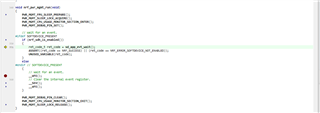
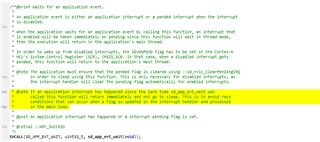
    When I look at sd_app_evt_wait I see this comment about interrupts. The 2nd note sounds relevant.

    Obviously I cannot step into sd_app_evt_wait.

    Could the calls to  nrf_drv_twi_* have immediately caused an interrupt?

    It's really only the call to get eh 192 bytes of accelerometer data that I really care about and it appears to take >5ms to complete. 

Reply
  • Thanks, they're all marked as volatile and I don't get any error codes from the nrf_drv_twi_* calls.

    Is there any way to know why it doesn't enter sleep mode?

    My main loop calls nrf_pwr_mgmt_run() immediately after the  nrf_drv_twi_* calls.

    When I look at sd_app_evt_wait I see this comment about interrupts. The 2nd note sounds relevant.

    Obviously I cannot step into sd_app_evt_wait.

    Could the calls to  nrf_drv_twi_* have immediately caused an interrupt?

    It's really only the call to get eh 192 bytes of accelerometer data that I really care about and it appears to take >5ms to complete. 

Children
  • I think I have a race condition because some nrf_drv_twi_ calls respond so quickly. I am working to debug it at the moment.

  • There was no race condition.

    I've made some significant progress that maybe you can help me with.

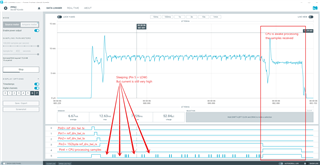
    I changed the code to perform the first 3 (of 4) twi calls synchronously, and the 4th call is the time-consuming one which I run asynchronously. I also hooked up the PPK2 logic analyser to show where the time was spent. See screenshot below

    Pins 0,1,2, show time spent in twi_tx, twi_rx, twi_tx.

    Pin 3 show time spent receiving 192 bytes in twi_rx 

    Pin 4 shows the time spent processing the samples (moving averages etc)

    Pin 5 shows time spent inside nrf_pwr_mgmt_run. This is the most interesting because it shows that lots of time is spent inside nrf_pwr_mgmt_run() but the current is still high.

    I expected the current to drop to a few uA's while the NRF52840 is inside nrf_pwr_mgmt_run() 

    I am confused by this result because it seems to show that the code is inside nrf_pwr_mgmt_run but the current is still very high. 

  • Hi,


    The CPU seems to be in sleep mode for most of the time.

    Any current going through the pull-resistors should not be much higher than ~1 mA, and the sleep current with an active TWIM (w/DMA) should be around 1.5 mA.

    The 192 bytes should be read in one transaction, but you have several wake-ups within this TWIM reception. Is there anything else running in your system while this process is on-going?


    Kind regards,

    Håkon

  • I am not aware of anything else which might be running. 

    My earlier test showed that the LIS3DH draws ~1mA during this process. So based on your figures, I think we should see a combined ~3.5mA. (instead of ~8mA at the moment.)

    Neither figure is really low enough and perhaps it would be better to use SPI instead of TWI. The LIS3DH supports SPI at 10Mhz. Do you expect this would use use less power?

    Thanks again for your help.

  • I also think that I must have a communication problem with the LIS3DH because 5ms for 192 bytes implies ~38kbps.The datasheet has specific instructions about the i2c protocol it expects, but it is not obvious to me how the nrf_drv_twi calls might deviate from their expectations.

    But 10Mhz seems far better than 400khz. and certainly better than 38kbps. So I think this is the best way to eliminate this problem. I can breadboard it using the Sparkfun LIS3DH board. 

    In fact I've also ordered the newer https://www.st.com/en/mems-and-sensors/ais2dw12.html

    https://www.arrow.com/en/products/steval-mki206v1/stmicroelectronics

    It claims even lower current and I think it might have lower noise levels.

    Thanks again for your help

Related