This post is older than 2 years and might not be relevant anymore
More Info: Consider searching for newer posts

Thermostat cluster enable issue

Hi All,

I am developing product using nRF52840 and SDK nRF5_SDK_for_Thread_and_Zigbee_v3.0.0_d310e71.

This product is basically, using the Thermostat cluster and Zigbee protocol to communicate with the Zigbee gateway.

So, I referred light_bulb example and followed steps to enable "Thermostat cluster and attributes".

I have included the respective files also but I am unable to execute the below callback function case statement,

static zb_void_t zcl_device_cb(zb_uint8_t param)
{
    zb_uint8_t                       cluster_id;
    zb_uint8_t                       attr_id;
    zb_buf_t                       * p_buffer = ZB_BUF_FROM_REF(param);
    zb_zcl_device_callback_param_t * p_device_cb_param =
                     ZB_GET_BUF_PARAM(p_buffer, zb_zcl_device_callback_param_t);

    NRF_LOG_INFO("zcl_device_cb id %hd", p_device_cb_param->device_cb_id);

    /* Set default response value. */
    p_device_cb_param->status = RET_OK;

    switch (p_device_cb_param->device_cb_id)
    {
        case ZB_ZCL_SET_ATTR_VALUE_CB_ID:
            cluster_id = p_device_cb_param->cb_param.set_attr_value_param.cluster_id;
            attr_id    = p_device_cb_param->cb_param.set_attr_value_param.attr_id;

            if (cluster_id == ZB_ZCL_CLUSTER_ID_THERMOSTAT)
            {
                uint16_t value = p_device_cb_param->cb_param.set_attr_value_param.values.data16;

                NRF_LOG_INFO("thermostat local temperature: %d", value);
                if (attr_id == ZB_ZCL_ATTR_THERMOSTAT_LOCAL_TEMPERATURE_ID)
                {
                    local_temperature_value(value);
                }
            }
            else
            {
                /* Other clusters can be processed here */
                NRF_LOG_INFO("Unhandled cluster attribute id: %d", cluster_id);
            }
        break;

        default:
            p_device_cb_param->status = RET_ERROR;
            break;
    }

    NRF_LOG_INFO("zcl_device_cb status: %hd", p_device_cb_param->status);
}

Also, I am attaching code for reference please let me know what else I forgot to enable the functions. It is urgent for me to solve this issue.

Radiator_nRF_v0.9.0.zip

And, with these attributes, for some of the commands, I need to implement custom attributes so if you share how to add custom attributes to this cluster.

Thanks in advance.

Regards,

Rohit R

Parents
  • Hi Marte,

    Thank you for the details, 

    As of now, sending custom command is pending. I will work on this in some time. 

    But current requirement I am trying to enabled the required attributes list. With reference to your code and other I have created extended list also. 

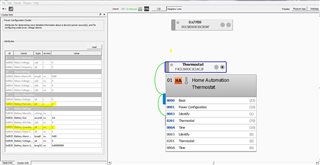
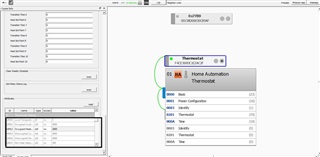
    But unoccupied, min and max, local_calibration and etc are not getting highlighted from thermostat cluster. And also Battery percentage attribute also facing same problem. they are not getting highlighted and these are must attributes (mandatory ids). 

    I have tested in SDK 3.0 I am getting highlighted below points but in SDK 4.1 i am facing this issue. Let me know why?

    Below is the image attached for both cluster. And also my thermostat.h file please check what is wrong. Why I am not getting these attributes highlighted. 

    0508.zb_zcl_thermostat.h

    5807.zb_zcl_power_config.h

    Thanks and regards

    Rohit 

  • Hi Marte, 

    Any update on this. 

    Urgent!

    Is there any difference in my file. 

    Thanks and Regards

    Rohit R

  • Hi Marte, 

    Thank you for the response. 

    The button does not make the device go into sleep mode or wake up from sleep when it is pressed. What it does is to enable sleepy end device behavior. This is there so that the user can decide, when resetting the device, whether they want the behavior enabled or not. In the multi sensor example it is enabled from start, as zb_set_rx_on_when_idle(ZB_FALSE) is called in main() before the Zigbee stack is started. Light switch instead calls sleepy_device_setup(), which checks whether the button for enabling sleepy end device is pressed or not, and will enable the behavior if the button is pressed. Additionally, the button must be pressed while resetting the board. Pressing the button while the device is on will not affect the sleepy end device behavior.

    - Okay, my understanding is wrong. 

    above, zb_set_rx_on_when_idle(ZB_FALSE) will not make it go to sleep, it will enable sleepy end device behavior. It will go to sleep when there is nothing to do and the signal ZB_COMMON_SIGNAL_CAN_SLEEP is generated. This happens when there is no immediate callback for execution and there is no outgoing packet on the MAC level. If there are any alarms in the queue, then the device will wake up when the first alarm is called. If there are no alarms in the queue, then the sleep duration is set to 10 seconds.

    -Okay, as per your suggestion I have referred the multi sensor example and made the respected changes in zigbee_signal_handler() as done in multi sensor done. 

    - as per explanation it in sleep mode is configured and it will enter into sleep if there is no signal. Correct? Correct me if I am wrong. 

    And wake up from sleep every 10sec default time. Correct?

    You will not be able to use sleepy end device if you want your device to wake up if there is a Zigbee command.

    - Okay, then How to configure it then? 

    You can also change the sleep functionality if you do not want to use the default behavior by using the weak functions zb_osif_go_idle or zb_nrf52840_sleep.

    - Sorry, It is unclear. 

    - And, we can not use this "ZB_COMMON_SIGNAL_CAN_SLEEP ". If we are waking up device using Zigbee command and GPIO interrupt. Correct? If yes, then let me know which example explain this 2 waking mechanism. I will refer the that example for my implementation. 


    Thanks and Regards

    Rohit R

  • Hi Marte, 

    I had gone through the link that you have shared regarding Zigbee stack sleep. 

    But for me points are unclear. Means I am not getting how to handle go to sleep and wake up from sleep in this, 


    /**@brief Function which tries to sleep down the MCU
    *
    * Function which sleeps the MCU on the non-sleepy End Devices to optimize the power saving.
    * The weak definition inside the OSIF layer provides some minimal working template
    */
    zb_void_t zb_osif_go_idle(zb_void_t)
    {
    //TODO: implement your own logic if needed
    zb_osif_wait_for_event();
    }

    can you please guide me here, 

    I have one GPIO pins which toggles as input and output pin during command sharing between nRF and STM8 board over UART. Means this gpio pins first configured as input and if interrupt it switch to output pin and stay for 5msec high to send commands over UART. 

    So, my plan is to use this gpio for waking up device from sleep mode. Is it possible? 

    And also wake up using wake up timer?

    I have referred ble_peripheral examples here for GPIO interrupt. Can I use same method in Zigbee code ? 

    As per your suggestion, I have referred multi sensor example to enable sleep_now() function in my code. I have included it my code zigbee_signal_handler().

    Attached is my main.c file. Let me know your feed back on this. 

    /**
     * Copyright (c) 2018 - 2019, Nordic Semiconductor ASA
     *
     * All rights reserved.
     *
     * Redistribution and use in source and binary forms, with or without modification,
     * are permitted provided that the following conditions are met:
     *
     * 1. Redistributions of source code must retain the above copyright notice, this
     *    list of conditions and the following disclaimer.
     *
     * 2. Redistributions in binary form, except as embedded into a Nordic
     *    Semiconductor ASA integrated circuit in a product or a software update for
     *    such product, must reproduce the above copyright notice, this list of
     *    conditions and the following disclaimer in the documentation and/or other
     *    materials provided with the distribution.
     *
     * 3. Neither the name of Nordic Semiconductor ASA nor the names of its
     *    contributors may be used to endorse or promote products derived from this
     *    software without specific prior written permission.
     *
     * 4. This software, with or without modification, must only be used with a
     *    Nordic Semiconductor ASA integrated circuit.
     *
     * 5. Any software provided in binary form under this license must not be reverse
     *    engineered, decompiled, modified and/or disassembled.
     *
     * THIS SOFTWARE IS PROVIDED BY NORDIC SEMICONDUCTOR ASA "AS IS" AND ANY EXPRESS
     * OR IMPLIED WARRANTIES, INCLUDING, BUT NOT LIMITED TO, THE IMPLIED WARRANTIES
     * OF MERCHANTABILITY, NONINFRINGEMENT, AND FITNESS FOR A PARTICULAR PURPOSE ARE
     * DISCLAIMED. IN NO EVENT SHALL NORDIC SEMICONDUCTOR ASA OR CONTRIBUTORS BE
     * LIABLE FOR ANY DIRECT, INDIRECT, INCIDENTAL, SPECIAL, EXEMPLARY, OR
     * CONSEQUENTIAL DAMAGES (INCLUDING, BUT NOT LIMITED TO, PROCUREMENT OF SUBSTITUTE
     * GOODS OR SERVICES; LOSS OF USE, DATA, OR PROFITS; OR BUSINESS INTERRUPTION)
     * HOWEVER CAUSED AND ON ANY THEORY OF LIABILITY, WHETHER IN CONTRACT, STRICT
     * LIABILITY, OR TORT (INCLUDING NEGLIGENCE OR OTHERWISE) ARISING IN ANY WAY OUT
     * OF THE USE OF THIS SOFTWARE, EVEN IF ADVISED OF THE POSSIBILITY OF SUCH DAMAGE.
     *
     */
    /** @file
     *
     * @defgroup zigbee_examples_light_bulb main.c
     * @{
     * @ingroup zigbee_examples
     * @brief Dimmable light sample (HA profile)
     */
    
    #include "sdk_config.h"
    #include "zboss_api.h"
    #include "zb_mem_config_med.h"
    #include "zb_error_handler.h"
    #include "zb_nrf52840_internal.h"
    #include "zigbee_helpers.h"
    
    #include "bsp.h"
    #include "boards.h"
    #include "app_pwm.h"
    #include "app_timer.h"
    
    #include "nrf_log.h"
    #include "nrf_log_ctrl.h"
    #include "nrf_log_default_backends.h"
    
    #include "app_uart.h"
    #include "app_error.h"
    #include "nrf_delay.h"
    #include "nrf.h"
    
    /**User Include file*********/
    #include "uart_config.h"
    #include "gpio_config.h"
    #include "timer_config.h"
    #include "commands.h" 
    #include "uart_statemachine.h" 
    #include "app_flash_memory.h"
    
    #include "zb_custom1_thermostat.h"
    #include "custom_app_event.h"


    /**< Scan only one, predefined channel to find the coordinator. */
    #define IEEE_CHANNEL_MASK                (ZB_TRANSCEIVER_ALL_CHANNELS_MASK)    // (1l << ZIGBEE_CHANNEL)
    
    #define ERASE_PERSISTENT_CONFIG           ZB_FALSE                              /**< Do not erase NVRAM to save the network parameters after device reboot or power-off. */
    
    
    #define ZIGBEE_NETWORK_STATE_LED          BSP_BOARD_LED_2                       /**< LED indicating that light switch successfully joind ZigBee network. */
    
    
    #if !defined ZB_ED_ROLE
    #error Define ZB_ED_ROLE to compile End Device source code.
    #endif


    /******************************************************************
    * GLOBAL VARIABLES
    *
    *******************************************************************/
    uint16_t ui16CurrentTemp =0, ui16OccupiedHeatSetpoint = 0, ui16UnOccupiedHeatSetpoint = 0;
    uint8_t  ui8LocalTemperatureCalibration = 0;
    uint32_t ui32HostflagsData = 0;
    
    bool boolSetTemperature = false;
    bool boolGetStatus = false;
    bool boolSetHostflags = false;
    bool boolSendDeviceConfig = false;
    /******************************************************************************************
    *EXTERNAL VARIABLES
    *
    *******************************************************************************************/
    extern bool boolReady;
    extern bool boolMCUInterrupt;
    extern bool boolSetCommand;
    extern uint8_t ui8SendDeviceConfig[BUFFER_SIZE];
    
    extern App_tsEventUart sAppUartEvent;
    extern E_StateMachineThermostat e_StateMachineThermostat;
    /******************************************************************************************
    *FUNCTIONS 
    *
    *******************************************************************************************/
    /* Declare attribute list for Basic cluster. */
    ZB_ZCL_DECLARE_BASIC_ATTRIB_LIST_EXT(basic_attr_list,
                                         &m_dev_ctx.basic_attr.zcl_version,
                                         &m_dev_ctx.basic_attr.app_version,
                                         &m_dev_ctx.basic_attr.stack_version,
                                         &m_dev_ctx.basic_attr.hw_version,
                                         m_dev_ctx.basic_attr.mf_name,
                                         m_dev_ctx.basic_attr.model_id,
                                         m_dev_ctx.basic_attr.date_code,
                                         &m_dev_ctx.basic_attr.power_source,
                                         m_dev_ctx.basic_attr.location_id,
                                         &m_dev_ctx.basic_attr.ph_env,
                                         m_dev_ctx.basic_attr.sw_ver);
    
    /* Declare attribute list for Identify cluster. */
    ZB_ZCL_DECLARE_IDENTIFY_ATTRIB_LIST(identify_attr_list,
                                        &m_dev_ctx.identify_attr.identify_time);
    
    /**power attributes**/
    ZB_ZCL_DECLARE_POWER_CONFIG_BATTERY_ATTRIB_LIST_EXT(power_config_attr_list,
                                            &m_dev_ctx.power_attr.battery_voltage,
                                            &m_dev_ctx.power_attr.battery_size,
                                            &m_dev_ctx.power_attr.battery_quantity,
                                            &m_dev_ctx.power_attr.battery_rated_voltage,
                                            &m_dev_ctx.power_attr.battery_alarm_mask,
                                            &m_dev_ctx.power_attr.battery_voltage_min_threshold,
                                            &m_dev_ctx.power_attr.battery_percentage_remaining,
                                            &m_dev_ctx.power_attr.battery_voltage_threshold1,
                                            &m_dev_ctx.power_attr.battery_voltage_threshold2,
                                            &m_dev_ctx.power_attr.battery_voltage_threshold3,
                                            &m_dev_ctx.power_attr.battery_percentage_min_threshold,
                                            &m_dev_ctx.power_attr.battery_percentage_threshold1,
                                            &m_dev_ctx.power_attr.battery_percentage_threshold2,
                                            &m_dev_ctx.power_attr.battery_percentage_threshold3,
                                            &m_dev_ctx.power_attr.battery_alarm_state);
    
    ZB_ZCL_DECLARE_TIME_ATTRIB_LIST(time_attr_list,
                                    &m_dev_ctx.time_attr.timeId,
                                    &m_dev_ctx.time_attr.time_status,
                                    &m_dev_ctx.time_attr.time_zone,
                                    &m_dev_ctx.time_attr.dst_start,
                                    &m_dev_ctx.time_attr.dst_end,
                                    &m_dev_ctx.time_attr.dst_shift,
                                    &m_dev_ctx.time_attr.standard_time,
                                    &m_dev_ctx.time_attr.local_time,
                                    &m_dev_ctx.time_attr.last_settime,
                                    &m_dev_ctx.time_attr.valid_untilTime);
    
    /* Declare extended attribute list for Thermostat cluster. */
    ZB_ZCL_DECLARE_THERMOSTAT_ATTRIB_LIST_EXT(thermostat_attr_list,
                                              &m_dev_ctx.thermostat_attr.local_temperature,
                                              &m_dev_ctx.thermostat_attr.local_temperature_calibration,
                                              &m_dev_ctx.thermostat_attr.occupied_heating_setpoint,
                                              &m_dev_ctx.thermostat_attr.unoccupied_heating_setpoint,
                                              &m_dev_ctx.thermostat_attr.pi_heating_demand,
                                              &m_dev_ctx.thermostat_attr.min_heating_setpoint_limit,
                                              &m_dev_ctx.thermostat_attr.max_heating_setpoint_limit,
                                              &m_dev_ctx.thermostat_attr.remote_sensing,
                                              &m_dev_ctx.thermostat_attr.control_seq_of_operation,
                                              &m_dev_ctx.thermostat_attr.system_mode,
                                              &m_dev_ctx.thermostat_attr.trv_mode,
                                              &m_dev_ctx.thermostat_attr.set_valve_position,
                                              &m_dev_ctx.thermostat_attr.error,
                                              &m_dev_ctx.thermostat_attr.current_setpoint,
                                              &m_dev_ctx.thermostat_attr.host_flags);
    
    /* Declare cluster list for Thermostat device (Basic, Identify, Thermostat, Fan Control, Thermostat UI). */
    ZB_DECLARE_CUSTOM_THERMOSTAT_CLUSTER_LIST(thermostat_clusters,
                                          basic_attr_list,
                                          identify_attr_list,
                                          power_config_attr_list,
                                          thermostat_attr_list,
                                          time_attr_list);
    
    
    ZB_HA_DECLARE_CUSTOM_THERMOSTAT_EP(thermostat_ep,
                                   THERMOSTAT_SENSOR_ENDPOINT,
                                   thermostat_clusters);
    
    ZB_HA_DECLARE_CUSTOM_THERMOSTAT_CTX(thermostat_ctx, thermostat_ep);
    
    /**@brief Function for initializing the application timer.
     */
    static void timer_init(void)
    {
        uint32_t error_code = app_timer_init();
        APP_ERROR_CHECK(error_code);
    }
    
    /**@brief Function for initializing the nrf log module.
     */
    static void log_init(void)
    {
        ret_code_t err_code = NRF_LOG_INIT(NULL);
        APP_ERROR_CHECK(err_code);
    
        NRF_LOG_DEFAULT_BACKENDS_INIT();
    }
    
    
    /**@brief Function for initializing LEDs.
     */
    static void leds_init(void)
    {
        bsp_board_init(BSP_INIT_LEDS);
    }
    
    /**@brief Function for initializing all clusters attributes.
    */
    static void thermostat_clusters_attr_init(void)
    {
         /* Basic cluster attributes data */
         m_dev_ctx.basic_attr.zcl_version = ZB_ZCL_VERSION;
         m_dev_ctx.basic_attr.app_version = THERMOSTAT_INIT_BASIC_APP_VERSION;
         m_dev_ctx.basic_attr.stack_version = THERMOSTAT_INIT_BASIC_STACK_VERSION;
         m_dev_ctx.basic_attr.hw_version = THERMOSTAT_INIT_BASIC_HW_VERSION;
       
        /* Use ZB_ZCL_SET_STRING_VAL to set strings, because the first byte should
         * contain string length without trailing zero.
         *
         * For example "test" string wil be encoded as:
         *   [(0x4), 't', 'e', 's', 't']
         */
          ZB_ZCL_SET_STRING_VAL(m_dev_ctx.basic_attr.mf_name,
                              THERMOSTAT_INIT_BASIC_MANUF_NAME,
                              ZB_ZCL_STRING_CONST_SIZE(THERMOSTAT_INIT_BASIC_MANUF_NAME));
    
          ZB_ZCL_SET_STRING_VAL(m_dev_ctx.basic_attr.model_id,
                              THERMOSTAT_INIT_BASIC_MODEL_ID,
                              ZB_ZCL_STRING_CONST_SIZE(THERMOSTAT_INIT_BASIC_MODEL_ID));
    
          ZB_ZCL_SET_STRING_VAL(m_dev_ctx.basic_attr.date_code,
                              THERMOSTAT_INIT_BASIC_DATE_CODE,
                              ZB_ZCL_STRING_CONST_SIZE(THERMOSTAT_INIT_BASIC_DATE_CODE));
    
          m_dev_ctx.basic_attr.power_source = THERMOSTAT_INIT_BASIC_POWER_SOURCE;
    
          ZB_ZCL_SET_STRING_VAL(m_dev_ctx.basic_attr.location_id,
                              THERMOSTAT_INIT_BASIC_LOCATION_DESC,
                              ZB_ZCL_STRING_CONST_SIZE(THERMOSTAT_INIT_BASIC_LOCATION_DESC));
    
    
          m_dev_ctx.basic_attr.ph_env = THERMOSTAT_INIT_BASIC_PH_ENV;
          //m_dev_ctx.basic_attr.sw_ver = "00000000";
          memcpy( m_dev_ctx.basic_attr.sw_ver,"00000000", 8);
        
        /* Identify cluster attributes data */
        m_dev_ctx.identify_attr.identify_time        = ZB_ZCL_IDENTIFY_IDENTIFY_TIME_DEFAULT_VALUE;
    
    //    /**power configuration attributes data**/
        m_dev_ctx.power_attr.battery_percentage_remaining = 0x02;
        m_dev_ctx.power_attr.battery_quantity = ZB_POWER_CONFIG_BATTERY_QUANTITY;
        m_dev_ctx.power_attr.battery_size = ZB_ZCL_POWER_CONFIG_BATTERY_SIZE_AA;
    
       /* Thermostat cluster attributes data */
        m_dev_ctx.thermostat_attr.local_temperature             = 0x07D0;
        m_dev_ctx.thermostat_attr.local_temperature_calibration = 0x00;
        m_dev_ctx.thermostat_attr.pi_heating_demand             = 0xFF;
        m_dev_ctx.thermostat_attr.occupied_heating_setpoint     = 0x07D0;
        m_dev_ctx.thermostat_attr.unoccupied_heating_setpoint   = 0x07D0;
        m_dev_ctx.thermostat_attr.min_heating_setpoint_limit    = 0x01F4;
        m_dev_ctx.thermostat_attr.max_heating_setpoint_limit    = 0x0BB8;
        m_dev_ctx.thermostat_attr.control_seq_of_operation      = ZB_ZCL_THERMOSTAT_CONTROL_SEQ_OF_OPERATION_HEATING_ONLY;
        m_dev_ctx.thermostat_attr.system_mode                   = ZB_ZCL_THERMOSTAT_SYSTEM_MODE_HEAT;
        m_dev_ctx.thermostat_attr.current_setpoint             = 0x0898;
        m_dev_ctx.thermostat_attr.trv_mode                     = ZB_ZCL_THERMOSTAT_TRV_MODE_DEFAULT_VALUE;
        m_dev_ctx.thermostat_attr.set_valve_position           = 0;
        m_dev_ctx.thermostat_attr.error                        = 0;
    
             /***time cluster attributes data**/
        m_dev_ctx.time_attr.timeId = ZB_ZCL_TIME_TIME_DEFAULT_VALUE;
        m_dev_ctx.time_attr.time_status = ZB_ZCL_TIME_TIME_STATUS_DEFAULT_VALUE;
    
        /*local temperature set attribute**/
       ZB_ZCL_SET_ATTRIBUTE(THERMOSTAT_SENSOR_ENDPOINT,
                            ZB_ZCL_CLUSTER_ID_THERMOSTAT,
                            ZB_ZCL_CLUSTER_SERVER_ROLE,
                            ZB_ZCL_ATTR_THERMOSTAT_LOCAL_TEMPERATURE_ID,
                            (zb_uint8_t *)&m_dev_ctx.thermostat_attr.local_temperature,
                            ZB_FALSE);
     
        ZB_ZCL_SET_ATTRIBUTE(THERMOSTAT_SENSOR_ENDPOINT,
                            ZB_ZCL_CLUSTER_ID_THERMOSTAT,
                            ZB_ZCL_CLUSTER_SERVER_ROLE,
                            ZB_ZCL_ATTR_THERMOSTAT_OCCUPIED_HEATING_SETPOINT_ID,
                            (zb_uint8_t *)&m_dev_ctx.thermostat_attr.occupied_heating_setpoint,
                            ZB_FALSE);
    
        ZB_ZCL_SET_ATTRIBUTE(THERMOSTAT_SENSOR_ENDPOINT,
                            ZB_ZCL_CLUSTER_ID_THERMOSTAT,
                            ZB_ZCL_CLUSTER_SERVER_ROLE,
                            ZB_ZCL_ATTR_THERMOSTAT_UNOCCUPIED_HEATING_SETPOINT_ID,
                            (zb_uint8_t *)&m_dev_ctx.thermostat_attr.unoccupied_heating_setpoint,
                            ZB_FALSE);
    
        ZB_ZCL_SET_ATTRIBUTE(THERMOSTAT_SENSOR_ENDPOINT, 
                             ZB_ZCL_CLUSTER_ID_THERMOSTAT, 
                             ZB_ZCL_CLUSTER_SERVER_ROLE, 
                             ZB_ZCL_ATTR_THERMOSTAT_HOST_FLAG_ID, 
                             (zb_uint8_t *)&m_dev_ctx.thermostat_attr.host_flags, 
                             ZB_FALSE);
    
        ZB_ZCL_SET_ATTRIBUTE(THERMOSTAT_SENSOR_ENDPOINT, 
                             ZB_ZCL_CLUSTER_ID_THERMOSTAT, 
                             ZB_ZCL_CLUSTER_SERVER_ROLE, 
                             ZB_ZCL_ATTR_THERMOSTAT_TRV_MODE_ID, 
                             (zb_uint8_t *)& m_dev_ctx.thermostat_attr.trv_mode, 
                             ZB_FALSE);
    
       /**Battery percentage value**/
       ZB_ZCL_SET_ATTRIBUTE(THERMOSTAT_SENSOR_ENDPOINT,
                            ZB_ZCL_CLUSTER_ID_POWER_CONFIG,
                            ZB_ZCL_CLUSTER_SERVER_ROLE,
                            ZB_ZCL_ATTR_POWER_CONFIG_BATTERY_REMAINING_ID,
                            (zb_uint8_t *)&m_dev_ctx.power_attr.battery_percentage_remaining,
                            ZB_FALSE);  
                                      
       ZB_ZCL_SET_ATTRIBUTE(THERMOSTAT_SENSOR_ENDPOINT,
                            ZB_ZCL_CLUSTER_ID_POWER_CONFIG,
                            ZB_ZCL_CLUSTER_SERVER_ROLE,
                            ZB_ZCL_ATTR_POWER_CONFIG_BATTERY_QUANTITY_ID,
                            (zb_uint8_t *)&m_dev_ctx.power_attr.battery_quantity,
                            ZB_FALSE);
    }
    
    /**@brief Function for local temperature
     *
     * @param[in]   new_value local temp value
     */
    void localTemperatureValue(zb_uint16_t ui16local_tempvalue)
    {
       zb_zcl_status_t zcl_status;
    
       zcl_status = zb_zcl_set_attr_val(THERMOSTAT_SENSOR_ENDPOINT, 
                                         ZB_ZCL_CLUSTER_ID_THERMOSTAT, 
                                         ZB_ZCL_CLUSTER_SERVER_ROLE, 
                                         ZB_ZCL_ATTR_THERMOSTAT_LOCAL_TEMPERATURE_ID, 
                                         (zb_uint8_t *)&ui16local_tempvalue , 
                                         ZB_FALSE);
       if(zcl_status != ZB_ZCL_STATUS_SUCCESS)
       {
          NRF_LOG_INFO("Set local temperature value fail. zcl_status: %d", zcl_status);
       }
    }
    void CurrentSetpointChangeValue(zb_uint16_t ui16CurrentSetpoint)
    {
       zb_zcl_status_t zcl_status;
       zcl_status = zb_zcl_set_attr_val(THERMOSTAT_SENSOR_ENDPOINT,
                                        ZB_ZCL_CLUSTER_ID_THERMOSTAT,
                                        ZB_ZCL_CLUSTER_SERVER_ROLE,
                                        ZB_ZCL_ATTR_THERMOSTAT_CURRENT_SETPOINT_CHANGE_ID,
                                        (zb_uint8_t *)&ui16CurrentSetpoint,
                                        ZB_FALSE);
       
       if(zcl_status != ZB_ZCL_STATUS_SUCCESS)
       {
          NRF_LOG_INFO("Setc current set point temperature value fail. zcl_status: %d", zcl_status);
       }
    
       
       if(ui16CurrentSetpoint != 0xFFFF)
       {
          ui16CurrentTemp = ui16CurrentSetpoint;
       }
       else
       {
          ui16CurrentTemp = 0xFFFF;
       }
    
    }
    
    /**
    **function to read/write the occupied heating setpoint 
    **Any change in occupied heating value will automatically copied to set point change attribute
    **
    **/
    void OccupiedHeatingSetpoint(zb_uint16_t ui16OccupiedSetpoint)
    {
       zb_zcl_status_t zcl_status;
    
       zcl_status = zb_zcl_set_attr_val(THERMOSTAT_SENSOR_ENDPOINT,
                                        ZB_ZCL_CLUSTER_ID_THERMOSTAT,
                                        ZB_ZCL_CLUSTER_SERVER_ROLE,
                                        ZB_ZCL_ATTR_THERMOSTAT_OCCUPIED_HEATING_SETPOINT_ID,
                                        (zb_uint8_t *)&ui16OccupiedSetpoint,
                                        ZB_FALSE);
       
         
       if(ui16OccupiedSetpoint != 0xFFFF)
       {
          ui16OccupiedHeatSetpoint = ui16OccupiedSetpoint;
          ui16CurrentTemp = ui16OccupiedSetpoint;
          CurrentSetpointChangeValue(ui16CurrentTemp);
       }
       else
       {
          ui16OccupiedHeatSetpoint == 0xFFFF;
       }
       if(zcl_status != ZB_ZCL_STATUS_SUCCESS)
       {
          NRF_LOG_INFO("Set occupied heating setpoint temperature value fail. zcl_status: %d", zcl_status);
       }
    }
    
    void ReadOccupiedHeatingSetpoint(zb_uint16_t ui16ReadOccupiedSetpoint)
    {
       zb_zcl_status_t zcl_status;
    
       zcl_status = zb_zcl_set_attr_val(THERMOSTAT_SENSOR_ENDPOINT,
                                        ZB_ZCL_CLUSTER_ID_THERMOSTAT,
                                        ZB_ZCL_CLUSTER_SERVER_ROLE,
                                        ZB_ZCL_ATTR_THERMOSTAT_OCCUPIED_HEATING_SETPOINT_ID,
                                        (zb_uint8_t *)&ui16ReadOccupiedSetpoint,
                                        ZB_FALSE);
    
       if(zcl_status != ZB_ZCL_STATUS_SUCCESS)
       {
          NRF_LOG_INFO("Set occupied heating setpoint temperature value fail. zcl_status: %d", zcl_status);
       }
    }
    /**
    **function to read/write the unoccupied heating setpoint 
    **Any change in unoccupied heating value will automatically copied to set point change attribute
    **
    **/
    void UnOccupiedHeatingSetpoint(zb_uint16_t ui16UnOccupiedSetpoint)
    {
       zb_zcl_status_t zcl_status;
    
       zcl_status = zb_zcl_set_attr_val(THERMOSTAT_SENSOR_ENDPOINT,
                                        ZB_ZCL_CLUSTER_ID_THERMOSTAT,
                                        ZB_ZCL_CLUSTER_SERVER_ROLE,
                                        ZB_ZCL_ATTR_THERMOSTAT_UNOCCUPIED_HEATING_SETPOINT_ID,
                                        (zb_uint8_t *)&ui16UnOccupiedSetpoint,
                                        ZB_FALSE);
       
       if(ui16UnOccupiedSetpoint != 0xFFFF)
       {
         ui16UnOccupiedHeatSetpoint = ui16UnOccupiedSetpoint;
         ui16CurrentTemp = ui16UnOccupiedSetpoint;
         CurrentSetpointChangeValue(ui16CurrentTemp);
       }
       else
       {
         ui16UnOccupiedHeatSetpoint =  0xFFFF;
       }
       if(zcl_status != ZB_ZCL_STATUS_SUCCESS)
       {
          NRF_LOG_INFO("Set unoccupied heating setpoint temperature value fail. zcl_status: %d", zcl_status);
       }
    }
    
    /**
    **function to read value of pi heating demand
    **Any change in valve position value will be copied to PI heating demand attribute which only read attribute
    **
    **/
    static void PIHeatingDemand (zb_uint8_t ui8PiHeatingDemand)
    {
       zb_zcl_status_t zcl_status;
    
       zcl_status = zb_zcl_set_attr_val(THERMOSTAT_SENSOR_ENDPOINT,
                                        ZB_ZCL_CLUSTER_ID_THERMOSTAT,
                                        ZB_ZCL_CLUSTER_SERVER_ROLE,
                                        ZB_ZCL_ATTR_THERMOSTAT_PI_HEATING_DEMAND_ID,
                                        &ui8PiHeatingDemand,
                                        ZB_FALSE);
       
    
       if(zcl_status != ZB_ZCL_STATUS_SUCCESS)
       {
          NRF_LOG_INFO("read pi heating demand value fail. zcl_status: %d", zcl_status);
       }
    }
    /**
    **function for read/write local temperature calibration
    **Any change in local temperature attribute then add this value to D11 and D12 of set temperature command
    **
    **/
    static void LocalTemperatureCalibration(zb_uint8_t ui8localTempCalibration)
    {
       zb_zcl_status_t zcl_status;
    
       zcl_status = zb_zcl_set_attr_val(THERMOSTAT_SENSOR_ENDPOINT,
                                        ZB_ZCL_CLUSTER_ID_THERMOSTAT,
                                        ZB_ZCL_CLUSTER_SERVER_ROLE,
                                        ZB_ZCL_ATTR_THERMOSTAT_LOCAL_TEMPERATURE_CALIBRATION_ID,
                                        &ui8localTempCalibration,
                                        ZB_FALSE);
       
       ui8LocalTemperatureCalibration = ui8localTempCalibration;
    
       if(zcl_status != ZB_ZCL_STATUS_SUCCESS)
       {
          NRF_LOG_INFO("local temperature calibration value fail. zcl_status: %d", zcl_status);
       }
    }
    /**
    **function to read/write the valve position
    **Any change in valve position value will be copied to PI heating demand attribute which only read attribute
    **
    **/
    void SetValvePosition(zb_uint8_t ui8ValvePosition)
    {
       zb_zcl_status_t zcl_status;
    
       zcl_status = zb_zcl_set_attr_val(THERMOSTAT_SENSOR_ENDPOINT,
                                        ZB_ZCL_CLUSTER_ID_THERMOSTAT,
                                        ZB_ZCL_CLUSTER_SERVER_ROLE,
                                        ZB_ZCL_ATTR_THERMOSTAT_SET_VALVE_POSITION_ID,
                                        &ui8ValvePosition,
                                        ZB_FALSE);
       
       PIHeatingDemand(ui8ValvePosition);
    
       if(zcl_status != ZB_ZCL_STATUS_SUCCESS)
       {
          NRF_LOG_INFO("Set valve position value fail. zcl_status: %d", zcl_status);
       }
    }
    
    void SetTRVMode (zb_uint8_t ui8TRVMode)
    {
       zb_zcl_status_t zcl_status;
    
       zcl_status = zb_zcl_set_attr_val(THERMOSTAT_SENSOR_ENDPOINT,
                                        ZB_ZCL_CLUSTER_ID_THERMOSTAT,
                                        ZB_ZCL_CLUSTER_SERVER_ROLE,
                                        ZB_ZCL_ATTR_THERMOSTAT_TRV_MODE_ID,
                                        &ui8TRVMode,
                                        ZB_FALSE);


       if(zcl_status != ZB_ZCL_STATUS_SUCCESS)
       {
          NRF_LOG_INFO("Set trv mode value fail. zcl_status: %d", zcl_status);
       }
    }
    /**@brief Function for remaining battery percentage 
     *
     * @param[in]   new_value local temp value
     */
    void ReadRemainigBatteryPercentage(zb_uint8_t ui8BatteryPercentage)
    {
       zb_zcl_status_t zcl_status;
    
       zcl_status = zb_zcl_set_attr_val(THERMOSTAT_SENSOR_ENDPOINT, 
                                         ZB_ZCL_CLUSTER_ID_POWER_CONFIG, 
                                         ZB_ZCL_CLUSTER_SERVER_ROLE, 
                                         ZB_ZCL_ATTR_POWER_CONFIG_BATTERY_REMAINING_ID, 
                                         &ui8BatteryPercentage , 
                                         ZB_FALSE);
       if(zcl_status != ZB_ZCL_STATUS_SUCCESS)
       {
          NRF_LOG_INFO("Set Battery percentage value fail. zcl_status: %d", zcl_status);
       }
    }
    /**
    **function to read the error status for different valve status 
    **Any change in valve status respective error state copied to Error attribute which is read only attribute
    **
    **/
    void ReadErrorStatus(zb_uint8_t ui8ErrorStatus)
    {
       zb_zcl_status_t zcl_status;
    
       zcl_status = zb_zcl_set_attr_val(THERMOSTAT_SENSOR_ENDPOINT, 
                                         ZB_ZCL_CLUSTER_ID_THERMOSTAT, 
                                         ZB_ZCL_CLUSTER_SERVER_ROLE, 
                                         ZB_ZCL_ATTR_THERMOSTAT_ERROR_ID, 
                                         &ui8ErrorStatus , 
                                         ZB_FALSE);
       if(zcl_status != ZB_ZCL_STATUS_SUCCESS)
       {
          NRF_LOG_INFO("read error status fail. zcl_status: %d", zcl_status);
       }
    }
    /**
    **function to read/write the flag status for different operation 
    **
    **
    **/
    void HostFlagStatus(zb_uint32_t ui32HostFlagsStatus)
    {
       zb_zcl_status_t zcl_status;
    
       zcl_status = zb_zcl_set_attr_val(THERMOSTAT_SENSOR_ENDPOINT, 
                                         ZB_ZCL_CLUSTER_ID_THERMOSTAT, 
                                         ZB_ZCL_CLUSTER_SERVER_ROLE, 
                                         ZB_ZCL_ATTR_THERMOSTAT_HOST_FLAG_ID, 
                                         (zb_uint8_t *)&ui32HostFlagsStatus, 
                                         ZB_FALSE);
       ui32HostflagsData = ui32HostFlagsStatus;
    
        //Rotate LCD by 180
        if((ui32HostflagsData & 0x000002)== 0x02)
        {    
          boolSetHostflags = false;
    
          boolSendDeviceConfig = true;
          if((ui8SendDeviceConfig[5] ^ DEVICE_CONFIG_BYTE_3_LCD_ROTATION) & DEVICE_CONFIG_BYTE_3_LCD_ROTATION ) 
          {
            ui8SendDeviceConfig[5] |= DEVICE_CONFIG_BYTE_3_LCD_ROTATION;        
          }
        }
        //LCD in default position
        if((ui32HostflagsData ^ 0x000002) & 0x02 )
        {
          boolSetHostflags = false;
          boolSendDeviceConfig = true;
          if(ui8SendDeviceConfig[5]  & DEVICE_CONFIG_BYTE_3_LCD_ROTATION) 
          {
            ui8SendDeviceConfig[5]  &= ui8SendDeviceConfig[5] ^ DEVICE_CONFIG_BYTE_3_LCD_ROTATION;		        
          }
        }
    
       if(zcl_status != ZB_ZCL_STATUS_SUCCESS)
       {
          NRF_LOG_INFO("Host flag status fail. zcl_status: %d", zcl_status);
       }
    }
    
    /**@brief Function which tries to sleep down the MCU 
     *
     * Function which sleeps the MCU on the non-sleepy End Devices to optimize the power saving.
     * The weak definition inside the OSIF layer provides some minimal working template
     */
    zb_void_t zb_osif_go_idle(zb_void_t)
    {
        //TODO: implement your own logic if needed
        zb_osif_wait_for_event();
    }
    
    /**@brief Callback function for handling ZCL commands.
     *
     * @param[in]   param   Reference to ZigBee stack buffer used to pass received data.
     */
    static zb_void_t zcl_device_cb(zb_uint8_t param)
    {
        zb_uint16_t                cluster_id;
        zb_uint16_t                attr_id;
        zb_buf_t                       * p_buffer = ZB_BUF_FROM_REF(param);
        zb_zcl_device_callback_param_t * p_device_cb_param =
                         ZB_GET_BUF_PARAM(p_buffer, zb_zcl_device_callback_param_t);
    
        NRF_LOG_INFO("zcl_device_cb id %hd", p_device_cb_param->device_cb_id);
    
        /* Set default response value. */
        p_device_cb_param->status = RET_OK;
    
        switch (p_device_cb_param->device_cb_id)
        {
            case ZB_ZCL_SET_ATTR_VALUE_CB_ID:
                   cluster_id = p_device_cb_param->cb_param.set_attr_value_param.cluster_id;
                   attr_id = p_device_cb_param->cb_param.set_attr_value_param.attr_id;
    
                 if (cluster_id == ZB_ZCL_CLUSTER_ID_THERMOSTAT)
                 {
                      if (attr_id == ZB_ZCL_ATTR_THERMOSTAT_OCCUPIED_HEATING_SETPOINT_ID)
                      {
                          zb_int16_t value = p_device_cb_param->cb_param.set_attr_value_param.values.data16;
                          OccupiedHeatingSetpoint(value);
                           boolSetTemperature = true;
                           boolReady = true;
                           boolMCUInterrupt = false; 
                          
                      }
                      else if (attr_id == ZB_ZCL_ATTR_THERMOSTAT_UNOCCUPIED_HEATING_SETPOINT_ID)
                      {
                          zb_int16_t value = p_device_cb_param->cb_param.set_attr_value_param.values.data16;
                          UnOccupiedHeatingSetpoint(value);
                           boolSetTemperature = true;
                           boolReady = true;
                           boolMCUInterrupt = false; 
                         
                      }
                      else if (attr_id ==ZB_ZCL_ATTR_THERMOSTAT_CURRENT_SETPOINT_CHANGE_ID)
                      {
                          zb_int16_t value = p_device_cb_param->cb_param.set_attr_value_param.values.data16;
                          CurrentSetpointChangeValue(value);
                           boolSetTemperature = true;
                           boolReady = true;
                           boolMCUInterrupt = false; 
                           
                      }
                      else if(attr_id ==ZB_ZCL_ATTR_THERMOSTAT_LOCAL_TEMPERATURE_CALIBRATION_ID)
                      {
                          zb_uint8_t value = p_device_cb_param->cb_param.set_attr_value_param.values.data8;
                          LocalTemperatureCalibration(value);
                      }
                      else if (attr_id ==ZB_ZCL_ATTR_THERMOSTAT_SET_VALVE_POSITION_ID)
                      {
                          zb_uint8_t value = p_device_cb_param->cb_param.set_attr_value_param.values.data8;
                          SetValvePosition(value);
                      }
                      else if(attr_id == ZB_ZCL_ATTR_THERMOSTAT_HOST_FLAG_ID)
                      {
                         zb_uint32_t value = p_device_cb_param->cb_param.set_attr_value_param.values.data32;
                         HostFlagStatus(value);
                         boolSetHostflags  = true; 
                         boolReady = true;
                         boolMCUInterrupt = false; 
                      }
                      else if(attr_id == ZB_ZCL_ATTR_THERMOSTAT_TRV_MODE_ID)
                      {
                         zb_uint8_t value = p_device_cb_param->cb_param.set_attr_value_param.values.data8;
                         SetTRVMode(value);
                      }
                 }
                  
              break;
    
    
            default:
                p_device_cb_param->status = RET_ERROR;
                break;
        }
    
        NRF_LOG_INFO("zcl_device_cb status: %hd", p_device_cb_param->status);
    }
    
    /**@brief ZigBee stack event handler.
     *
     * @param[in]   param   Reference to ZigBee stack buffer used to pass arguments (signal).
     */
    void zboss_signal_handler(zb_uint8_t param)
    {
        nrf_delay_ms(1000);
        zb_zdo_app_signal_hdr_t  * p_sg_p = NULL;
        zb_zdo_app_signal_type_t   sig    = zb_get_app_signal(param, &p_sg_p);
        zb_ret_t                   status = ZB_GET_APP_SIGNAL_STATUS(param);
        zb_bool_t                  comm_status;
    
        switch (sig)
        {
            case ZB_BDB_SIGNAL_DEVICE_FIRST_START:
            case ZB_BDB_SIGNAL_DEVICE_REBOOT:
                if (status == RET_OK)
                {
                    NRF_LOG_INFO("Joined network successfully");
                    bsp_board_led_on(ZIGBEE_NETWORK_STATE_LED);                
                    boolSetCommand  = true; 
                    boolReady = true;
                    boolGetStatus = true;
                }
                else
                {
                    NRF_LOG_ERROR("Failed to join network. Status: %d", status);
                    bsp_board_led_off(ZIGBEE_NETWORK_STATE_LED);
                    comm_status = bdb_start_top_level_commissioning(ZB_BDB_NETWORK_STEERING);
                    ZB_COMM_STATUS_CHECK(comm_status);
                }
                break;
    
            case ZB_ZDO_SIGNAL_PRODUCTION_CONFIG_READY:
                if (status != RET_OK)
                {
                    NRF_LOG_WARNING("Production config is not present or invalid");
                }
                break;
    
            case ZB_ZDO_SIGNAL_LEAVE:
                if (status == RET_OK)
                {
                    bsp_board_led_off(ZIGBEE_NETWORK_STATE_LED);
    
                    zb_zdo_signal_leave_params_t * p_leave_params = ZB_ZDO_SIGNAL_GET_PARAMS(p_sg_p, zb_zdo_signal_leave_params_t);
                    NRF_LOG_INFO("Network left. Leave type: %d", p_leave_params->leave_type);
                }
                else
                {
                    NRF_LOG_ERROR("Unable to leave network. Status: %d", status);
                }
                break;
    
            case ZB_COMMON_SIGNAL_CAN_SLEEP: //ZBOSS scheduler tracks the callback queue and if there is no immediate callback for execution and there is no outgoing packet on the MAC level, a special signal ZB_COMMON_SIGNAL_CAN_SLEEP is sent for an application. 
                {
                    zb_sleep_now(); //To go to the sleep mode, the application should call the zb_sleep_now() function.
                    zb_sleep_set_threshold(10000); //Set sleep threshold on device;Min = 20msec and Max = 86400000.
                }
                break;
    
            default:
                /* Unhandled signal. For more information see: zb_zdo_app_signal_type_e and zb_ret_e */
                NRF_LOG_INFO("Unhandled signal %d. Status: %d", sig, status);
                break;
        }
    
        if (param)
        {
            ZB_FREE_BUF_BY_REF(param);
        }
    }
    
    
    /**@brief Function for application main entry.
     */
    void main(void)
    {
        zb_ret_t       zb_err_code;
        zb_ieee_addr_t ieee_addr;
    
    //    nrf_delay_ms(1000);
    
        /* Initialize logging system and GPIOs. */
    //    timer_init();
    //    log_init();
    
        leds_init();
    
        Uart_Init_Func();    
    
        timer_config_func();
    
        ulp_input_pin_configuration();
     
        Flashinitialization();
    
        /* Set ZigBee stack logging level and traffic dump subsystem. */
        ZB_SET_TRACE_LEVEL(ZIGBEE_TRACE_LEVEL);
        ZB_SET_TRACE_MASK(ZIGBEE_TRACE_MASK);
        ZB_SET_TRAF_DUMP_OFF();
    
        /* Initialize Zigbee stack. */
        ZB_INIT("thermostat");
    
        /* Set device address to the value read from FICR registers. */
        zb_osif_get_ieee_eui64(ieee_addr);
        zb_set_long_address(ieee_addr);
    
        /* Set static long IEEE address. */
        zb_set_network_ed_role(IEEE_CHANNEL_MASK);
        zigbee_erase_persistent_storage(ERASE_PERSISTENT_CONFIG);
    
        zb_set_ed_timeout(ED_AGING_TIMEOUT_128MIN);
        zb_set_keepalive_timeout(ZB_MILLISECONDS_TO_BEACON_INTERVAL(3000));
        zb_set_rx_on_when_idle(ZB_FALSE);
    
        zb_set_node_descriptor_manufacturer_code(ZB_ZCL_MANF_CODE);
    
        /* Initialize application context structure. */
        UNUSED_RETURN_VALUE(ZB_MEMSET(&m_dev_ctx, 0, sizeof(m_dev_ctx)));
    
        /* Register callback for handling ZCL commands. */
        ZB_ZCL_REGISTER_DEVICE_CB(zcl_device_cb);
    
        /* Register thermostat device context (endpoints). */
        ZB_AF_REGISTER_DEVICE_CTX(&thermostat_ctx);
    
        thermostat_clusters_attr_init();
        /** Start Zigbee Stack. */
        zb_err_code = zboss_start();
        ZB_ERROR_CHECK(zb_err_code);   
         
       
        CommandBootloader();  //get bootloader command 
        nrf_delay_ms(500);
    
        while(1)
        {
           zboss_main_loop_iteration();
           UNUSED_RETURN_VALUE(NRF_LOG_PROCESS());
    
            CommunicationStateExecution();   //MCU and NP communication state     
            DataProcessing();                //Flag bit processing
            UARTStateStateMachine();    
        }
    }
    
    
    /**
     * @}
     */
    

    - With initialization will my sleep work and can I test the current consumption for the same?

    Please guide me how to implement GPIO wake up mechanism here and go to sleep()?

    Thanks and Regards

    Rohit R

  • Hi Rohit,

    Since you want your device to be able to receive Zigbee commands during low power mode, you cannot use sleepy end device. On devices that are not sleepy end devices the stack calls the nrf_pwr_mgmt_run API if the Zigbee scheduler queue is empty. This happens through the function zb_osif_wait_for_event(), and it happens by the stack already, as part of the internal handling of the stack inside zboss_main_loop_iteration()

    As you want to change the default behavior of the stack sleep routines, you should overwrite the function zb_osif_go_idle() to handle it the way you want. The way you can do this is by simply creating a new definition of the function in your main.c file, as this is a weak function. This is already done in the light bulb example, so you can look there for an example of how to do this. You can then implement functionality for putting the device to sleep/low power mode inside this function, as well as implementing GPIO interrupts and wake up timer.

    I also recommend actually measuring the power consumption of the device during development, to make sure that it satisfies your specifications. You can read the part about power consumption measurements on our Zigbee examples page in the documentation for more information about this.

    Best regards,

    Marte

  • Hi Marte, 

    Thank you for the response. 

    Since you want your device to be able to receive Zigbee commands during low power mode, you cannot use sleepy end device.

    - Okay , I will not configure this. 

    On devices that are not sleepy end devices the stack calls the nrf_pwr_mgmt_run API if the Zigbee scheduler queue is empty. This happens through the function zb_osif_wait_for_event(), and it happens by the stack already, as part of the internal handling of the stack inside zboss_main_loop_iteration()

    - Okay, so since it is already declared in my code. It is minimal possible sleep config. As it is already called by stack function. I do not need to call this again and with I can check default current? correct?. 

    The way you can do this is by simply creating a new definition of the function in your main.c file, as this is a weak function. This is already done in the light bulb example, so you can look there for an example of how to do this.

    - I am using light_bulb code only. I can see they have only called below snippet. Not handled any extra things to refer. 

    /**@brief Function which tries to sleep down the MCU
    *
    * Function which sleeps the MCU on the non-sleepy End Devices to optimize the power saving.
    * The weak definition inside the OSIF layer provides some minimal working template
    */
    zb_void_t zb_osif_go_idle(zb_void_t)
    {
    //TODO: implement your own logic if needed
    zb_osif_wait_for_event();
    }

    as well as implementing GPIO interrupts and wake up timer.

    - Okay, I will refer the power management code from peripheral example. 

    - In nrf_pwr_mgmt_shutdown() system enters into deep sleep mode and wake up on 4 ways." First is The DETECT signal. optionally generated by GPIO peripheral". This means I can use my ULP pin (GPIO pin as mentioned previous post) to wake up device correct? Let me know if i am wrong here.? 

    - Let me know your feedback as soon as possible. Because I have started this file including process and I would like to complete this today. Urgent for me. 

    Hi, Update from me, 

    - I had gone through the peripheral example and some link online. I tried to execute the system off mode configuration in simple code. Here, I want to wake up device using my ULP (GPIO pin ) interrupt. But I am not finding wake up function. I have put device in sleep in while (1) loop by calling "nrf_pwr_mgmt_run();" function. 

    - To make system OFF enabled I have used "NRF_PWR_MGMT_CONFIG_STANDBY_TIMEOUT_ENABLED 1". Followed the steps but it is waking up only after "RESET" is pressed but it doesn't work for me. 

    - As stated it should work on GPIO interrupt too correct? Then why it is not working on GPIO. 

    - And which function/API I have to call for wake up ? 

    Urgent. Please let me know your feedback. 

    Thanks and Regards

    Rohit R

  • Hi Marte, 

    Any update on this?

    Yesterday, I ran my code which contains below snippet in code, as per your explanation it handled by stack so tested current consumption with setup.

    Here, I got 0.03mA after discovery/ network connect. But this is too high. I want battery life should be 2 years so I need almost 1uA. 

    /**@brief Function which tries to sleep down the MCU
    *
    * Function which sleeps the MCU on the non-sleepy End Devices to optimize the power saving.
    * The weak definition inside the OSIF layer provides some minimal working template
    */
    zb_void_t zb_osif_go_idle(zb_void_t)
    {
    //TODO: implement your own logic if needed
    zb_osif_wait_for_event();
    }

    Also, I went through product specific document I found below measurement

    "ION_RAMOFF_EVENT System ON, no RAM retention, wake on any event 0.97 μA" typically. 

    - I want similar should happen in my code means, It should wake up on any event either Zigbee or gpio. But I am not understanding how to enable this. 

    - By calling "nrf_pwr_mgmt_run();" only this function in main infinite loop() it will give me above configuration or do I need to have any other configuration? Can you please help here the configuration. Please urgent !!.

    Thanks and Regards

    Rohit R

Reply
  • Hi Marte, 

    Any update on this?

    Yesterday, I ran my code which contains below snippet in code, as per your explanation it handled by stack so tested current consumption with setup.

    Here, I got 0.03mA after discovery/ network connect. But this is too high. I want battery life should be 2 years so I need almost 1uA. 

    /**@brief Function which tries to sleep down the MCU
    *
    * Function which sleeps the MCU on the non-sleepy End Devices to optimize the power saving.
    * The weak definition inside the OSIF layer provides some minimal working template
    */
    zb_void_t zb_osif_go_idle(zb_void_t)
    {
    //TODO: implement your own logic if needed
    zb_osif_wait_for_event();
    }

    Also, I went through product specific document I found below measurement

    "ION_RAMOFF_EVENT System ON, no RAM retention, wake on any event 0.97 μA" typically. 

    - I want similar should happen in my code means, It should wake up on any event either Zigbee or gpio. But I am not understanding how to enable this. 

    - By calling "nrf_pwr_mgmt_run();" only this function in main infinite loop() it will give me above configuration or do I need to have any other configuration? Can you please help here the configuration. Please urgent !!.

    Thanks and Regards

    Rohit R

Children
  • Hi Rohit,

    I have asked our developers about this, about how to further reduce current consumption and what the best way to do it when you want to wake up on received Zigbee commands and GPIO interrupt, in addition to the alarm and timer that is already a part of the sleep routine. 

    Best regards,

    Marte

  • Hi Marte, 

    Thank you I will wait for your response. Please let me know as early as possible.

    what the best way to do it when you want to wake up on received Zigbee commands and GPIO interrupt

    - Yes, more focus on wake up on zigbee commands from gateway ( first priority) and then GPIO as (second priority). 

    - But also, check my comments shared. Am I following correct steps or not? If I am doing anything wrong here then correct me. I will follow the steps and again check for current consumption. 

    Thanks and Regards

    Rohit R

  • Hi Rohit,

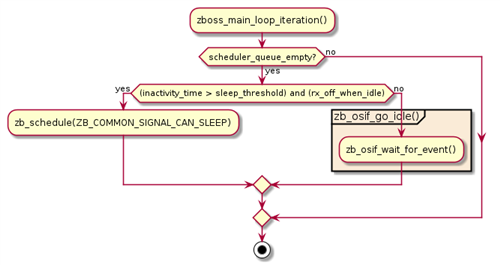
    You should not call nrf_pwr_mgmt_run() in the main loop yourself. When you call zboss_main_loop (or zboss_main_loop_iteration if you want to include custom features) in main you simply start the Zigbee stack, and the stack will interact with the application using stack signals (zboss_signal_handler) and ZCL callbacks (zcl_device_cb). So all of this is handled internally by the stack after you start the main loop. This includes the signal that it can go to sleep. The stack decides that it has nothing more to do, as there are no stack tasks or anything in the queue that needs to be handled, so the stack informs the device that it can go to sleep or power down. This will cause zb_osif_go_idle to be called automatically. This function checks if the logger has anything to process and calls the function zb_osif_wait_for_event, which in turn calls the nrf_pwr_mgmt_run API. You can see part of this in the flowchart below, which is from the page about Zigbee stack sleep routines in our documentation. Since your device is not a sleepy end device, the third step will result in no, since "rx_off_when_idle" is not true, and it will go to zb_osif_go_idle.

    While I wait for a response from the developers, you can also take a look at Powering down RAM sections to further reduce current consumption by powering down sections of the RAM memory that are not used by the application.

    Best regards,

    Marte

  • Hi Marte, 

    Thank you for the response. 

    Sorry my mistake, I have made confusion while explaining. 

    You should not call nrf_pwr_mgmt_run() in the main loop yourself.

    - This example is peripheral code. I have made one of example copy and followed some online tutorial steps to run this API. 

    When you call zboss_main_loop (or zboss_main_loop_iteration if you want to include custom features) in main you simply start the Zigbee stack, and the stack will interact with the application using stack signals (zboss_signal_handler) and ZCL callbacks (zcl_device_cb). So all of this is handled internally by the stack after you start the main loop. This includes the signal that it can go to sleep. The stack decides that it has nothing more to do, as there are no stack tasks or anything in the queue that needs to be handled, so the stack informs the device that it can go to sleep or power down. This will cause zb_osif_go_idle to be called automatically.

    - Yes, This is present in my radiator code. Here I have not added anything in while loop(). I kept code same as present in light_bulb code. With this only I have tested the current and it gave me 0.03mA after discovery. Where my Radiators STM base board and nRF52 Dev-kit connected. I want battery to life 2 years so I need almost 1uA current that too only my RF board (nRF should consume 1uA current). 

    While I wait for a response from the developers,

    - ya , sure please let me know i will wait for positive response. 

    you can also take a look at Powering down RAM sections to further reduce current consumption by powering down sections of the RAM memory that are not used by the application.

    - Okay, I will check this part too. 

    Thank you so much.  

    Regards, 

    Rohit R

  • Hi Marte, 

    I went through the Power down RAM section. Here, It is mentioned that use zigbee_power_down_unused_ram() function from  Zigbee application components. If I tried to search API/ function here it says zero result. 

    Similarly, Checked the light_switch example as it was mentioned in link for reference but in example alsp it says zero result. Am I following anything wrong here?

    Hi, I got this. zigbee_power_down_unused_ram() this present in light_switch SDK4.1 example and helper.c file but not present in SDK3.0. 

    Can we use in SDK 3.0 ? If yes the How to handle it in helper.c file or any other file. 

    Thanks and Regards

    Rohit R

Related