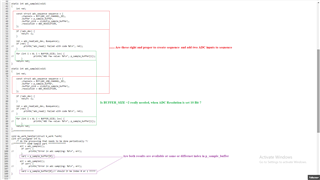
I need twoADC channels. I tried to configure using :
CONFIG_ADC= y in prj file,
&adc{
#io-channel-cells = < 0x2 >;
}; in overlay file .. the compile error appears as shown in atteched iamge.
Gulzar Singh
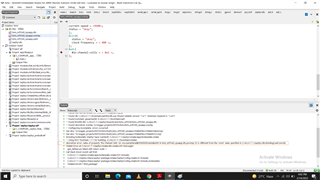
I need twoADC channels. I tried to configure using :
CONFIG_ADC= y in prj file,
&adc{
#io-channel-cells = < 0x2 >;
}; in overlay file .. the compile error appears as shown in atteched iamge.
Gulzar Singh

Hi, I created an application for testng the sampling of 2 channels on AIN0 and AIN1. The files are attached. I have few doubts.
1. In the adc.h, is #define BUFFER_SIZE 2 right or wrong to sample 2 analog channels ? If in future, 3 chhannels are required, may I set #define BUFFER_SIZE 3.
2. In the main file, I adc instantiated by binding and then, set up channels using err = adc_channel_setup() .. function. Is it proper way ?
3. As, I copied the most coe from sample program, what is meaning of following ?
#if defined (CONFIG_BOARD_BMS_NRF5340_CPUAPP)
NRF_SAADC->TASKS_CALIBRATEOFFSET = 1;
4. I wrote two sample functions, as in adc.c. Is this proper way to add to sequence ? If, wrong any where, may you make changes and attache corrected code file ?
5. I called adc sampling functions in repeatitive timer. Is the result of adc from AIN0 and AIN1 be avaialble at same index or at different indices in p_sample_buffer[].
void my_work_handler(struct k_work *work)
{int err;
    /* do the processing that needs to be done periodically */
//********** AIN0 Sample part **************
       err = adc_sample1();
        if (err) {
//            printk("Error in adc sampling: %d\n", err);
        }
        Var1 = p_sample_buffer[0];

err = adc_sample2();
        if (err) {
//            printk("Error in adc sampling: %d\n", err);
        }
        Var2 = p_sample_buffer[0];
}
K_WORK_DEFINE(my_work, my_work_handler);

void my_timer_handler(struct k_timer *dummy)
{
    k_work_submit(&my_work);
}

K_TIMER_DEFINE(my_timer, my_timer_handler, NULL);
//****************
void main()
{
	//ADC setup
          adc_dev = device_get_binding(ADC_DEVICE_NAME);
              if (!adc_dev) {
              printk("device_get_binding ADC (=%s) failed\n", ADC_DEVICE_NAME);
          }

          err = adc_channel_setup(adc_dev, &m_1st_channel_cfg);
          if (err) {
                  printk("Error in adc AIN0 setup: %d\n", err);
              }

          err = adc_channel_setup(adc_dev, &m_2nd_channel_cfg);
          if (err) {
                  printk("Error in adc AIN1 setup: %d\n", err);
              }

          #if defined (CONFIG_BOARD_BMS_NRF5340_CPUAPP)
          NRF_SAADC->TASKS_CALIBRATEOFFSET = 1;
          #else
          #error "Choose supported board or add new board for the application"
          #endif

}
// ADC.C File
//****************
static int adc_sample1(void)
{
	int ret;

	const struct adc_sequence sequence = {
		.channels = BIT(ADC_1ST_CHANNEL_ID),
		.buffer = p_sample_buffer,
		.buffer_size = sizeof(p_sample_buffer),
		.resolution = ADC_RESOLUTION,
	};

	if (!adc_dev) {
		return -1;
	}

	ret = adc_read(adc_dev, &sequence);
	if (ret) {
//        printk("adc_read() failed with code %d\n", ret);
	}

	for (int i = 0; i < BUFFER_SIZE; i++) {
//                printk("ADC raw value: %d\n", p_sample_buffer[i]);
        }
	return ret;
}

static int adc_sample2(void)
{
	int ret;

	const struct adc_sequence sequence = {
		.channels = BIT(ADC_2ND_CHANNEL_ID),
		.buffer = p_sample_buffer,
		.buffer_size = sizeof(p_sample_buffer),
		.resolution = ADC_RESOLUTION,
	};

	if (!adc_dev) {
		return -1;
	}

	ret = adc_read(adc_dev, &sequence);
	if (ret) {
//        printk("adc_read() failed with code %d\n", ret);
	}

	for (int i = 0; i < BUFFER_SIZE; i++) {
//                printk("ADC raw value: %d\n", p_sample_buffer[i]);
        }
	return ret;
}
//****************
Gulzar Singh

Hello Gulzar,
I have started looking at your files. Could you please send me the whole project so I can try to reproduce it?
Best Regards,
Kazi Afroza Sultana
Hi, here is the code in attached file.
//**********************
#include <hal/nrf_saadc.h>
//**********
#define ADC_DEVICE_NAME DT_LABEL(DT_INST(0, nordic_nrf_saadc))
#define ADC_RESOLUTION 10
#define ADC_GAIN ADC_GAIN_1_6
#define ADC_REFERENCE ADC_REF_INTERNAL
#define ADC_ACQUISITION_TIME ADC_ACQ_TIME(ADC_ACQ_TIME_MICROSECONDS, 10)
#define ADC_1ST_CHANNEL_ID 0
#define ADC_1ST_CHANNEL_INPUT NRF_SAADC_INPUT_AIN0
#define ADC_2ND_CHANNEL_ID 1
#define ADC_2ND_CHANNEL_INPUT NRF_SAADC_INPUT_AIN1


#define  BUFFER_SIZE 2
int err;
static int p_sample_buffer[BUFFER_SIZE];

const struct device *adc_dev;

static const struct adc_channel_cfg m_1st_channel_cfg = {
	.gain = ADC_GAIN,
	.reference = ADC_REFERENCE,
	.acquisition_time = ADC_ACQUISITION_TIME,
	.channel_id = ADC_1ST_CHANNEL_ID,
#if defined(CONFIG_ADC_CONFIGURABLE_INPUTS)
	.input_positive = ADC_1ST_CHANNEL_INPUT,
#endif
};

static const struct adc_channel_cfg m_2nd_channel_cfg = {
	.gain = ADC_GAIN,
	.reference = ADC_REFERENCE,
	.acquisition_time = ADC_ACQUISITION_TIME,
	.channel_id = ADC_2ND_CHANNEL_ID,
#if defined(CONFIG_ADC_CONFIGURABLE_INPUTS)
	.input_positive = ADC_2ND_CHANNEL_INPUT,
#endif
};

static int adc_sample1(void)
{
	int ret;

	const struct adc_sequence sequence = {
		.channels = BIT(ADC_1ST_CHANNEL_ID),
		.buffer = p_sample_buffer,
		.buffer_size = sizeof(p_sample_buffer),
		.resolution = ADC_RESOLUTION,
	};

	if (!adc_dev) {
		return -1;
	}

	ret = adc_read(adc_dev, &sequence);
	if (ret) {
//        printk("adc_read() failed with code %d\n", ret);
	}

	for (int i = 0; i < BUFFER_SIZE; i++) {
//                printk("ADC raw value: %d\n", p_sample_buffer[i]);
        }
	return ret;
}

static int adc_sample2(void)
{
	int ret;

	const struct adc_sequence sequence = {
		.channels = BIT(ADC_2ND_CHANNEL_ID),
		.buffer = p_sample_buffer,
		.buffer_size = sizeof(p_sample_buffer),
		.resolution = ADC_RESOLUTION,
	};

	if (!adc_dev) {
		return -1;
	}

	ret = adc_read(adc_dev, &sequence);
	if (ret) {
//        printk("adc_read() failed with code %d\n", ret);
	}

	for (int i = 0; i < BUFFER_SIZE; i++) {
//                printk("ADC raw value: %d\n", p_sample_buffer[i]);
        }
	return ret;
}
//****************

void my_work_handler(struct k_work *work)
{int err;unsigned int k;
    /* do the processing that needs to be done periodically */
//********** AIN0 Sample part **************
       err = adc_sample1();
        if (err) {
//            printk("Error in adc sampling: %d\n", err);
        }
        var1 = p_sample_buffer[0];

       err = adc_sample2();
        if (err) {
//            printk("Error in adc sampling: %d\n", err);
        }
        var2 = p_sample_buffer[0];// should it be index 0 or 1 ?????
}


K_WORK_DEFINE(my_work, my_work_handler);

void my_timer_handler(struct k_timer *dummy)
{
    k_work_submit(&my_work);
}

K_TIMER_DEFINE(my_timer, my_timer_handler, NULL);
//********************************************************
void main(){

          //ADC setup
          adc_dev = device_get_binding(ADC_DEVICE_NAME);
              if (!adc_dev) {
              printk("device_get_binding ADC (=%s) failed\n", ADC_DEVICE_NAME);
          }

          err = adc_channel_setup(adc_dev, &m_1st_channel_cfg);
          if (err) {
                  printk("Error in adc AIN0 setup: %d\n", err);
              }

          err = adc_channel_setup(adc_dev, &m_2nd_channel_cfg);
          if (err) {
                  printk("Error in adc AIN1 setup: %d\n", err);
              }

          #if defined (CONFIG_BOARD_BMS_NRF5340_CPUAPP)
          NRF_SAADC->TASKS_CALIBRATEOFFSET = 1;
          #else
          #error "Choose supported board or add new board for the application"
          #endif
	k_timer_start(&my_timer, K_SECONDS(4), K_SECONDS(30));
while(1)
	{
	// do something
	}
}
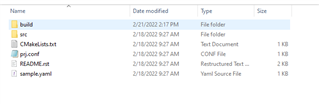
I mean the project folder which contain build file, configure file, cmakelist text file and source file. like the following screenshot:
Hi, I just need answer of three queries as shown in attached image.