Please tell me how to reduce the current consumption in sleep mode.

Hello, I'm an engineer from Japan.

There is a problem that the standby current in sleep mode is higher than expected.
I am using "ble_central - ble_app_blinky_C" as a base program.
In this program, both central and peripheral use sleep mode during standby.

In sleep mode, I would like to be in the "ON_RAMON_EVENT" state described in the evaluation board manual.
In that case, the current consumption is expected to be 0.8uA, but when measured with the Power Profiler Kit II, the standby current is 43uA.

This is the same for both central and peripheral.
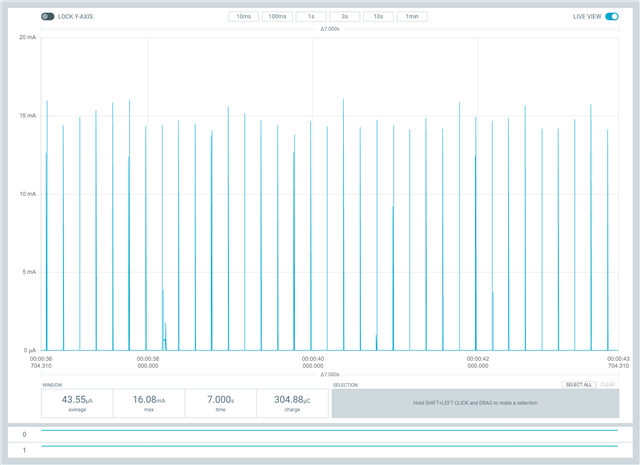
I think I need to set it before entering sleep mode, but I don't know how to do it.
Data is simple data transmission of On/OFF, but timer interrupt is used.
The data transmission interval is 200ms, but I don't want to change it from the viewpoint of reaction speed.

Can someone tell me how to reduce the current consumption in sleep mode?

thank you.

Parents
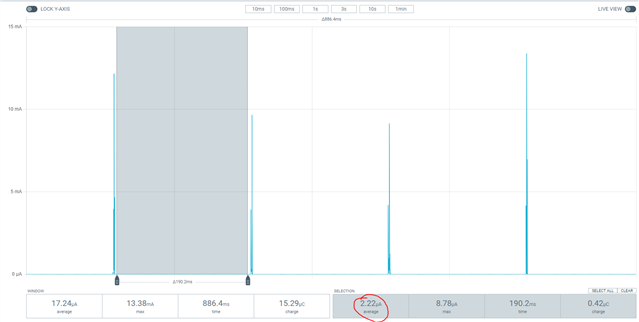
  • Thank you for explaining and uploading the file. So it seems like we misunderstand each other. You refer to the standby current being the total current when the device is connected and keeps a connection alive, correct? While I mean that the standby current is what the application is drawing in between radio events (the spikes in your power profiling app. Between these, you can see that the average current consumption is ~2µA

    Using the external LF clock will indeed help, as it doesn't make the application wake up every now and then to calibrate the internal RC oscillator. lowering the TX power will also reduce current consumption by a lot as the radio events (spikes) will reduce quite a bit, but this will affect the range and radio performance of your application.

    Increasing the connection interval will increase the time between every radio event so the stretches of ~2µA will be longer and the average lower. I think 5µA while maintaining a connection like this is a bit optimistic, and the 1-2µA average current consumption can only be expected if you have very long sleep times between radio event or if you disconnect from the peripheral entirely and wake up every now and then to connect and do a data transfer. More details on ways to optimize power on nRF52 designs can be found in this guide by my colleague Scott.

    Best regards,

    Simon

Reply
  • Thank you for explaining and uploading the file. So it seems like we misunderstand each other. You refer to the standby current being the total current when the device is connected and keeps a connection alive, correct? While I mean that the standby current is what the application is drawing in between radio events (the spikes in your power profiling app. Between these, you can see that the average current consumption is ~2µA

    Using the external LF clock will indeed help, as it doesn't make the application wake up every now and then to calibrate the internal RC oscillator. lowering the TX power will also reduce current consumption by a lot as the radio events (spikes) will reduce quite a bit, but this will affect the range and radio performance of your application.

    Increasing the connection interval will increase the time between every radio event so the stretches of ~2µA will be longer and the average lower. I think 5µA while maintaining a connection like this is a bit optimistic, and the 1-2µA average current consumption can only be expected if you have very long sleep times between radio event or if you disconnect from the peripheral entirely and wake up every now and then to connect and do a data transfer. More details on ways to optimize power on nRF52 designs can be found in this guide by my colleague Scott.

    Best regards,

    Simon

Children
No Data
Related