eDRX enabled but no observable reduction in power consumption

Hello Nordic team,

We are using an nRF5340 as the host processor, and an nRF9160 module is mounted on top of it.
All LTE modem AT commands are sent from nRF5340 to nRF9160.

We have enabled eDRX mode on the nRF9160, and the device is entering reduced power mode successfully.

eDRX Configuration:

The following AT command is sent to enable eDRX:

AT+CEDRXS=1,4,"0001"

The network negotiates and responds with:

+CEDRXS: 4,"0001","001","0001"
OK
From this response, we understand that:
  • LTE‑M eDRX is accepted by the network
  • The requested eDRX value is successfully negotiated

Observed Behavior

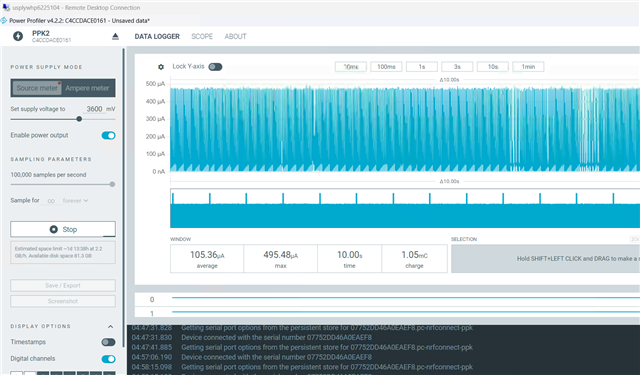
  • After enabling eDRX, we can see a clear difference in the current waveform pattern
  • The RF spike frequency is reduced, and the device is clearly entering reduced power mode
  • So functionally, eDRX appears to be working

However:

  • The average current consumption remains almost the same
  • Measured current is approximately ~110 µA
    • Before enabling eDRX
    • After enabling eDRX
  • No noticeable reduction in average power consumption is observed

Measurement Setup

  • Power is measured at the supply side
  • Energy harvesting circuit is enabled
  • Battery is also connected

Questions

  1. Is it expected that eDRX mainly changes the current pattern (paging cycle) but does not significantly reduce the average current, especially when PSM is not enabled?  

Power consumption Measurement:
  

Parents
  • Hi,

    You are not seeing a lot of difference because you keep your eDRX paging interval very short (~10sec). You are still in ranges supported by normal NB-IoT iDRX (which is used by default). If you want to have a significant power consumption reduction, you can try to make the paging interval longer.

    PSM combined with eDRX would allow you to save even more power. As in PSM mode the whole chip can go into deep sleep. But that also costs the chip to "disconnect" from the network. Overall, adding PSM depends on the pageing frequency that you want. 

    If you want to learn more about eDRX and PSM, you can check this lesson from the Cellular DevAcademy course.

    We also have an Online Power Profiler for LTE that allows you to simulate the expected power consumption in your device.

    If you have more questions feel free to ask.

    Best regards,

    Simon D-M

Reply
  • Hi,

    You are not seeing a lot of difference because you keep your eDRX paging interval very short (~10sec). You are still in ranges supported by normal NB-IoT iDRX (which is used by default). If you want to have a significant power consumption reduction, you can try to make the paging interval longer.

    PSM combined with eDRX would allow you to save even more power. As in PSM mode the whole chip can go into deep sleep. But that also costs the chip to "disconnect" from the network. Overall, adding PSM depends on the pageing frequency that you want. 

    If you want to learn more about eDRX and PSM, you can check this lesson from the Cellular DevAcademy course.

    We also have an Online Power Profiler for LTE that allows you to simulate the expected power consumption in your device.

    If you have more questions feel free to ask.

    Best regards,

    Simon D-M

Children
  • Hello Simon,
    Thank you for the explanation — that clarifies why we are not seeing much change with a short eDRX cycle.

    Based on this, we have a few follow‑up questions to better understand and tune our configuration:

    1. AcT type for LTE‑M Cat‑M1
      We are using an LTE‑M (Cat‑M1) SIM.
      Can you please confirm that AcT type 4 is the correct value to use in AT+CEDRXS for LTE‑M Cat‑M1 on nRF9160?

    2. Recommended eDRX value without using PSM
      At the moment, we do not want to enable PSM.
      In this case:

      • What minimum eDRX paging interval would you recommend to see a noticeable reduction in average current compared to normal?
    3. Expected power consumption improvement
      When using eDRX only (without PSM) on LTE‑M Cat‑M1:

      • What approximate average current reduction can be expected compared to normal mode?
      • Is it normal that short eDRX cycles (≈10 seconds) mainly change the paging pattern but result in very little average current improvement, as we are observing (~110 µA)?

    This will help us choose appropriate eDRX parameters and set realistic expectations for power savings without PSM.

    Thanks again for your support.

    Best regards,
    Bhumi

  • Hi Bhumi,

    Bhumi said:
    AcT type for LTE‑M Cat‑M1
    We are using an LTE‑M (Cat‑M1) SIM.
    Can you please confirm that AcT type 4 is the correct value to use in AT+CEDRXS for LTE‑M Cat‑M1 on nRF9160?

    Yes, type 4 is the right one for LTE-M.

    However, I can see that you are based in India, and I believe that LTE-M is not available in your country. From what I know, only NB-IoT is available in India. (coverage map)

    And for NB-IoT, I believe you should choose type 5.

    Bhumi said:
    • Recommended eDRX value without using PSM
      At the moment, we do not want to enable PSM.
      In this case:

      • What minimum eDRX paging interval would you recommend to see a noticeable reduction in average current compared to normal?
    • Expected power consumption improvement
      When using eDRX only (without PSM) on LTE‑M Cat‑M1:

      • What approximate average current reduction can be expected compared to normal mode?
      • Is it normal that short eDRX cycles (≈10 seconds) mainly change the paging pattern but result in very little average current improvement, as we are observing (~110 µA)?

    For both of these questions, I can't really give you a good answer... It depends way too much on what you want to do with your device. The best thing for you would be to first tune it on the Online Power Profiler for LTE to achieve your power consumption goal, and then try to tune your actual device.

    Sorry for not being able to give you a good answer for the last questions.

    Best regards,

    Simon D-M

  • Hello Simon,

    Thank you for the clarification regarding the AcT type and for pointing out the LTE‑M vs NB‑IoT availability. That is helpful.

    To better understand our measurements and choose appropriate eDRX values, we would like to clarify one additional point related to iDRX (Idle DRX):

    • What is the typical default iDRX paging interval used by the nRF9160 when the modem is in Idle and eDRX is not enabled?
    • Is this iDRX interval fully network‑controlled, or does the modem have a typical/default range it operates in (for example, a few seconds)?
    • Is there any recommended way (AT command, trace, or observable behavior) to infer or verify the effective iDRX cycle duration on a running device?

    We are trying to understand whether our configured short eDRX intervals (≈10 s) are effectively operating close to the default iDRX behavior, which would explain the minimal difference in average current consumption.

    Additionally, we would like to confirm whether the application configuration (prj.conf) could be influencing our measurements:

    • Are there any specific prj.conf options that should be enabled or disabled when evaluating power consumption reduction using eDRX?

    Thanks again for your support and guidance.

    Best regards,
    Bhumi

  • Hi,

    Bhumi said:
    • What is the typical default iDRX paging interval used by the nRF9160 when the modem is in Idle and eDRX is not enabled?
    • Is this iDRX interval fully network‑controlled, or does the modem have a typical/default range it operates in (for example, a few seconds)?

    The iDRX is fully network-controlled, so I can't give you a precise value. But I had to give you a range, it should range from ~100ms to ~10sec by default.

    Bhumi said:
    Is there any recommended way (AT command, trace, or observable behavior) to infer or verify the effective iDRX cycle duration on a running device?

    You should be able to see it in the modem traces. You should also be able to see the paging on the power measurement. It should do a spike when the paging is happening.

    Bhumi said:
    Are there any specific prj.conf options that should be enabled or disabled when evaluating power consumption reduction using eDRX?

    When measuring the current, you should not have the modem traces enabled. They are drawing power, so while having them activated you won't get a relevant value for power consumption.

    To learn more about power management with cellular, you can check these blogs. They are a bit old, but they are mostly still relevant.

    LTE-M vs NB-IoT Field Test: How Distance Affects Power Consumption

    Maximizing battery lifetime in cellular IoT: An analysis of eDRX, PSM, and AS-RAI

    Best regards,

    Simon D-M

Related