nrf54: (Ab)using SPIM as a shift-register - between-TXLIST latency

Hi

I'm trying to drive a 75hc595-type shift register with a SPIM instance on the nrf54l15.

I connect MOSI to the shift register data input, CLK to the shift register clock, and CSN to the output-stage-enable register (i.e. latch from the input shifter to the output). I use the maximum frequency of the SPIM22, namely a prescaler of 2, to reach 8MHz on the output, aiming for 1 MHz output on the shift register. To set the outputs, I use EasyDMA in List mode with a MAXCNT of 1. Using CSNPOL Low, CSN is driven HIGH at the end of the transfer, thus sampling automatically into the shift register. I set IFTIMING.CSNDUR to 0.

Because I have a fixed number of bytes to sample (~240), I use a TIMER22 as a byte-counter, and a PPI group in DPPI20. I link the SPI ENDED event to the SPI STARTED event in one PPI channel, which I add to a PPIGROUP, and into the TIMER22 COUNT event. I then program a CC to the maximum number of bytes, and link it in another PPI channel to the PPIGROUP DISABLE task to break the loop and stop transferring after the programmed number of bytes.

I was expecting _some_ delay caused by the CSN and rearming. But I'm observing >1us of delay between clock pulse sequences (i.e. SPI transfer active), resulting in an oscilloscope-measured time of 2us (instead of slightly more than 1us expected) between CSN pulses, halving the aimed-for frequency. Essentially, the bus idles for 1 us after every byte (which also takes 1us to transfer).

I'm a bit confused about these delays. I know that SHORTS.END_START is supposed to use IFTIMING.CSNDUR as a delay in peripheral clock cycles, so this should be 1/16 us (or 1/8 us) - not a full microsecond, so the peripheral is supposed to be faster. From what I understand from the documentation, the counter is also counting with a max delay of 1 from the PCLK, which is also 16MHz - but what I'm seeing looks like a clock of 1 MHz dominating the results.

Could you kindly point me to my mistake? I'm thinking about using the DMA TX END (rather than the SPI END) event to queue the next transfer, but I'm a bit hesitant regarding the safety of such a hack. Would the timings guarantee that the latency is enough to trigger only after the ENDED event? What would happen if the START task is triggered before (or in the same cycle where) the SPI ENDED event fires?

Is there another, better way? I was thinking about using the SPIM to transfer one array of 240 bytes at once, and pulsing the shift-latch using a different timer, but I'm a bit weary about the ultra-tight and hard-to-debug timing requirements caused by this approach given that my understanding of the PPI latencies already seems to be off.

Parents
  • Hi,


    Do you have any measurements to share, so I can see the delay? I would expect 1 us typically, based on the description in the datasheet.


    The time from .START -> actual transmission start is typically 1 us:

    https://docs.nordicsemi.com/bundle/ps_nrf54L15/page/_tmp/nrf54l15/autodita/SPIM/parameters.elec_spec.html

    And when .PSEL.CSN is configured, the timing will behave as described in the datasheet:

    https://docs.nordicsemi.com/bundle/ps_nrf54L15/page/spim.html#ariaid-title4


    Ie. you will get a delay before- and after a transmission, thus you will see a "double delay" between each transaction (one byte in your scenario).

    I set IFTIMING.CSNDUR to 0.

    If we look at the definition of this register:

    https://docs.nordicsemi.com/bundle/ps_nrf54L15/page/spim.html#ariaid-title59

    it mentions specifically:

    Note that for low values of CSNDUR, the system turnaround time will dominate the actual time between transactions


    Kind regards,

    Håkon

  • Hi

    I apologize for the delay.
    Unfortunately, I currently only have access to the capture of a pin (BCK) toggled at a fixed delay after the SPI end. This is expected to read ~1us for every transaction when considering the raw transmission time.

    Your mention of the 1us START delay explains the other 1us of delay between the transfers.

    I find the datasheet a bit confusing regarding the CSNDUR, especially because the timing diagram in Figure 4 does not actually include this "turnaround" time. Is the time of "CSN high" a function of min(1us, CSNDUR*(1/PCLK))? Or 1us + CSNDUR*(1/PLK)? And does this 1us START delay apply also with SHORTS.ENDED_START ?

    Considering my usecase, would it be possible to PPI a pin to pulse the "CSN" pin (then disconnected from the SPI) precisely after the last bit has been asserted and the CLK has sampled? Specifically, is the SHORT on the TIMER clear constant in time, and is the peripheral clock of one domain synched?
    Or is there a "best practice" to implement the SRCLK signal on a 595-type IC in sync with the SPI peripheral?

    Kind regards

  • Hi,


    I would strongly recommend that you look at the different signals to see how they behave, it'll be a lot easier for you if you are able to see how and where the delays propagate through the system

    cwriter said:
    Unfortunately, I currently only have access to the capture of a pin (BCK) toggled at a fixed delay after the SPI end. This is expected to read ~1us for every transaction when considering the raw transmission time.

    Transmission takes 1 us, and from TASKS_START =1 to actual transmission is typically 1 us. This seems to add up, as you measure 2.16 us, unless I am reading this incorrectly?

    cwriter said:
    I find the datasheet a bit confusing regarding the CSNDUR, especially because the timing diagram in Figure 4 does not actually include this "turnaround" time. Is the time of "CSN high" a function of min(1us, CSNDUR*(1/PCLK))? Or 1us + CSNDUR*(1/PLK)? And does this 1us START delay apply also with SHORTS.ENDED_START ?

    Figure 4 shows that there is a delay when asserting and when de-asserting the CSN pin, as per the configured CSNDUR duration.

    cwriter said:
    Considering my usecase, would it be possible to PPI a pin to pulse the "CSN" pin (then disconnected from the SPI) precisely after the last bit has been asserted and the CLK has sampled? Specifically, is the SHORT on the TIMER clear constant in time, and is the peripheral clock of one domain synched?

    I think it would be easier if you share a picture of what you're ideally want to implement, and share that.

    I might be misunderstanding what you're doing here, but:

    When reading the application, my immediate question is; How should the CSN be toggled if you expect to send continuously?


    So, you can use PPI to toggle a pin based on start/stop, but you will also need to add a timer instance or similar to let the csn pin return to idle for a small period of time.


    Kind regards,

    Håkon

  • Hi

    I think it would be easier if you share a picture of what you're ideally want to implement, and share that.

    I apologize if I was being unclear. I tried to abstract the problem to the smallest possible component, which I realize may have been confusing.

    I'm trying to drive a somewhat complex Display:

    https://www.sharpsecd.com/static/media/LS021B7DD02_Spec_LCP-0620032_201201.5be4ecdb4b72073f1e52.pdf

    To conserve precious pin state, the hardware design uses a 595 shift IC to assert the datalines.
    The sharp datasheet lists very strict timings, but at least a few tested samples seem to be quite lenient and can tolerate a slower clock (at the cost of lower frame rates, which is acceptable).

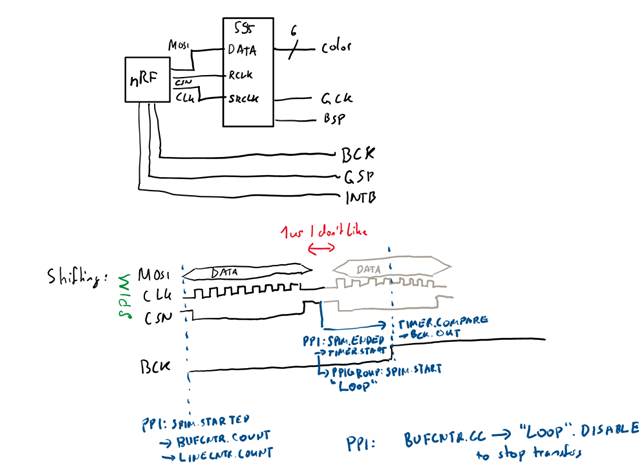
    I've added a rough overview on how I'm driving the system. A goal is to not have the CPU involved in the transfers, hence I'm using the PPI interface.

    In summary, I'm using the SPIM in DMA.TXLIST mode to emit 1 byte, then assert CSN (which moves from the 595's input register to the output), then start the next transfer using a PPI group.
    At the end of each byte, the SPIM auto-sets CSN, which asserts the input register of the 595 to the outputs. I then use a timer to delay the BCK toggle (which samples the outputs into the display) to roughly the middle of the following transfer. Because of the TXLIST, the DMA pointer is advanced, and the next transfer will transfer the next byte.
    The PPI group is disabled when the counter reaches the specified amount of bytes, therefore disconnecting the loop. 
    Essentially, this allows me to transfer a "frame buffer" (which also contains the control signals) from RAM without any CPU intervention. During the special frame start / frame end sequences of the display, I'm currently using an IRQ state machine for now.
    The linking of PPI to actual "byte end" events allows for precise timing of the signals. If I was to transfer thousands of bytes, I'm worried that hard-coding timer values might skew when the DMA delays ever so slightly, and the skew leading to imprecise signals towards the end of the transfer.

    The result is qualitatively correct, but the timings are stretched due to the delay between the SPI transfers. Hence, the question is how I can reduce this delay.

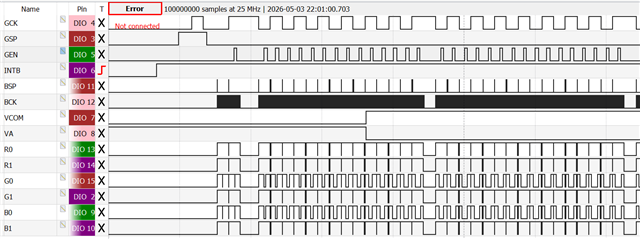
    The stretched clocks on GCK / delays between the blocks of BCK are due to an interrupt which gradually releases chunks of the ring buffer; I'll optimize this later.

    The sharp data sheet is a bit weird in that it does not list a minimum frequency but lists tight pulse width levels that correspond exactly to the frequency. I'm fine driving this out of spec: Using this setup, the maximum frequency I can achieve on BCK is 0.5 MHz (instead of 0.746 MHz) - this is fine. However, due to the added delay between the SPI transfers, the frequency of BCK is a measured ~230 kHz, and I'd like to improve this value.

    I would strongly recommend that you look at the different signals to see how they behave, it'll be a lot easier for you if you are able to see how and where the delays propagate through the system

    Sorry if I was unclear. I looked at them and I know how they behave. I'm trying to figure out how I can make them behave differently.

    Transmission takes 1 us, and from TASKS_START =1 to actual transmission is typically 1 us. This seems to add up, as you measure 2.16 us, unless I am reading this incorrectly?

    This is also my understanding. The question I have is how it's possible to remove this 1us delay after TASKS_START (or hide it by starting the work earlier)

    Figure 4 shows that there is a delay when asserting and when de-asserting the CSN pin, as per the configured CSNDUR duration.

    Exactly. But it does not show a 1us delay (it does not say "CSNDUR + turnaround time"), which is why I was wondering if this 1us delay can be skipped somehow (and what the CSN high period was if CSNDUR=0). Hence; the question is if this delay does not apply when using SHORTS - and if it does, how I can precisely stop the ever-looping SHORTS mode after n transmissions.

    When reading the application, my immediate question is; How should the CSN be toggled if you expect to send continuously?

    CSN is toggled after each transfer. I use TXLIST mode with MAXCNT=1 to have ~240 bytes * (number of buffered lines) transferred, the CSN pin rises after each byte (which is the sampling signal for the RCLK pin on the 595). Ideally, there would be just 1 SPI clock cycle (~1/8us) of CSN high, before the next transfer is triggered - or, in absolute times, the hold time of the 595 is 24ns - so CSN high can last essentially arbitrarily short, but it must be (stably) high before the next transfer. 

    So, you can use PPI to toggle a pin based on start/stop, but you will also need to add a timer instance or similar to let the csn pin return to idle for a small period of time.

    Yes, but I'm not sure how I could ensure this setup works in case of DMA stalls, and when using START/STOP, I'd still run into the issue of the 1us delay between data transfers - this infamous 1us - or did I misunderstand this?

    Kind regards

  • Hi,


    Thank you for sharing a schematic. This is helpful for my understanding of the situation.

    cwriter said:

    In summary, I'm using the SPIM in DMA.TXLIST mode to emit 1 byte, then assert CSN (which moves from the 595's input register to the output), then start the next transfer using a PPI group.
    At the end of each byte, the SPIM auto-sets CSN, which asserts the input register of the 595 to the outputs. I then use a timer to delay the BCK toggle (which samples the outputs into the display) to roughly the middle of the following transfer. Because of the TXLIST, the DMA pointer is advanced, and the next transfer will transfer the next byte.
    The PPI group is disabled when the counter reaches the specified amount of bytes, therefore disconnecting the loop. 
    Essentially, this allows me to transfer a "frame buffer" (which also contains the control signals) from RAM without any CPU intervention. During the special frame start / frame end sequences of the display, I'm currently using an IRQ state machine for now.
    The linking of PPI to actual "byte end" events allows for precise timing of the signals. If I was to transfer thousands of bytes, I'm worried that hard-coding timer values might skew when the DMA delays ever so slightly, and the skew leading to imprecise signals towards the end of the transfer.

    I would recommend setting up a test with TIMER/GPIOTE/PPI controlled CSN pin in this scenario, where you start a timer based on the NRF_SPIMx->EVENTS_STARTED event, and clear/set the GPIOTE IN channel when each byte is finished (based on a set capture/compare value).

    You can potentially think about adding a "dummy byte" in every other byte, if this has a negative impact on the timing requirements of the sequence as a whole.

    cwriter said:
    The sharp data sheet is a bit weird in that it does not list a minimum frequency but lists tight pulse width levels that correspond exactly to the frequency. I'm fine driving this out of spec: Using this setup, the maximum frequency I can achieve on BCK is 0.5 MHz (instead of 0.746 MHz) - this is fine. However, due to the added delay between the SPI transfers, the frequency of BCK is a measured ~230 kHz, and I'd like to improve this value.

    Is this a requirement, ie. that the display must run on 0.75*8 = 6 MHz? This is hard to obtain based on a 16 MHz peripheral clock.

    cwriter said:
    This is also my understanding. The question I have is how it's possible to remove this 1us delay after TASKS_START (or hide it by starting the work earlier)

    Removing this start-up delay would effectively be to use DMA to transfer more-than-1-byte, and using application controlled CSN (GPIOTE/PPI/TIMER)

    This will create a delay at the very start of a transaction, lets say of 240 byte, but there will then be no delay between each byte. Depending on the timing requirements of the display, this "no delay between bytes" could potentially be problematic? Example: if the pulse on "CSN" must occur for every byte _and_ must be 125 ns, and the bit width of the upcoming sequence is then 125 ns, this leaves the possibility of a skew/overlap, or am I misunderstanding?

    What I am trying to ask: Can the "CSN" signal overlap with the upcoming byte safely?

    I read this as a potential "show-stopper" for this solution, based on your comment here:

    cwriter said:
    Ideally, there would be just 1 SPI clock cycle (~1/8us) of CSN high, before the next transfer is triggered - or, in absolute times, the hold time of the 595 is 24ns - so CSN high can last essentially arbitrarily short, but it must be (stably) high before the next transfer. 

    This indicate that the sequence must be in-order, ie. cannot run in parallel?

    But, that could then be worked around by sending every second byte as a dummy-byte. Your DMA buffer would then be 2*wanted_buffer_size.

    Another option would be to use the NRF_I2S peripheral to bit bang this implementation, as it generates a word sync (left/right).

    cwriter said:
    Yes, but I'm not sure how I could ensure this setup works in case of DMA stalls, and when using START/STOP, I'd still run into the issue of the 1us delay between data transfers - this infamous 1us - or did I misunderstand this?

    Stalling would be in the 16 MHz cycle range, so in the 62.5 ns range, and depend on other DMA activity happening at the exact same time.


    Kind regards,

    Håkon

Reply
  • Hi,


    Thank you for sharing a schematic. This is helpful for my understanding of the situation.

    cwriter said:

    In summary, I'm using the SPIM in DMA.TXLIST mode to emit 1 byte, then assert CSN (which moves from the 595's input register to the output), then start the next transfer using a PPI group.
    At the end of each byte, the SPIM auto-sets CSN, which asserts the input register of the 595 to the outputs. I then use a timer to delay the BCK toggle (which samples the outputs into the display) to roughly the middle of the following transfer. Because of the TXLIST, the DMA pointer is advanced, and the next transfer will transfer the next byte.
    The PPI group is disabled when the counter reaches the specified amount of bytes, therefore disconnecting the loop. 
    Essentially, this allows me to transfer a "frame buffer" (which also contains the control signals) from RAM without any CPU intervention. During the special frame start / frame end sequences of the display, I'm currently using an IRQ state machine for now.
    The linking of PPI to actual "byte end" events allows for precise timing of the signals. If I was to transfer thousands of bytes, I'm worried that hard-coding timer values might skew when the DMA delays ever so slightly, and the skew leading to imprecise signals towards the end of the transfer.

    I would recommend setting up a test with TIMER/GPIOTE/PPI controlled CSN pin in this scenario, where you start a timer based on the NRF_SPIMx->EVENTS_STARTED event, and clear/set the GPIOTE IN channel when each byte is finished (based on a set capture/compare value).

    You can potentially think about adding a "dummy byte" in every other byte, if this has a negative impact on the timing requirements of the sequence as a whole.

    cwriter said:
    The sharp data sheet is a bit weird in that it does not list a minimum frequency but lists tight pulse width levels that correspond exactly to the frequency. I'm fine driving this out of spec: Using this setup, the maximum frequency I can achieve on BCK is 0.5 MHz (instead of 0.746 MHz) - this is fine. However, due to the added delay between the SPI transfers, the frequency of BCK is a measured ~230 kHz, and I'd like to improve this value.

    Is this a requirement, ie. that the display must run on 0.75*8 = 6 MHz? This is hard to obtain based on a 16 MHz peripheral clock.

    cwriter said:
    This is also my understanding. The question I have is how it's possible to remove this 1us delay after TASKS_START (or hide it by starting the work earlier)

    Removing this start-up delay would effectively be to use DMA to transfer more-than-1-byte, and using application controlled CSN (GPIOTE/PPI/TIMER)

    This will create a delay at the very start of a transaction, lets say of 240 byte, but there will then be no delay between each byte. Depending on the timing requirements of the display, this "no delay between bytes" could potentially be problematic? Example: if the pulse on "CSN" must occur for every byte _and_ must be 125 ns, and the bit width of the upcoming sequence is then 125 ns, this leaves the possibility of a skew/overlap, or am I misunderstanding?

    What I am trying to ask: Can the "CSN" signal overlap with the upcoming byte safely?

    I read this as a potential "show-stopper" for this solution, based on your comment here:

    cwriter said:
    Ideally, there would be just 1 SPI clock cycle (~1/8us) of CSN high, before the next transfer is triggered - or, in absolute times, the hold time of the 595 is 24ns - so CSN high can last essentially arbitrarily short, but it must be (stably) high before the next transfer. 

    This indicate that the sequence must be in-order, ie. cannot run in parallel?

    But, that could then be worked around by sending every second byte as a dummy-byte. Your DMA buffer would then be 2*wanted_buffer_size.

    Another option would be to use the NRF_I2S peripheral to bit bang this implementation, as it generates a word sync (left/right).

    cwriter said:
    Yes, but I'm not sure how I could ensure this setup works in case of DMA stalls, and when using START/STOP, I'd still run into the issue of the 1us delay between data transfers - this infamous 1us - or did I misunderstand this?

    Stalling would be in the 16 MHz cycle range, so in the 62.5 ns range, and depend on other DMA activity happening at the exact same time.


    Kind regards,

    Håkon

Children
  • Hi

    Thank you for the suggestions!

    I would recommend setting up a test with TIMER/GPIOTE/PPI controlled CSN pin in this scenario, where you start a timer based on the NRF_SPIMx->EVENTS_STARTED event, and clear/set the GPIOTE IN channel when each byte is finished (based on a set capture/compare value).
    Stalling would be in the 16 MHz cycle range, so in the 62.5 ns range, and depend on other DMA activity happening at the exact same time.

    I'll try this in a few days. I would like to use DMA on other peripherals (UART/I2C) concurrently, but I'll see if I can stop those transfers during the sensitive regions. Even at 16 MHz, I would be able to only sustain at most 4 such conflicts, no? Even if I were to set CSN in the PCLK clock cycle before the first SPI CLK posedge, this could lead to issues.

    You can potentially think about adding a "dummy byte" in every other byte, if this has a negative impact on the timing requirements of the sequence as a whole.

    I think this would add another "1us" of waiting, which would degrade into (roughly) the same effect as the 1us setup time.

    Is this a requirement, ie. that the display must run on 0.75*8 = 6 MHz? This is hard to obtain based on a 16 MHz peripheral clock.

    Unfortunately, Sharp does not seem to provide information for small-scale use cases. From what I can see, it looks like the datasheet is (mainly) modeled to match the driver IC implementation. I think this given frequency is the max clock BCK can be driven with, and it's the "minimum" clock to still adhere to the refresh rate constraints. From a technical standpoint, the Memory-In-Pixel Displays (from what I could gather from the public documentation, anyway) behaves a bit like a shift register, and is mainly a passive component with SRAM cells where the digital clock speed does not really matter. The LCD part (VCOM/VA/VB) is quite easy to achieve, and this one is also timing-sensitive. 

    The datasheet uses a bit of a weird logic because the listed frequency is "rate of BCK polarity changes", not "rate of BCK rising edges", so the full target using a 595 shifter in-between would be 0.75 MHz * 8 (bits) * 2 (2 edges per cycle) = 12 MHz. This is unobtainium on 16 MHz with a prescaler of 2, but I'll take 8 MHz gladly Smiley
    So in short, driving the pixel clock at 0.5MHz instead of 0.75MHz (or shifting into the shift register at 8 instead of 12 MHz) should be all ok - it's just that the image transfer time increases.

    Depending on the timing requirements of the display, this "no delay between bytes" could potentially be problematic? Example: if the pulse on "CSN" must occur for every byte _and_ must be 125 ns, and the bit width of the upcoming sequence is then 125 ns, this leaves the possibility of a skew/overlap, or am I misunderstanding?

    The 595 can start shifting into the input register without affecting the outputs, so the display will not see any issue (the display clock BCK can safely be PPI'd + TIMER'd + GPIOTE'd after data was shifted into the output stage of the 595 where there is essentially a 1us window, minus a tiny setup time on the 595's outputs). The issue when clocking uninterrupted is in the (fake) CSN. The 595 shifts to the output stage only on rising edges, so the (fake) CSN pin _could_ essentially just be a 2 MHz 50% duty PWM signal - but the rising edge must be at least 24ns (i.e. at least one PCLK cycle) after the last data bit was shifted (with a rising SPI CLK edge), and must be at least one cycle before the next rising SPI CLK. So yes, there are not many PPI delay cycles that will work when clocking at full rate.

    What I am trying to ask: Can the "CSN" signal overlap with the upcoming byte safely?

    CSN: The rising edge must be after the rising edge of the last bit of each SPI byte, and before the rising edge of the first bit. High time / Low time is lenient (the 595 is pos-edge sampling).

    Another option would be to use the NRF_I2S peripheral to bit bang this implementation, as it generates a word sync (left/right).

    Yes, this would be almost perfect! Unfortunately, the I2S does not support a 4-bit transfer window, and the 595 only samples on the rising edge - therefore, this would also include a dummy byte, and the data rate would again be relatively low.

    This indicate that the sequence must be in-order, ie. cannot run in parallel?

    I did not quite get this, sorry. It can be "parallel" in that there is no need to be able to stall the transfer - but if the transfer is not stalled a little bit, timing the CSN posedge within 1 SPI clock cycle will certainly be hard, especially since it should tolerate SPI clock skew.

    The key issue I have is that I'm afraid of desyncs when not timing the events with the actual clock on the SPI clock line. Essentially, I'm looking for some kind of re-synchronization.
    I was considering the following other options which would link actual SPI bus behavior to events - maybe you could tell me if this could work? (Unfortunately, I fail to get more information about these elements from the documentation - they seem to be underdocumented for the SPIM compared to the TWI and UART counterparts, and the DMA.MATCH is referenced to the EasyDMA section, which does not discuss it at all).

    SPIM SHORT
    Just to be clear: You're confirming that the SPIM.SHORTS[END_START] also suffers from a 1us delay? There was a similar question here for an older revision, which seems to indicate that the delay is present even with the short: NRF5340 SPIM turnaround time  

    SPIM RX MATCH event
    If the SPIM MISO line is not connected (no pin configured in the CONFIG register), will the DMA read a defined value (maybe 0)? If so, is it possible to program the DMA.RX.MATCH event to a single 0 byte value which could trigger after every byte, and PPI the CSN toggle? Does this work without setting a DMA read pointer (i.e. with DMA.RX.MAXCNT=0), or is it safe to read into the same buffer that was used to send? Does it match on 4-byte-values only or does it match on single bytes? What is the delay of DMA.RX.MATCH?

    SPIM SUSPEND + RESUME
    Does a SUSPEND task triggered immediately after starting assert CSN when the byte ends? Does RESUME also have the 1us latency or can the SPIM resume immediately? Even if this does not assert the CSN, this could be an option to PPI the CSN, and potentially stretch the SPI clock in order to get more time in between, i.e. START -> SUSPEND (byte still transfers) -> (Transfer ends) -> PPI'd + TIMER'd + GPIOTE'd CSN triggers -> PPI'd RESUME + TIMER.CLEAR for the next byte. Unfortunately, there seems to be no SUSPENDED event - is this correct? - but the timer could be used to work around this.
    In short: Is there any documentation about the SUSPEND mechanism for SPIM available?

    SPIM CLK SNIFFING
    Not possible from what I take from the datasheet, but worth a try: Is it possible to connect the input buffer of the GPIO to a GPIOTE counting rising edges while the SPI peripheral is clocking it? If yes, this could be used to count the rising edges, and simply trigger on every 8th rise.

    SPIM + PPI (assuming no SPI clock/DMA skew at all)
    Just to verify: What values would need to be set? Is the PPI triggering on every rising edge of the PCLK (16 MHz) or is it double-clocked on rising and falling edges (32 MHz)? Would I need to set a delay of 7 cycles due to a 1 cycle PPI delay in the same domain?

    I2S + PPI
    Looking at the I2S peripheral, there is no delay of 1us, and it seems to be possible to clock at the same frequency. Would it be possible to set MAXCNT to 1 and chain the transfers through PPI to achieve a higher throughput than using SPI? Does the I2S peripheral automatically update the TXD pointer internally (given that the description reads: "EVENTS_TXPTRUPD: TDX.PTR register has been copied to internal double-buffers. When the I2S module is started and TX is enabled, this event will be generated for every ceil(RXTXD.MAXCNT/4) words that are sent on the SDOUT pin." it should, trigger on every start when MAXCNT=1 - or did I misread?

    Kind regards

Related